Introduction
The management of modern IT environments is no longer seen as a hardware task. It is now treated as a software engineering discipline. When infrastructure is managed through code, it becomes predictable, repeatable, and scalable. This shift is what allows global companies to deploy applications across multiple regions in minutes rather than weeks.
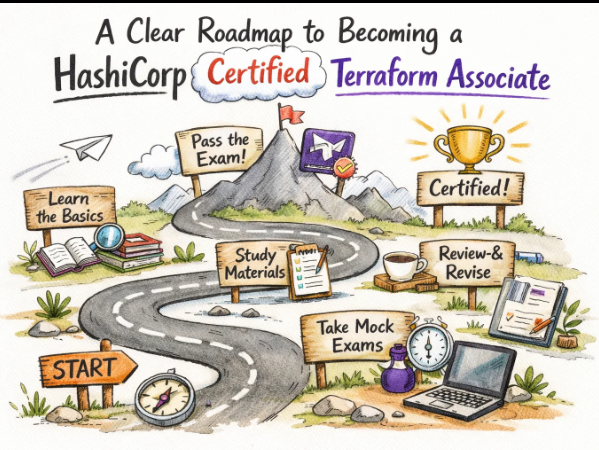
A formal recognition of these skills is provided by the Hashicorp Certified Terraform Associate program. This certification is intended for those who wish to validate their grasp of the Terraform ecosystem. By earning this credential, an individual’s ability to interact with various cloud providers using a single, unified language is confirmed.
Why it matters in today’s software, cloud, and automation ecosystem
The modern cloud ecosystem is diverse. Most organizations do not rely on a single provider. Instead, a mix of AWS, Azure, and private clouds is often used. Terraform is unique because it provides a consistent workflow regardless of the underlying platform. This cloud-agnostic approach is why it is preferred by top-tier engineering teams.
Automation is the heartbeat of this ecosystem. Without it, the speed of software delivery is hindered by manual bottlenecks. This certification ensures that the principles of automation are understood deeply. When infrastructure is treated as code, the risk of human error is minimized, and the stability of the entire system is enhanced.
Why certifications are important for engineers and managers
For the individual engineer, a certification acts as a professional milestone. It is a signal to the market that a specific standard of knowledge has been met. It often opens doors to more complex and rewarding projects. Furthermore, the process of preparing for the exam forces a structured review of the tool, filling in any gaps in practical experience.
For engineering managers, certifications are a tool for risk mitigation. When a team is certified, a baseline level of technical competence is established. This ensures that the code being written for the company’s infrastructure follows industry best practices. It also aids in career development planning, as clear goals are set for the growth of the team.
Why Choose DevOpsSchool?
Selecting the right environment for professional growth is a critical decision. DevOpsSchool is recognized for its commitment to high-quality technical education. A curriculum that balances theory with extensive practical application is maintained. The focus is kept on ensuring that students do not just pass an exam, but actually master the tool in a way that is useful for their daily work.
The learning experience at DevOpsSchool is enriched by the presence of seasoned mentors. Guidance is offered throughout the preparation journey, ensuring that no student is left behind. Comprehensive study aids and a supportive community are provided, making the path to certification much smoother. It is an institution where the success of the learner is the primary objective.
Certification Deep-Dive: Hashicorp Certified Terraform Associate
What is this certification?
This credential is a foundational validator for individuals working in cloud operations. Proficiency in the core features of Terraform and the Hashicorp Configuration Language (HCL) is tested through this program.
Who should take this certification?
Infrastructure architects, system administrators, and developers who interact with cloud resources should pursue this. It is also highly beneficial for those transitioning from traditional IT roles into cloud-native positions.
Certification Overview Table
| Track | Level | Who it’s for | Prerequisites | Skills Covered | Recommended Order |
| DevOps | Associate | Systems Engineers | Cloud Fundamentals | HCL, State Management | 1 |
| DevSecOps | Associate | Security Engineers | Security Basics | Governance, Sentinel | 2 |
| SRE | Associate | Stability Experts | Linux Knowledge | Scaling, Reliability | 1 |
| AIOps | Associate | AI Developers | Basic Scripting | Model Infrastructure | 3 |
| DataOps | Associate | Data Architects | Database Concepts | Data Pipelines | 2 |
| FinOps | Associate | Cost Managers | Billing Awareness | Cost Allocation | 3 |
Skills you will gain
- Knowledge of the Terraform architecture is acquired.
- The ability to write and organize HCL code is developed.
- Remote backends and state locking mechanisms are mastered.
- Complex resource dependencies are managed effectively.
- The use of community and custom modules is understood.
- Variable injection and sensitive data handling are practiced.
Real-world projects you should be able to do after this certification
- A global content delivery network is provisioned across multiple cloud regions.
- A self-healing infrastructure cluster is created using auto-scaling policies.
- Environment isolation is achieved through the use of Terraform workspaces.
- Infrastructure drift is detected and corrected using automated scripts.
- A reusable module library is built to standardize company-wide deployments.
Preparation plan
7-Day Plan (Accelerated)
- Day 1-2: The fundamental commands and HCL syntax are reviewed.
- Day 3-4: Remote state storage and backend configurations are practiced.
- Day 5: The logic behind modules and providers is studied.
- Day 6: Practice quizzes are completed to identify weak points.
- Day 7: Final review of the documentation is done before the exam.
30-Day Plan (Balanced)
- Week 1: An in-depth study of the core Terraform workflow is conducted.
- Week 2: Hands-on labs focusing on resource creation and destruction are performed.
- Week 3: Advanced topics like state manipulation and dynamic blocks are explored.
- Week 4: Mock exams are taken and the logic behind incorrect answers is analyzed.
60-Day Plan (Comprehensive)
- Month 1: Every section of the official exam guide is thoroughly researched. Several small-scale projects are built from scratch.
- Month 2: Large-scale scenarios involving multiple providers are simulated. Deep dives into the CLI and API are performed. Consistent practice testing is maintained.
Common mistakes to avoid
- State files are stored locally instead of using a secure remote backend.
- Changes are applied manually in the cloud console, causing “infrastructure drift.”
- Hardcoding of sensitive values like API keys is done within the HCL files.
- The
terraform destroycommand is used without verifying the plan output. - Version constraints for providers and modules are not defined, leading to unexpected errors.
Best next certification after this
- Same track: Professional-level Terraform certifications or advanced cloud provider certifications (e.g., AWS Professional).
- Cross-track: Certified Kubernetes Administrator (CKA) for container management.
- Leadership / management: Certified Agile Leadership or Prince2 for those moving into management roles.
Choose Your Learning Path
DevOps Path
This path is tailored for those focusing on continuous integration and delivery. The automation of development environments is the primary goal here.
DevSecOps Path
This path is designed for security professionals. The focus is placed on “shifting left” and integrating security checks directly into the infrastructure code.
Site Reliability Engineering (SRE) Path
This path is best for those responsible for system uptime. Managing infrastructure that can automatically recover from failures is the main objective.
AIOps / MLOps Path
This path is intended for engineers supporting machine learning workloads. Standardized environments for data training are built using Terraform.
DataOps Path
This path is for professionals managing large-scale data platforms. The automated provisioning of data lakes and warehouses is emphasized.
FinOps Path
This path is for those managing the financial aspects of the cloud. Logic is applied to ensure that no unused resources are left running, saving costs.
Role → Recommended Certifications Mapping
| Role | Recommended Certification |
| DevOps Engineer | Terraform Associate + Jenkins Cert |
| Site Reliability Engineer (SRE) | Terraform Associate + Prometheus/Grafana |
| Platform Engineer | Terraform Associate + Kubernetes Cert |
| Cloud Engineer | Terraform Associate + Azure/AWS Associate |
| Security Engineer | Terraform Associate + CISSP/CCSP |
| Data Engineer | Terraform Associate + Google Data Eng |
| FinOps Practitioner | Terraform Associate + Cloud Cost Management |
| Engineering Manager | Terraform Associate + Management Cert |
Next Certifications to Take
A continuous learning journey is essential for staying relevant in the tech industry.
- Same-track: Azure Solutions Architect Expert is recommended for those wanting to specialize in the Microsoft ecosystem.
- Cross-track: Red Hat Certified System Administrator is suggested for building a strong foundation in Linux.
- Leadership-focused: TOGAF certification is recommended for those aiming for Enterprise Architect roles.
Training & Certification Support Institutions
DevOpsSchool
High-level training and mentorship are provided by this group. A strong emphasis is placed on the practical application of DevOps tools in real business settings.
Cotocus
Specialized consulting and training services are offered here. The alignment of IT teams with business goals through automation is a core focus.
ScmGalaxy
A wealth of knowledge regarding software configuration is available on this platform. Articles, tutorials, and community forums are maintained for continuous learning.
BestDevOps
Innovative training programs for the modern engineer are delivered here. The latest trends in cloud automation are integrated into the curriculum.
devsecopsschool.com
Educational content focused on the intersection of security and operations is provided. Students are taught how to build secure-by-design infrastructure.
sreschool.com
This institution focuses on the principles of reliability. Techniques for managing large-scale, high-traffic systems are shared through expert-led courses.
aiopsschool.com
The use of artificial intelligence to improve IT operations is explored here. Training on modern AIOps platforms is provided to forward-thinking professionals.
dataopsschool.com
This school specializes in the automation of data lifecycles. Efficient methods for managing data quality and delivery are taught to data engineers.
finopsschool.com
Strategies for managing cloud spend are taught at this school. The balance between operational speed and financial efficiency is a key topic of study.
FAQs Section
- Is previous coding experience required for this certification?
While deep coding skills are not mandatory, a basic understanding of scripting logic is very helpful. - How long does it take to get certified?
Depending on the starting point, most people achieve this within one to two months. - What is the format of the exam?
The exam is conducted online and consists of approximately 57 questions. - Are there many job openings for Terraform-certified professionals?
Yes, a significant number of cloud-focused roles list Terraform as a required or preferred skill. - Is Terraform difficult to learn compared to other tools?
Many find HCL easier to learn than traditional programming languages like Python or Java. - Can I practice for free?
Yes, the open-source version of Terraform can be downloaded and used for practice at no cost. - What is the most important topic for the exam?
State management and the lifecycle of a Terraform resource are usually the most tested areas. - Is the certification recognized internationally?
Yes, it is globally recognized as a standard for infrastructure automation. - Do I need a cloud account to study?
It is highly recommended to have a free-tier account on AWS, Azure, or GCP for hands-on practice. - What happens if the exam is failed?
The exam can be retaken after a specific waiting period, provided the fee is paid again. - Are the questions based on real scenarios?
Many questions are designed to test how a person would react to specific technical situations. - Is it necessary to renew the certification?
Yes, renewal is required every two years to ensure knowledge remains up to date.
Hashicorp Certified Terraform Associate FAQs
- How is the
terraform initcommand used?
This command is used to initialize a working directory and download necessary providers. - What is the purpose of the state file?
The state file is used by Terraform to keep track of the resources that have been created. - Can Terraform manage resources on-premises?
Yes, as long as a provider is available for the on-premises technology, it can be managed. - What is a “Provider” in Terraform?
A provider is a plugin that allows Terraform to communicate with a specific API, such as AWS or GitHub. - What is the difference between a variable and an output?
Variables are used to input data into a configuration, while outputs are used to display information after deployment. - How are modules beneficial?
Modules allow for the creation of reusable building blocks, which simplifies the management of large environments. - What is the
terraform plancommand for?
It is used to preview the changes that will be made to the infrastructure before they are actually executed. - Is Terraform Cloud the same as the CLI?
No, Terraform Cloud is a managed service that provides additional collaboration and governance features.
Testimonials
Aman
The transition to a cloud-focused role was made much easier by this certification. The core concepts were explained in a way that made sense immediately. A great sense of clarity was achieved.
Deepa
Professional confidence was boosted after mastering the infrastructure-as-code workflow. The ability to manage multiple cloud providers using one tool is a game-changer. Highly recommended for any engineer.
Karthik
The learning path provided was very helpful for balancing work and study. Skill improvement was noticed by the team almost immediately. It is a worthwhile investment for a long-term career.
Meera
The practical examples used in the preparation were very similar to actual work tasks. Real-world application of the tool became second nature. The certification has opened several new doors.
Suresh
A deeper understanding of automation was gained through this process. The focus on best practices helped in cleaning up old, manual processes. A very positive experience overall.
Conclusion
The Hashicorp Certified Terraform Associate certification represents more than just a passing grade on an exam. It is a commitment to a modern way of managing digital assets. As the world continues to move toward software-defined infrastructure, these skills will only become more valuable.
Long-term career success is built on a foundation of continuous improvement and strategic learning. By choosing to master Terraform, an engineer is preparing for the future of the technology industry. The benefits of this certification, from career growth to technical mastery, are significant for anyone willing to put in the effort.