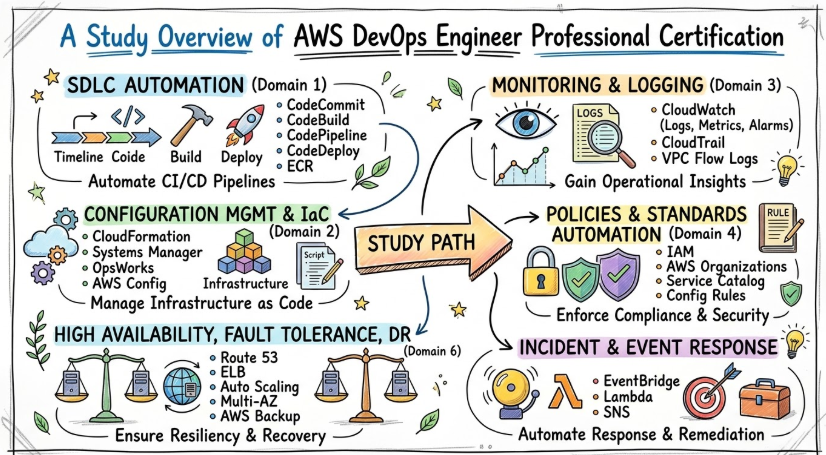
Introduction
Navigating the complex world of modern cloud computing can often feel like a maze. For those who are currently working in software engineering or systems management, the AWS Certified DevOps Engineer – Professional credential is often viewed as the ultimate goal. This guide is written to help you understand exactly what this career path looks like and why it is considered so important for long-term professional growth in the global tech market.
What is the AWS Certified DevOps Engineer – Professional?
This certification is widely respected as one of the most challenging and rewarding credentials in the entire technology industry. It is specifically designed for individuals who have already gained several years of experience in managing, operating, and provisioning distributed application systems on the Amazon Web Services (AWS) platform. The primary focus is placed on the technical expertise required to automate the testing and deployment of code in a way that is both secure and scalable.
Why it Matters in Today’s Ecosystem
In the current software and automation ecosystem, speed and reliability are the two most important factors for any business. Companies are under constant pressure to release new features faster than ever before, but this must be done without causing system failures or security breaches. This is exactly where the DevOps professional comes into play. By mastering this level of certification, an engineer demonstrates that they know how to build robust systems that can handle massive amounts of traffic while maintaining a high level of security and cost-efficiency.
Importance for Engineers and Managers
For an individual engineer, obtaining this certification acts as a powerful proof of skill that is recognized by employers worldwide. It often leads to significant salary increases and the opportunity to work on more high-profile, complex projects. For engineering managers, having a team of certified professionals ensures that the organization’s cloud operations are being handled according to industry best practices. This leads to more stable software releases and a much more predictable development lifecycle.
Certification Overview Table
| Track | Level | Who it’s for | Prerequisites | Skills Covered | Recommended Order |
| AWS DevOps | Professional | Experienced DevOps & Cloud Engineers | Strong AWS Associate knowledge | Automation, HA, Monitoring, Security | Associate first, then Professional |
Why Choose DevOpsSchool?
Selecting the right training partner is a critical step in your certification journey. DevOpsSchool is frequently chosen by professionals because the training is delivered by mentors who possess extensive real-world experience in the industry. The curriculum is designed to go far beyond simple exam preparation. Instead, a heavy emphasis is placed on teaching learners how to solve the actual technical problems that occur in a modern production environment. The personalized support and community access provided by the school ensure that every student has the tools they need to succeed in their career.
Certification Deep-Dive
What is this certification?
The AWS Certified DevOps Engineer – Professional is a high-level credential that validates your ability to manage and operate systems that are distributed across the cloud. It is centered around the idea of building a “hands-off” environment where code can move smoothly from a developer’s workstation to the final customer without manual intervention.
Who should take this certification?
This path is highly recommended for Software Engineers who want to transition into a more architecture-focused role. It is also perfect for Systems Administrators who are looking to move away from manual tasks and into the world of automation. Even Engineering Managers who wish to stay technically sharp and understand the modern cloud lifecycle will find immense value in this program.
Skills You Will Gain
By pursuing this certification, a deep understanding of continuous delivery systems and methodologies is developed. You will learn how to implement and manage automated security controls, governance processes, and compliance validation. Furthermore, expertise is gained in the deployment of monitoring, logging, and metrics systems on the AWS platform. The ability to design and manage tools that allow for the automated scaling of applications is also a core skill that is mastered during this process.
Real-World Projects You Should Be Able to Do
Once the certification is achieved, you will be capable of creating a fully automated CI/CD pipeline that handles everything from code testing to final deployment. You will also be able to set up complex, auto-scaling environments that automatically adjust their size based on real-time user traffic. Additionally, the implementation of centralized logging systems that provide instant alerts to the engineering team becomes a standard task. Designing a comprehensive disaster recovery plan that can restore a website in a matter of minutes is another critical project you will be prepared to lead.
Preparation Plan
A 7–14 days plan should be focused primarily on taking multiple practice exams to identify specific areas of weakness. During this time, the official AWS whitepapers should be read thoroughly to grasp the theoretical foundations. A 30 days plan requires at least two hours of dedicated study each day, with a heavy focus on hands-on labs. You should practice setting up services like AWS CodePipeline, CodeDeploy, and CloudFormation until they become second nature. For a 60 days plan, it is recommended to build three end-to-end projects from scratch while reading deep-dive technical blogs. This longer timeframe ensures that the knowledge is deeply embedded and ready for professional use.
Common Mistakes to Avoid
One of the most common mistakes is relying too heavily on theoretical study without spending enough time in the AWS console. Another frequent error is ignoring the security and IAM (Identity and Access Management) aspects of the exam, which are actually very important. Many candidates also fail to spend enough time learning how to troubleshoot deployments that have failed, which is a major part of the professional-level testing.
Best Next Certification After This
In the same track, the AWS Certified Security – Specialty is considered the best next step to further enhance your profile. For those looking at a cross-track option, the AWS Certified Solutions Architect – Professional is highly valued. If you are moving toward a leadership or management role, obtaining the Certified Kubernetes Administrator (CKA) credential is a smart move for managing containerized workloads.
Choose Your Learning Path
The DevOps Learning Path is best suited for those who have a passion for automation and the mechanics of the software delivery lifecycle. It focuses on creating a seamless bridge between the development of code and its daily operation in a production environment.
The DevSecOps Learning Path is perfect for engineers who believe that security should be integrated into every step of the process rather than being added as an afterthought. This path combines high-level automation with deep security auditing and compliance checks.
The Site Reliability Engineering (SRE) Learning Path is designed for individuals who care deeply about system uptime and reliability. This path places a heavy emphasis on monitoring, scaling, and the creation of automated incident response systems to keep platforms running smoothly.
The AIOps / MLOps Learning Path is created for those who work closely with data science teams. It focuses on the unique challenges of automating the deployment and management of machine learning models within a cloud environment.
The DataOps Learning Path is centered on the flow and management of data across an organization. It is ideal for professionals who are responsible for managing large-scale databases and complex data pipelines in the cloud.
The FinOps Learning Path is best for managers and architects who need to maintain strict control over cloud spending. It teaches the necessary skills to balance high-level technical performance with the financial goals of the business.
Role → Recommended Certifications Mapping
For a DevOps Engineer, the combination of the AWS DevOps Professional and a Terraform Associate certification is highly recommended. A Site Reliability Engineer (SRE) should look toward combining the AWS DevOps Professional with a CKA (Kubernetes) certification. Those in the role of a Platform Engineer will find the most success by holding both the AWS DevOps Professional and the AWS Solutions Architect Professional credentials.
A Cloud Engineer is best served by starting with the AWS SysOps Associate before moving into the AWS DevOps Professional level. For a Security Engineer, the AWS Security Specialty combined with the DevOps Professional creates a very strong profile. A Data Engineer should aim for the AWS Data Analytics Specialty alongside their DevOps training.
FinOps Practitioners are encouraged to take the Cloud Digital Leader exam in addition to the AWS DevOps Professional. Finally, an Engineering Manager can gain a great deal of perspective by starting with the AWS Cloud Practitioner and then moving through to the AWS DevOps Professional level.
Next Certifications to Take
To maintain a competitive edge, a variety of certifications should be considered. For a same-track advancement, the AWS Certified Security Specialty is the most logical choice. If a cross-track expansion is desired, the Google Professional Cloud DevOps Engineer certification offers a different perspective on cloud management. For those focusing on leadership, a PMP or ITIL Foundation certificate is highly recommended to round out your management skills.
Training & Certification Support Institutions
DevOpsSchool is recognized as a premier platform for technical education, offering deep-dive training programs that are led by industry veterans. Their courses are specifically designed to provide students with the practical, hands-on skills that are required to excel in modern tech roles.
Cotocus is an institution that specializes in providing both consulting services and high-quality technical training. They are well-regarded for their ability to simplify complex cloud technologies through a very practical and direct teaching style.
ScmGalaxy serves as an excellent community resource for individuals who want to master the art of software configuration management. They provide a wealth of tutorials and career guidance that is useful for both beginners and experienced engineers.
BestDevOps offers targeted learning paths that are suitable for both individuals and large corporate teams. Their curriculum is updated on a regular basis to ensure that it reflects the most current changes in the fast-moving cloud industry.
devsecopsschool.com is a dedicated online platform that focuses exclusively on the integration of security into the DevOps lifecycle. It is the top choice for engineers who want to specialize in building secure automation pipelines.
sreschool.com provides specialized education in the concepts of Site Reliability Engineering. It is widely considered the best place to learn about maintaining system health, managing error budgets, and ensuring maximum uptime.
aiopsschool.com is focused on the future of IT operations, teaching students how to use artificial intelligence to manage and optimize cloud environments. It is a forward-looking institution for those wanting to stay ahead of the curve.
dataopsschool.com helps engineers understand the entire lifecycle of data management in a cloud-native world. It is the perfect choice for professionals who are moving into roles that require the management of massive data sets.
finopsschool.com is a specialized center for training in cloud financial management. It teaches the essential skills needed to ensure that a company’s cloud infrastructure is as cost-effective as it is high-performing.
FAQs Section
General FAQs
- Is the AWS DevOps Professional exam considered difficult?
Yes, it is widely viewed as one of the most challenging exams in the AWS catalog because of its focus on deep technical scenarios. - How much time is usually needed for preparation?
Most working professionals find that they need between two and four months of consistent study to feel ready. - Are there any mandatory prerequisites for the exam?
While there are no official prerequisites, it is strongly advised that an Associate-level certification is obtained first. - In what order should the AWS certifications be taken?
It is usually best to complete the Developer or SysOps Associate exam before attempting the Professional level. - How does this certification impact a person’s career?
It is a highly valued credential that often serves as a requirement for senior-level cloud and DevOps roles. - What specific job roles can be pursued with this certificate?
Professionals often move into roles such as Senior DevOps Engineer, SRE, or Cloud Infrastructure Architect. - Is the certification valid for a lifetime?
No, the certificate is valid for three years, after which a recertification process must be completed. - What is the total duration of the exam?
Candidates are given 180 minutes to complete the entire examination. - What is the minimum passing score required?
A minimum score of 750 out of 1000 is required to pass the exam. - Does the exam consist only of multiple-choice questions?
Yes, the format includes both multiple-choice and multiple-response questions. - Can the exam be taken from a home or office?
Yes, AWS offers the option to take the exam via an online proctored environment. - Is the investment in the exam worth it?
Given the significant salary increases reported by certified individuals, it is considered a very wise investment.
AWS DevOps Engineer – Professional Specific FAQs
13. What are the primary topics covered in the exam?
The exam is heavily focused on continuous delivery, process automation, and high availability.
14. Is a high level of coding skill required?
While you do not need to be a full-time developer, an understanding of scripting and formats like YAML and JSON is necessary.
15. How important is AWS CloudFormation for this exam?
It is one of the most critical tools covered, and a deep understanding of it is required for success.
16. Is the topic of monitoring included in the test?
Yes, a large portion of the questions involve CloudWatch, AWS X-Ray, and various logging strategies.
17. Are multi-account environments discussed in the exam?
Yes, knowledge of AWS Organizations and Control Tower is essential for many of the questions.
18. How detailed is the security section of the exam?
The security section is very deep, focusing on automated security checks and complex IAM policies.
19. What is the most effective way to practice for the test?
Using the AWS free tier to build and tear down real CI/CD pipelines is the best preparation.
20. Is knowledge of Kubernetes required?
A basic understanding of EKS is helpful, but the exam remains focused primarily on native AWS services.
Testimonials
The deep understanding of automation that was gained during this training was truly life-changing for my daily workflow.
— Arjun
A new level of professional confidence was found after completing this certification path. It made a huge difference in my career.
— Sneha
The ability to look at a cloud environment and see the bigger picture is what I gained from this program. I now feel like a true expert.
— Vikram
The practical focus of the courses ensured that I didn’t just pass an exam, but actually became a better engineer in the process.
— — Ananya
As someone in leadership, this certification provided the technical language needed to guide my team through complex cloud migrations.
— Rohan
Conclusion
The AWS Certified DevOps Engineer – Professional certification is much more than a simple professional credential. It represents a significant journey that changes the way an engineer thinks about software and cloud systems. By following a structured learning path and utilizing the expert resources available today, the highest levels of professional success can be achieved. Strategic planning, consistent study, and hands-on practice are the true keys to a long and successful career in the cloud ecosystem.