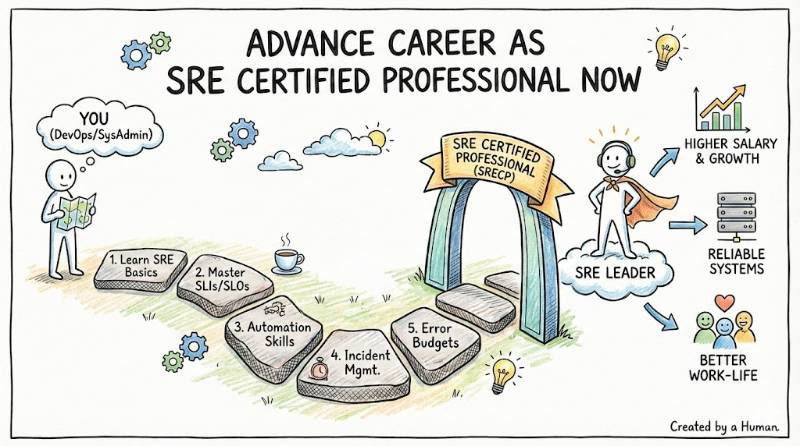
1. Introduction to Site Reliability Engineering
software is expected to be available every second of every day. Whether it is a banking app or a social media platform, downtime is not tolerated by users. To meet these high expectations, a specific way of working is required. This is where the SRE Certified Professional (SRECP) certification comes into play. Site Reliability Engineering is defined as a discipline that incorporates aspects of software engineering and applies them to infrastructure and operations problems. The main goal is to create ultra-scalable and highly reliable software systems.
The importance of an SRE Certified Professional is seen in how the cloud and automation ecosystem is managed. In the past, developers wrote code and operations teams managed the servers. Now, these two worlds are merged. Reliability is no longer seen as a “nice to have” feature; it is treated as a fundamental requirement. Because of this shift, engineers who can bridge the gap between coding and system stability are in high demand across India and the rest of the world.
For both engineers and managers, certifications are seen as a vital part of professional growth. For an individual engineer, a certification is viewed as a validation of their technical expertise. It acts as a signal to employers that the professional is capable of handling complex production environments. For managers, a certified team is preferred because it ensures that everyone is speaking the same technical language and following the same safety protocols. This leads to fewer mistakes and much faster recovery times when systems do fail.
2. Certification Overview Table
The following table provides a clear view of the SRE Certified Professional program details.
| Track | Level | Who it’s for | Prerequisites | Skills Covered | Recommended Order |
| Site Reliability | Professional | Developers, Ops, Managers | Basic Linux & Coding | SLIs/SLOs, Error Budgets, Toil Reduction | Foundational, then SRECP |
Why Choose DevOpsSchool?
When a decision is made to pursue a professional certification, the choice of the training institution is very important. DevOpsSchool is often chosen because of its reputation for providing deep, technical knowledge that is easy to understand. The courses are not just based on books; they are built around real-world scenarios that engineers face every day in their jobs.
A major reason why DevOpsSchool is preferred is the quality of its mentorship. The instructors are individuals who have spent years managing massive infrastructures. This means that when a question is asked, the answer is based on actual experience rather than theory. Furthermore, a heavy emphasis is placed on hands-on labs. Students are given environments where they can break things and learn how to fix them in a safe setting. This practical approach ensures that the skills are truly mastered before an engineer has to apply them to a real production environment. The curriculum is also kept up to date with the latest industry changes, ensuring that the training remains relevant.
3. Certification Deep-Dive: SRE Certified Professional (SRECP)
What is this certification?
The SRE Certified Professional (SRECP) is a specialized program that teaches how to manage large-scale systems using software engineering principles. It is focused on finding the perfect balance between releasing new features and making sure the system remains stable and reliable.
Who should take this certification?
This certification is recommended for software engineers who want to understand operations, and for system administrators who want to learn how to code. It is also highly beneficial for platform engineers, cloud architects, and engineering managers who are responsible for the uptime of critical business services.
Skills you will gain
- Defining Metrics: Knowledge is gained on how to set Service Level Indicators (SLIs) and Service Level Objectives (SLOs).
- Managing Error Budgets: A deep understanding of how to use error budgets to decide when to push new code or focus on stability is developed.
- Incident Response: Mastery over the process of handling system failures and conducting blameless post-mortems is achieved.
- Toil Reduction: Skills are acquired in identifying manual, repetitive tasks and replacing them with automated scripts.
- Monitoring and Alerting: Expertise is built in setting up systems that notify the right people before a small issue becomes a big outage.
Real-world projects you should be able to do
- Full-Stack Monitoring: A complete monitoring system for a distributed application is built using tools like Prometheus and Grafana.
- Automation of Repairs: An automated system that restarts failing services or clears disk space without human help is created.
- Capacity Planning: Data-driven models are developed to predict when more server capacity will be needed based on user growth.
- Disaster Recovery Drills: A plan for recovering a whole data center from scratch is designed and tested using automation.
Preparation Plan
7–14 Days Plan
In the first two weeks, the core philosophy of SRE is studied. The SRE handbook is read, and the basic definitions of reliability are memorized. Small automation scripts are written to get comfortable with the environment.
30 Days Plan
During the first month, the focus is shifted to metrics. Practical labs are completed where SLIs and SLOs are configured for a sample app. Mock exams are taken to identify areas where the understanding is still weak.
60 Days Plan
By the second month, advanced topics like chaos engineering and complex incident management are tackled. The principles are applied to a real-world project. A final review of all technical domains is conducted before the exam is scheduled.
Common mistakes to avoid
- Tool Obsession: A common mistake is focusing only on learning a specific tool instead of understanding the SRE principles behind it.
- Ignoring Culture: The cultural side of SRE, such as the need for blamelessness and shared responsibility, is often overlooked.
- Skipping the Basics: Many try to jump into advanced automation before they fully understand how to manually troubleshoot a system.
Best next certification after this
- Same Track: Advanced Chaos Engineering Professional.
- Cross-Track: DevSecOps Certified Professional to add security to the reliability focus.
- Leadership/Management: Technical Lead or Engineering Manager certification for those moving into people management.
4. Choose Your Learning Path
Finding the right path is a key step in building a long-term career. Six main paths are identified below.
DevOps Path
This path is designed for those who want to improve the speed of software delivery. It is best for engineers who enjoy working on CI/CD pipelines and making sure that code moves from a developer’s laptop to production smoothly.
DevSecOps Path
The focus here is on security. It is chosen by professionals who believe that security should be part of the build process, not an afterthought. Vulnerability scanning and compliance automation are key topics in this path.
Site Reliability Engineering (SRE) Path
This is the path for those who are passionate about stability. It is ideal for people who want to use code to solve operational headaches. The focus is on high availability and large-scale system performance.
AIOps / MLOps Path
This path is best for those interested in the future of operations. It involves using machine learning to predict outages and manage the lifecycle of machine learning models in a production environment.
DataOps Path
DataOps is chosen by those who work closely with data scientists and data engineers. It focuses on the automated, high-quality delivery of data throughout an organization.
FinOps Path
This is a path centered on the financial health of the cloud. It is designed for those who want to ensure that the cloud infrastructure is not only fast and reliable but also cost-effective.
5. Role → Recommended Certifications Mapping
Specific roles require different types of validation. The mapping below is recommended.
- DevOps Engineer: DevOps Certified Professional and Kubernetes Expert certifications are highly suggested.
- Site Reliability Engineer (SRE): The SRE Certified Professional is the primary requirement, followed by Advanced Monitoring.
- Platform Engineer: Infrastructure as Code (IaC) and Cloud Architecture certifications are best suited for this role.
- Cloud Engineer: Certifications from major providers like AWS, Azure, or GCP are recommended alongside SRE basics.
- Security Engineer: The DevSecOps Certified Professional is considered the gold standard for this career track.
- Data Engineer: DataOps and Big Data specialized certifications should be pursued.
- FinOps Practitioner: A FinOps Certified Practitioner credential is required to manage cloud budgets effectively.
- Engineering Manager: Leadership and SRE for Managers certifications are recommended to lead technical teams.
6. Next Certifications to Take
Once the SRECP is completed, the learning journey is continued through these recommendations.
For Every Learner:
- Same-track: A Chaos Engineering certification is recommended to learn how to test system resilience.
- Cross-track: A FinOps certification is suggested to understand the cost implications of high reliability.
- Leadership: A project management or technical leadership certification is advised for long-term growth.
7. Training & Certification Support Institutions
A few key institutions are known for providing excellent support in this field.
- DevOpsSchool: This institution is widely respected for its deep technical curriculum. A lot of support is provided to students through live sessions and interactive labs. It is a top choice for those in India.
- Cotocus: This center is focused on modern cloud technologies. High-quality training for platform engineering and cloud automation is offered here.
- ScmGalaxy: A strong community focus is maintained by this institution. It is a great place to find resources on configuration management and CI/CD tools.
- BestDevOps: This platform is designed to help beginners get a firm foot in the DevOps world. Simple and clear tutorials are provided to make learning easier.
- devsecopsschool.com: All efforts here are directed toward security. It is the best place to learn how to secure the software supply chain.
- sreschool.com: A dedicated focus on reliability is found here. Everything from basic SRE concepts to advanced chaos engineering is taught.
- aiopsschool.com: This school explores the use of artificial intelligence in IT operations. It is a forward-looking institution for tech-savvy engineers.
- dataopsschool.com: The challenges of data management are addressed by this school. It provides the tools and processes needed for efficient data operations.
- finopsschool.com: This site is dedicated to the financial side of the cloud. It teaches how to optimize costs without sacrificing performance.
8. FAQs Section
General Career FAQs
1. Is the SRECP certification very hard?
The exam is challenging but fair. A mix of technical knowledge and logical thinking is required to pass.
2. How many hours should be spent on study?
At least 5 to 10 hours a week for two months is usually recommended for a solid preparation.
3. Are there any prerequisites for the exam?
A basic understanding of how computers communicate (networking) and some experience with a command line is needed.
4. What is the best sequence for these certifications?
Starting with a foundational DevOps course is usually advised before moving to the SRECP.
5. How much does the career grow after this?
Many professionals see a significant jump in their salary and responsibilities after becoming a certified SRE.
6. Can a system administrator move into SRE?
Yes, this is a very common career path. The certification provides the coding and automation skills needed for the switch.
7. Is on-call work always part of the SRE role?
In many companies, it is. However, SREs work to automate the “on-call” tasks so that they are rarely woken up at night.
8. Is SRE different from traditional IT operations?
Yes, SRE uses software engineering to solve problems that were previously handled manually by operations teams.
9. Is this certification valid in the USA and Europe?
Yes, the SRE principles taught are global standards used by companies like Google, Netflix, and Amazon.
10. How is the certification renewed?
Renewal is usually done by taking a refresher course or a higher-level exam every few years.
11. Is the SRE market good in India?
The market is excellent. Many global tech hubs in India are constantly looking for certified SRE professionals.
12. Do I need to be an expert in Python?
You don’t need to be a developer, but a working knowledge of a language like Python is very helpful for automation.
SRE Certified Professional Specific FAQs
13. What topics are covered in the SRECP exam?
Topics like monitoring, incident management, error budgets, and automation are heavily covered.
14. Are lab exercises part of the training?
Yes, hands-on labs are a core part of the training provided by authorized partners.
15. Is “Post-Mortem” analysis taught?
Yes, learning how to analyze a failure without blaming individuals is a key part of the course.
16. How are SLIs and SLOs different?
An SLI is what is measured (like speed), and an SLO is the target value we want to hit (like 99.9% speed).
17. Is cloud-native technology part of the course?
Yes, the principles are often taught using modern tools like Docker and Kubernetes.
18. Can a recent graduate take the SRECP?
It is possible, but a few months of internship or work experience in IT is highly recommended first.
19. What is “Toil” in SRE?
Toil is manual, repetitive work that provides no long-term value. Learning how to eliminate it is a major goal of the certification.
20. Is the exam certificate provided immediately?
Usually, a digital certificate is provided shortly after the exam is successfully completed.
9. Testimonials
Arjun
The SRECP course was a turning point for me. My understanding of system reliability was greatly expanded, and I now feel much more confident in my daily tasks.
Sana
A very clear path was provided by this certification. I learned how to move away from manual work and focus on building automated systems that actually stay up.
Robert
The focus on real-world application was what I liked the most. The labs at DevOpsSchool were very helpful in making the complex concepts feel simple.
Kavita
My career clarity was improved significantly. I now understand exactly what is needed to manage a large-scale cloud infrastructure without getting overwhelmed.
Vikram
The confidence growth I experienced after passing the SRECP was amazing. I am now leading a team of SREs and applying these principles every single day.
10. Conclusion
The SRE Certified Professional (SRECP) certification is an essential step for anyone who wants to be a leader in the tech industry. It offers a way to master the skills needed for the future of software and cloud operations. By focusing on reliability and automation, a professional is able to provide immense value to any organization.
The long-term career benefits of this certification are clear. It leads to better jobs, higher pay, and a more fulfilling work-life balance through the reduction of manual toil. Strategic learning and careful planning are encouraged for everyone who wants to stay ahead in this fast-moving field.