Introduction
Security is no longer just a checkbox at the end of a project. In the current cloud landscape, it is the very foundation upon which every piece of software is built. Cloud environments are complex, and the risks are real. This is why the AWS Certified Security – Specialty designation is regarded as one of the most respected credentials for professionals working in the AWS ecosystem.
What is AWS Certified Security – Specialty?
This is a specialized certification designed by AWS to validate an individual’s ability to secure the cloud. It goes beyond basic configurations. It focuses on deep technical areas like encryption, logging, monitoring, and infrastructure security. It is intended for those who already have a grasp of cloud basics but want to become the “go-to” person for keeping data safe.
Why It Matters in Today’s Ecosystem
Modern software development relies heavily on automation and speed. In the world of DevOps and Site Reliability Engineering (SRE), security must be integrated into every step. A single misconfigured bucket or an overly permissive identity policy can lead to significant issues. By earning this certification, a professional demonstrates that they understand how to build automated, secure guardrails that protect a company’s reputation and assets.
Importance for Engineers and Managers
For engineers, certifications serve as a structured way to fill knowledge gaps. It is easy to use a tool without truly understanding the security implications. For managers, having certified team members provides a level of assurance. It means the team is following industry best practices and can handle complex compliance requirements. It bridges the gap between “making things work” and “making things secure.”
Certification Overview Table
| Track | Level | Who it’s for | Prerequisites | Skills Covered | Recommended Order |
| Security | Specialty | Security Engineers, DevOps, SREs | AWS Cloud Practitioner or Associate | Incident Response, Logging, Infrastructure Security, IAM, Data Protection | After Associate Exams |
Why Choose DevOpsSchool?
DevOpsSchool is chosen by many professionals because the training is grounded in real-world scenarios. Instead of just focusing on theory, the curriculum is designed to solve actual industry problems. The support provided by the instructors ensures that complex topics are simplified. It is a community where learning is continuous and practical.
Certification Deep-Dive
AWS Certified Security – Specialty
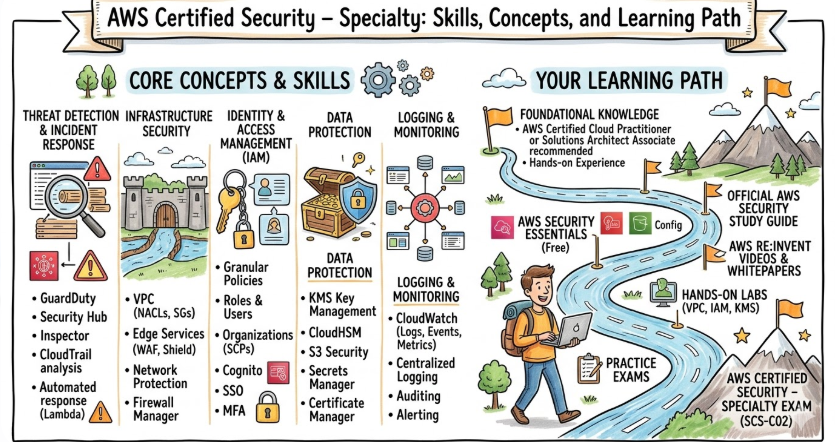
This certification is a deep dive into the security services provided by AWS. It covers how to protect data both at rest and in transit, and how to respond to security incidents effectively.
Who should take this certification?
It is ideal for anyone tasked with securing AWS workloads. This includes Security Engineers, Cloud Architects, and DevOps professionals who want to master the security pillar of the Well-Architected Framework.
Skills you will gain
- Mastery of Identity and Access Management (IAM) for granular control.
- Deep understanding of data encryption using KMS (Key Management Service).
- Ability to set up complex logging and monitoring using CloudWatch and CloudTrail.
- Expertise in network security through VPC configurations and WAF (Web Application Firewall).
- Knowledge of automated incident response and remediation.
Real-world projects you should be able to do
- A secure multi-tier VPC architecture can be designed and implemented.
- An automated system for detecting and rotating exposed IAM keys can be built.
- Centralized logging for multiple AWS accounts can be configured.
- End-to-end encryption for sensitive data stored in S3 and RDS can be managed.
Preparation Plan
7–14 Days Plan (The Intensive Review)
- Focus is placed on the official exam guide and sample questions.
- Whitepapers on AWS Security Best Practices are read thoroughly.
- High-level revision of KMS, IAM policies, and VPC security groups is completed.
30 Days Plan (The Balanced Approach)
- Two hours are dedicated daily to video lessons and documentation.
- Hands-on labs are performed to practice policy creation and encryption.
- Practice exams are taken weekly to identify weak areas.
60 Days Plan (The Mastery Path)
- Deep dives into every security service are conducted over the first month.
- Complex scenarios, such as cross-account access and hybrid cloud security, are practiced.
- The final two weeks are spent on timed practice tests and reviewing logs.
Common Mistakes to Avoid
- The importance of the “Shared Responsibility Model” is often underestimated.
- Complex IAM policy evaluation logic is not fully understood.
- The difference between various encryption types (SSE-S3, SSE-KMS, SSE-C) is confused.
- Troubleshooting steps for network connectivity in a secure VPC are ignored.
Best Next Certification After This
- Same Track: AWS Certified Security – Specialty is already at the top of the security track.
- Cross-Track: AWS Certified Solutions Architect – Professional for a broader architectural view.
- Leadership / Management: Certified Information Systems Security Professional (CISSP).
Choose Your Learning Path
1. DevOps Path
Focus is placed on automating security within the CI/CD pipeline. This is best for engineers who want to ensure that security checks are part of the code deployment process.
2. DevSecOps Path
Emphasis is given to “shifting left.” This path is designed for those who want to integrate security tools directly into the development lifecycle from the start.
3. Site Reliability Engineering (SRE) Path
Reliability and security are treated as two sides of the same coin. This is for professionals who manage large-scale systems and need them to be both resilient and safe.
4. AIOps / MLOps Path
Security for machine learning models and data pipelines is prioritized. This is best for data scientists and engineers who need to protect intellectual property and sensitive datasets.
5. DataOps Path
The focus is on data governance and privacy. This path is ideal for those managing large data lakes and ensuring compliance with regulations like GDPR.
6. FinOps Path
Security is linked with cost optimization. This is for professionals who need to ensure that security tools are used efficiently without ballooning the cloud budget.
Role → Recommended Certifications Mapping
- DevOps Engineer: AWS SysOps Associate + AWS Security Specialty.
- Site Reliability Engineer (SRE): AWS Developer Associate + AWS Security Specialty.
- Platform Engineer: AWS Solutions Architect Associate + AWS Security Specialty.
- Cloud Engineer: AWS Cloud Practitioner + AWS Security Specialty.
- Security Engineer: AWS Security Specialty + CISSP.
- Data Engineer: AWS Data Engineer Associate + AWS Security Specialty.
- FinOps Practitioner: AWS Cloud Practitioner + AWS Security Specialty.
- Engineering Manager: AWS Cloud Practitioner + AWS Security Specialty.
Next Certifications to Take
For those looking to grow beyond this certification, the following steps are recommended:
- Same-Track: Advanced Networking Specialty is suggested for deeper infrastructure control.
- Cross-Track: Professional level Architect or DevOps certifications are encouraged to broaden expertise.
- Leadership-Focused: Certifications related to IT Governance or Strategic Management are advised for career progression into senior leadership.
Training & Certification Support Institutions
DevOpsSchool
Complete support for various cloud and automation tracks is provided. The focus remains on practical skills that are directly applicable in the workplace.
Cotocus
Specialized training programs are offered for corporate teams. The curriculum is tailored to meet specific organizational security goals and cloud transitions.
ScmGalaxy
A vast repository of community knowledge and tutorials is maintained. It serves as a helpful resource for troubleshooting and staying updated on DevOps trends.
BestDevOps
In-depth coaching for certification exams is provided. The mentors here focus on helping students understand the “why” behind every security configuration.
devsecopsschool.com
A dedicated platform for security-focused engineering is available. It bridges the gap between traditional security and modern cloud-native practices.
sreschool.com
Training on reliability and performance is delivered. Security is treated as a core component of system stability in all their modules.
aiopsschool.com
Education on the intersection of Artificial Intelligence and Operations is offered. Secure handling of AI workloads is a major highlight.
dataopsschool.com
The focus is on the lifecycle of data management. Secure data flows and compliance frameworks are taught extensively.
finopsschool.com
Guidance on managing cloud finances is provided. The training includes how to implement security measures that are also cost-effective.
FAQs Section
1. How is the difficulty level perceived compared to Associate level exams?
While Associate exams cover a broad range of services, this Specialty exam is much more narrow and deep. A significantly higher level of technical precision is required, especially regarding policy logic and encryption.
2. Is extensive prior cloud experience considered a necessity for success?
Success is much more likely when a professional has at least two years of hands-on experience with AWS. Theoretical knowledge is rarely enough to navigate the complex, multi-layered security scenarios presented in the exam.
3. What is the recommended approach for tackling complex scenario questions?
A focus should be placed on identifying the “most secure” and “least operationally complex” solution. Often, multiple answers are technically correct, but the one that follows the Principle of Least Privilege is usually favored.
4. How are the latest security updates in AWS reflected in the exam content?
The exam is updated periodically to include newer services and features. A strong focus on modern automated remediation and centralized security governance is now observed in the more recent question sets.
5. What impact is observed on salary expectations post-certification?
A notable increase in market value is often reported by certified individuals. This credential acts as a verified proof of high-end technical skill, which is highly sought after by global organizations.
6. Is the use of practice exams considered the most effective study method?
Practice exams are vital for understanding the phrasing of questions. However, they should be used to identify knowledge gaps rather than for memorizing answers, as the actual exam scenarios are unique.
7. How is the “Shared Responsibility Model” tested in a practical sense?
Questions are frequently designed to test whether an engineer knows exactly where AWS’s responsibility ends and the customer’s responsibility begins, especially regarding guest operating systems and data.
8. Are specialized security tools from third parties included in the scope?
The exam focuses almost exclusively on native AWS security services. While knowledge of general security principles is helpful, the specific configurations of AWS-native tools are what is truly tested.
9. What is the significance of the 750 passing score in terms of domain mastery?
Achieving this score indicates that a professional has moved beyond basic configuration and can now make high-level architectural decisions that protect entire cloud environments.
10. How is the exam experience different when taken via online proctoring?
A strict environment is required for online testing. It is essential that the workspace is clear and the internet connection is stable to avoid any interruptions during the three-hour session.
11. Is a focus on automation and scripting required for this specialty?
Yes, security at scale cannot be achieved manually. A clear understanding of how to use Lambda for automated security fixes and how to read JSON-based policies is mandatory.
12. What role does this certification play in achieving senior platform roles?
It is often viewed as a prerequisite for Lead Cloud Engineer or Principal Security positions. It demonstrates that the professional can lead a team in building secure-by-default infrastructures.
AWS Certified Security – Specialty Specific FAQs
1. Is the evaluation of complex JSON-based IAM policies a major component?
A significant portion of the exam involves reading and troubleshooting complex policy documents. The interaction between Identity-based and Resource-based policies is heavily emphasized.
2. How are encryption keys managed across different AWS regions in the exam?
Scenario-based questions regarding KMS multi-region keys and cross-region replication of encrypted data are very common and require a deep understanding of key usage.
3. Is the integration of AWS Organizations for security governance tested?
The use of Service Control Policies (SCPs) to set security guardrails across multiple accounts is a primary focus area for the exam.
4. What depth of knowledge is required for AWS PrivateLink security?
An understanding of how to provide secure, private connectivity to services without exposing traffic to the public internet is a key technical requirement.
5. Are disaster recovery scenarios for security incidents covered?
The ability to restore encrypted backups and maintain security during a failover event is a critical skill that is frequently evaluated.
6. How is the effectiveness of AWS WAF rules evaluated in the test?
Questions often focus on the correct placement of WAF rules to mitigate common web attacks like SQL injection and Cross-Site Scripting (XSS).
7. Is the configuration of Amazon Detective for root cause analysis included?
The exam tests the ability to use Detective alongside GuardDuty to investigate the origin and impact of potential security breaches.
8. What is the importance of understanding S3 Block Public Access?
This is a fundamental security control. The exam tests the ability to apply this at both the account and bucket levels to prevent accidental data exposure.
Testimonials
Ananya
The clarity gained regarding IAM policies was incredible. This certification allowed for much more confident handling of complex permissions in our production environment.
Vikram
The real-world application of encryption techniques was a game changer. Data protection is now handled with a much higher level of precision across our cloud assets.
Sarah
Preparation for this exam provided a structured way to understand incident response. A much more proactive approach is now taken toward security monitoring.
Rajesh
Career growth was noticeably faster after adding this specialty to the profile. It served as a clear signal of expertise to leadership and peers alike.
Michael
As a manager, the knowledge gained helped in identifying security gaps that were previously overlooked. The team’s cloud posture is now significantly stronger.
Conclusion
The AWS Certified Security – Specialty is more than just a certificate. It is a commitment to excellence in one of the most important fields in technology. As cloud adoption grows, the need for skilled professionals who can protect these environments will only increase. By following a structured learning path and utilizing the right training resources, a strong foundation for long-term career success is built. Security is a journey, and this certification is a significant milestone on that path.