Introduction
In the shifting landscape of modern cloud architecture, data has emerged as the lifeblood of every successful enterprise. The role of a data engineer is no longer just about moving bits and pieces; it is about building the resilient infrastructure that powers artificial intelligence and business intelligence. The AWS Certified Data Engineer – Associate certification is a formal validation of an engineer’s ability to design, build, and maintain these critical data lifecycles.
For professionals and engineering managers alike, this certification serves as a benchmark for excellence. It ensures that the person responsible for the data platform understands how to balance performance, security, and cost. In a market that is increasingly data-driven, holding this credential is a clear signal of technical maturity and strategic thinking.
Certification Overview Table
| Track | Level | Who it’s for | Prerequisites | Skills Covered | Recommended Order |
| Data Engineering | Associate | Cloud & Data Professionals | Foundational AWS Knowledge | Ingestion, ETL, Pipelines | After Solutions Architect |
Provider: DevOpsSchool
Why Choose DevOpsSchool?
DevOpsSchool is frequently chosen by ambitious engineers because of its unique, mentor-led approach. A focus is placed on solving real-world production problems rather than just memorizing exam questions. The training environment is designed to simulate actual industry challenges, ensuring that every concept is understood at a deep, functional level. By partnering with this institution, a structured and proven path to mastery is followed.
Certification Deep-Dive: AWS Certified Data Engineer – Associate
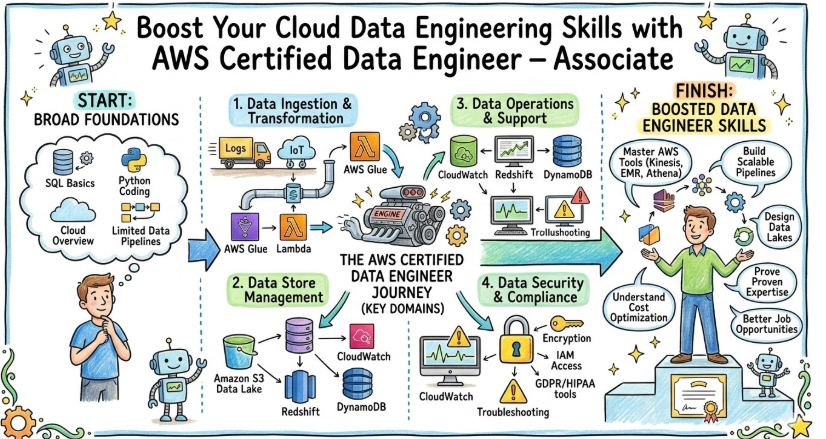
What is this certification? This is a technical credential that focuses on the core tasks of a data engineer: ingesting data, transforming it into a usable format, and ensuring it is stored securely and efficiently.
Who should take this certification?
- Software Engineers transitioning into data-centric roles.
- Cloud Engineers who manage data storage and processing clusters.
- SREs responsible for the uptime of analytical platforms.
- Data Analysts who want to build their own automated pipelines.
Skills you will gain
- Designing scalable data lakes using Amazon S3.
- Implementing complex ETL workflows with AWS Glue.
- Managing high-performance data warehouses with Amazon Redshift.
- Orchestrating serverless applications with AWS Step Functions.
- Applying robust security layers to sensitive organizational data.
Real-world projects you should be able to do after this certification
- Creating an automated data ingestion system for multi-source logs.
- Designing a cost-effective archiving strategy for long-term data storage.
- Building a real-time analytics engine for streaming social media data.
- Implementing a centralized governance model for a multi-account data lake.
Preparation Plan
- 7–14 Days Plan: An intensive review of the official exam domains is conducted. High-level whitepapers are studied, and practice exams are used to gauge readiness.
- 30 Days Plan: A balanced study routine is established. Time is split between theoretical learning and hands-on console experience with Glue and Athena.
- 60 Days Plan: A mastery-level approach is taken. Complex, end-to-end pipelines are built. Deep dives into performance tuning and cost optimization are prioritized.
Common mistakes to avoid
- Neglecting the nuances of data partitioning in S3.
- Overlooking the security implications of public S3 buckets.
- Failing to understand the pricing models of different ingestion services.
- Relying solely on video tutorials without doing the actual lab work.
Best next certification after this
- Same track: AWS Certified Data Analytics – Specialty.
- Cross-track: AWS Certified Solutions Architect – Professional.
- Leadership / management: Cloud Business Professional for strategic growth.
Choose Your Learning Path
1. The DevOps Perspective The focus here is on “Infrastructure as Code.” It is best for those who want to automate the deployment of data services using tools like Terraform.
2. The DevSecOps Perspective This path is for security enthusiasts. It emphasizes data encryption at rest and in transit, ensuring compliance with global standards.
3. The SRE Perspective Ideal for engineers focused on reliability. This path covers monitoring, alerting, and building self-healing data pipelines.
4. The AIOps / MLOps Perspective This is for those working on the edge of innovation. It focuses on how data engineering feeds directly into machine learning training cycles.
5. The DataOps Perspective A focus is placed on the lifecycle of data delivery. It is best for teams that need to improve the speed and quality of their data insights.
6. The FinOps Perspective This is the path for the cost-conscious engineer. It teaches how to run massive data operations without exceeding the cloud budget.
Role → Recommended Certifications Mapping
- DevOps Engineer: AWS Certified DevOps Engineer – Professional.
- Site Reliability Engineer (SRE): AWS Certified SysOps Administrator – Associate.
- Platform Engineer: AWS Certified Solutions Architect – Associate.
- Cloud Engineer: AWS Certified Developer – Associate.
- Security Engineer: AWS Certified Security – Specialty.
- Data Engineer: AWS Certified Data Engineer – Associate.
- FinOps Practitioner: Cloud Digital Leader.
- Engineering Manager: AWS Certified Cloud Practitioner.
Next Certifications to Take
For the Career Climber:
- Same-track: Advanced Data Analytics Specialty.
- Cross-track: Solutions Architect Professional.
- Leadership-focused: Certified Agile Practitioner.
For the Infrastructure Expert:
- Same-track: DevOps Engineer Professional.
- Cross-track: Security Specialty.
- Leadership-focused: IT Management certifications.
Training & Certification Support Institutions
DevOpsSchool Industry-leading training is provided here with a heavy emphasis on hands-on labs. Every learner is guided by mentors who have spent decades in the field. It is a comprehensive ecosystem for career growth.
Cotocus A results-oriented training institution that focuses on high-demand cloud skills. The curriculum is tailored to meet the needs of modern tech giants, ensuring students are job-ready.
ScmGalaxy This is a massive knowledge hub for the engineering community. Valuable resources and professional training are offered to help engineers stay at the top of their game.
BestDevOps Simplified, step-by-step coaching is the hallmark of this institution. It is highly recommended for those who want a clear and uncomplicated path to certification.
devsecopsschool.com A dedicated platform for learning how to secure the modern cloud. It is an essential resource for any engineer who wants to specialize in security.
sreschool.com This institution focuses on the principles of reliability and scalability. It provides the deep technical training needed to manage high-availability systems.
aiopsschool.com A forward-thinking school that combines AI with IT operations. It is perfect for those who want to lead the next wave of technological innovation.
dataopsschool.com The entire lifecycle of data management is taught here. A focus is placed on collaboration and technical efficiency in data delivery.
finopsschool.com Financial transparency in the cloud is the core focus. This school teaches engineers how to align their technical decisions with business financial goals.
Operational & Strategic FAQs
- How does this certification change my daily workflow?
A more structured approach to building pipelines is adopted. Decisions are based on AWS best practices for cost and performance rather than just functionality. - Can I transition from a traditional DBA role using this path?
Yes, this is the ideal bridge. It helps a database administrator move from managing local servers to architecting global cloud data solutions. - What is the biggest challenge for those coming from a non-cloud background?
The biggest hurdle is understanding “serverless” logic. Shifting from managed hardware to services like AWS Glue requires a new way of thinking about resources. - How do I justify the cost of this certification to my manager?
It is presented as a way to reduce company cloud waste. Certified engineers know how to pick the right-sized services, which directly saves the organization money. - Is the “Associate” level enough for a senior role?
It is a powerful start. While “Professional” levels exist, the Associate level proves you have the hands-on skills to build and maintain production systems. - How does this help in an interview compared to just having experience?
Experience is great, but certification acts as a “pre-filter.” It gives the interviewer immediate proof that your knowledge has been verified by AWS. - What if I am already a Solutions Architect?
This certification is a deep-dive. While the Architect role is broad, the Data Engineer role is specific. It allows you to specialize in the “plumbing” of data-driven apps. - Is there a specific order for the learning modules?
Yes, a logical flow is followed: first storage (S3), then processing (Glue/EMR), and finally consumption (Athena/Redshift). - How much “coding” will I actually do in the exam?
The focus is not on writing long scripts, but on identifying errors in code and understanding how Python fits into the pipeline. - Does this certification cover data privacy laws like GDPR?
Yes, a significant portion is dedicated to how AWS services are used to stay compliant with global data protection rules. - How do I keep my skills fresh after the exam?
Continuous learning is encouraged. Following AWS blogs and practicing new features in a “sandbox” account is the best way to stay relevant. - Why is the failure rate high for some candidates?
Most failures happen when candidates rely only on theory. Success is usually found by those who have spent time actually using the AWS Console.
Specific Operational FAQs: AWS Certified Data Engineer – Associate
- How is “Data Governance” tested in this specific exam?
It is tested through scenarios. You are asked how to manage access across teams while keeping the data encrypted and audited. - What is the operational difference between Athena and Redshift in the exam?
The exam tests your ability to choose: use Athena for quick, ad-hoc queries on S3, and use Redshift for heavy, high-performance warehousing. - How are “Batch” and “Streaming” pipelines compared?
Questions focus on latency. You must decide if a process needs to be real-time (Kinesis) or if it can be processed in chunks (Glue Batch). - Is there a focus on “Data Quality”?
Absolutely. You are tested on how to catch “bad data” before it reaches the warehouse using AWS tools like Glue DataBrew. - How does the exam handle “Legacy” data migration?
It looks at how to move data from old, on-premise systems into the cloud efficiently using tools like AWS Snowball. - What is the role of “Orchestration” in the testing?
It tests how you glue everything together. Using AWS Step Functions to ensure Step B only starts after Step A finishes successfully. - How deep do I need to know AWS Lake Formation?
A solid understanding is required. You must know how it simplifies the security of a data lake compared to manual S3 policies. - Are “Cost-Optimization” questions common?
Yes, every technical choice is filtered through cost. You are often asked for the most cost-effective way to solve a specific data problem.
Testimonials
Karan A total shift in perspective was experienced after this certification. The way data pipelines are viewed now is much more architectural and systematic.
Ananya Career clarity was the biggest takeaway for me. The structured learning path made me realize exactly where my strengths in data engineering lie.
Arjun Real-world application was the focus of my training. I was able to implement a new data lake at my company within weeks of getting certified.
Meera Confidence growth was immediate. Being able to speak with authority on data security and performance has changed how I interact with my team.
Siddharth Skill improvement was noticeable from day one. The certification process filled in many gaps in my knowledge regarding AWS serverless data tools.
Conclusion
The AWS Certified Data Engineer – Associate certification is a vital milestone for any cloud professional. It provides the structured knowledge and technical validation needed to thrive in a data-heavy world. By investing in this credential, a foundation for long-term career growth and technical leadership is laid. Strategic learning and careful planning are encouraged for anyone ready to take this next step.