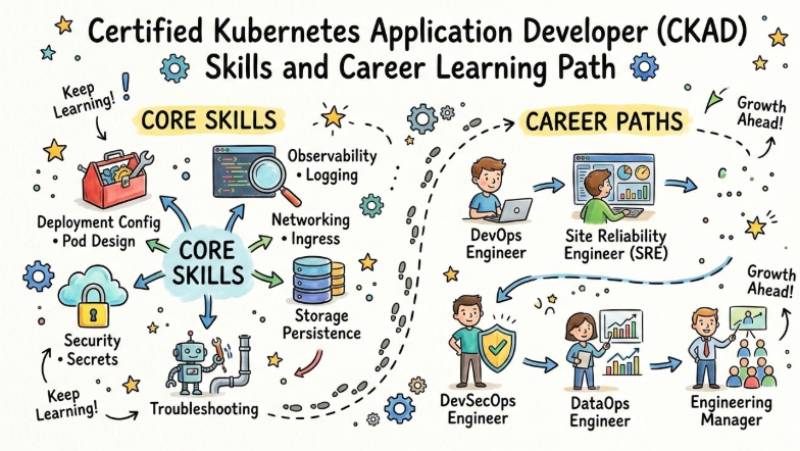
Introduction
The Certified Kubernetes Application Developer (CKAD) is a professional credential that verifies an individual’s ability to design, build, and deploy cloud-native applications for Kubernetes. In the modern world of software and automation, Kubernetes has become the standard for managing containers. Being able to navigate this ecosystem is no longer just an advantage; it is a necessity for staying relevant in the tech industry.
Cloud computing and microservices have changed how software is created. Kubernetes acts as the operating system for these cloud applications. For engineers and managers, certifications like the CKAD are vital because they provide a structured way to prove hands-on skills. It shows that a professional can handle real-world challenges, manage application resources, and ensure that software runs reliably in a production environment.
Certifications serve as a benchmark for quality. They help managers identify talent and give engineers the confidence to solve complex architectural problems. In a global market, having a recognized credential ensures that your skills are understood and valued across different regions and industries.
Certification Overview Table
| Track | Level | Who it’s for | Prerequisites | Skills Covered | Recommended Order |
| Application Development | Intermediate | Developers, SREs, Cloud Engineers | Basic Linux & Docker | Pod Design, Deployment, Networking, Storage | After K8s Fundamentals |
Provider: devopsschool
Why Choose DevOpsSchool?
Choosing the right place to learn is as important as the certification itself. DevOpsSchool is selected by many because the focus is kept on practical, hands-on training rather than just theory. The instructors are people who work in the industry and understand the daily struggles of a DevOps or Platform engineer.
The curriculum is updated regularly to match the latest changes in the Kubernetes ecosystem. Students are given access to lab environments where they can practice commands and troubleshooting in real time. This approach ensures that when the exam day arrives, the candidate is not just prepared to pass, but prepared to work.
Certification Deep-Dive: Certified Kubernetes Application Developer (CKAD)
What is this certification?
The CKAD is a performance-based exam that tests the knowledge required to create, configure, and expose cloud-native applications. It focuses on the specific tasks an application developer needs to perform within a Kubernetes cluster.
Who should take this certification?
This is ideal for Software Developers, DevOps Engineers, and System Administrators who are responsible for deploying and managing applications in containerized environments. It is also highly beneficial for Engineering Managers who want to understand the technical workflows of their teams.
Skills you will gain
- Designing and creating Pods and Deployments.
- Configuring application variables, Secrets, and ConfigMaps.
- Setting up Liveness and Readiness probes for health checks.
- Managing Persistent Volume Claims for data storage.
- Implementing Network Policies to secure application traffic.
- Troubleshooting application failures within a cluster.
Real-world projects you should be able to do
- Migrate a legacy web application into a multi-container Pod.
- Build a CI/CD pipeline that automatically updates Kubernetes deployments.
- Set up a scalable microservice architecture with proper resource limits.
- Implement a rolling update strategy with zero downtime for a live site.
Preparation Plan
7–14 Days Plan (The Intensive Review)
- Focus entirely on the “Kubernetes.io” documentation.
- Practice “kubectl” commands for 3 hours daily.
- Run through all core resources: Pods, Deployments, and Services.
30 Days Plan (The Balanced Path)
- Week 1: Focus on Core Concepts and Pod design.
- Week 2: Study Configuration, Observability, and Troubleshooting.
- Week 3: Master Services, Networking, and State Persistence.
- Week 4: Take multiple mock exams to build speed.
60 Days Plan (The Deep Learning Path)
- Month 1: Learn the fundamentals of Docker and Linux networking alongside Kubernetes basics.
- Month 2: Deep dive into each CKAD domain, building a small project for each topic. Spend the final two weeks on speed drills.
Common mistakes to avoid
- Spending too much time on one difficult question during the exam.
- Forgetting to set the correct Namespace before running commands.
- Relying on “copy-paste” from the internet instead of learning the YAML structure.
- Not using aliases (like
kforkubectl) to save time.
Best next certification after this
- Same track: Certified Kubernetes Administrator (CKA).
- Cross-track: Certified Kubernetes Security Specialist (CKS).
- Leadership / management: Cloud Digital Leader or DevOps Management programs.
Choose Your Learning Path
DevOps Path
This path is best for those who want to bridge the gap between development and operations. It focuses on automation, CI/CD, and infrastructure as code.
DevSecOps Path
Designed for engineers who want to integrate security into every stage of the pipeline. It is best for those working in highly regulated industries like finance or healthcare.
Site Reliability Engineering (SRE) Path
This is for professionals focused on scalability and reliability. It emphasizes monitoring, incident response, and performance tuning.
AIOps / MLOps Path
Best for data scientists and engineers who need to deploy Machine Learning models at scale. It focuses on the intersection of AI and operational efficiency.
DataOps Path
Targeted at data engineers. This path ensures that data pipelines are automated, secure, and highly available.
FinOps Path
This is for those who manage cloud costs. It is best for professionals who need to balance technical performance with budget constraints.
Role → Recommended Certifications Mapping
- DevOps Engineer: CKAD, CKA, Jenkins Certified Engineer.
- Site Reliability Engineer (SRE): CKAD, Prometheus Certified Associate, CKA.
- Platform Engineer: CKAD, Terraform Associate, CKS.
- Cloud Engineer: CKAD, AWS/Azure Solutions Architect, CKA.
- Security Engineer: CKAD, CKS, HashiCorp Vault Associate.
- Data Engineer: CKAD, Spark Developer, DataOps Fundamentals.
- FinOps Practitioner: CKAD, FinOps Certified Practitioner.
- Engineering Manager: CKAD (for awareness), Cloud Digital Leader, PMP.
Next Certifications to Take
For every learner, a balanced growth strategy is recommended. Based on industry trends, the following steps are suggested:
- Same-track: Certified Kubernetes Administrator (CKA) should be pursued to understand cluster management.
- Cross-track: A Security focused certification like CKS is recommended to handle modern threats.
- Leadership-focused: A Management or Strategy certification is advised to help transition into senior roles.
Training & Certification Support Institutions
DevOpsSchool
Training is provided through a mix of live sessions and self-paced learning. A strong emphasis is placed on lab-based exercises. Support is offered for exam preparation and career coaching.
Cotocus
A specialized institution that focuses on high-end technology consulting and training. It is known for its deep dive into cloud-native tools. Industry-specific workshops are often conducted here.
ScmGalaxy
This platform serves as a community hub for SCM and DevOps professionals. Extensive documentation and free resources are provided. It is a great place for finding tutorials on automation tools.
BestDevOps
Practical roadmaps for beginners and pros are offered. The training style is kept simple and direct. It is often chosen by those who prefer a structured, step-by-step learning environment.
devsecopsschool.com
This institution focuses exclusively on the “Security” aspect of the DevOps lifecycle. Advanced tools for vulnerability scanning and container security are taught. It is the go-to place for security-conscious engineers.
sreschool.com
Training is centered around the Google SRE handbook principles. Topics like error budgets and SLIs/SLOs are covered in detail. It is designed for those managing large-scale distributed systems.
aiopsschool.com
Education on how to use AI and ML to improve IT operations is provided. Students are taught how to automate root cause analysis. It is ideal for those looking at the future of IT management.
dataopsschool.com
Courses are built around the lifecycle of data management. Automation of data quality and delivery is the primary focus. It bridges the gap between data science and operations.
finopsschool.com
The financial side of the cloud is taught here. Professionals learn how to optimize spending without sacrificing speed. It is essential for anyone responsible for cloud budgets.
FAQs Section
General Career FAQs
- Is the CKAD exam very difficult?
It is a performance-based exam, meaning you must solve problems, not just answer questions. It is challenging but fair. - How much time is needed to prepare?
Most working professionals need about 4 to 8 weeks of consistent practice. - Are there any prerequisites?
There are no official prerequisites, but a basic understanding of Linux and Docker is highly recommended. - In what order should I take Kubernetes exams?
Many start with CKAD as it is developer-focused, then move to CKA, and finally CKS. - Does this certification help in getting a job?
Yes, it is one of the most respected certifications in the DevOps and Cloud industry globally. - Can I use the documentation during the exam?
Yes, you are allowed to access the official Kubernetes documentation during the test. - What job roles can I apply for?
Roles like Cloud Developer, DevOps Engineer, and System Architect are common. - Is the certificate valid forever?
No, it is typically valid for two years, after which renewal is required to stay current. - How is the exam conducted?
It is an online, proctored exam that you take from your own computer. - What is the passing score?
A score of 66% or higher is usually required to pass the CKAD. - Are retakes allowed?
Most exam purchases include one free retake if the first attempt is not successful. - Is it worth it for managers?
Yes, it helps managers understand the technical limitations and possibilities of the tools their teams use.
CKAD Specific FAQs
- What is the main focus of CKAD?
The focus is on application resources like Pods, Deployments, Services, and ConfigMaps. - Do I need to know how to set up a cluster?
No, cluster setup is more of a CKA task. CKAD focuses on using an existing cluster. - Which version of Kubernetes is used?
The exam is updated regularly to reflect a recent stable version of Kubernetes. - Is YAML knowledge required?
Yes, being able to read and write YAML files is essential for the exam. - Can I use a notepad during the exam?
An internal digital notepad is provided within the exam environment. - How many questions are there?
Usually, there are between 15 and 20 lab-based tasks to complete. - What is the duration of the exam?
The exam is two hours long. - Is there much coding involved?
No heavy coding in languages like Python is needed, but command-line proficiency is a must.
Testimonials
Aravind S.
The clarity provided by this certification path was immense. Complex concepts of networking were finally understood through hands-on practice. It has been a major boost for my daily work.
Meera J.
Confidence in handling production clusters was gained after preparing for the CKAD. The real-world scenarios in the labs helped me solve a major deployment issue at my company the very next week.
Thomas K.
As a cloud engineer, I needed a way to prove my skills to my clients. This certification is recognized everywhere and has opened doors to better project opportunities.
Sanjay V.
Security was always a bit of a mystery until I studied for this. I now understand how to protect my applications using network policies. It was a very practical learning experience.
Elena R.
Transitioning into an engineering manager role was made easier because I actually understood what my developers were talking about. This guide provided the roadmap I needed to get started.
Conclusion
The Certified Kubernetes Application Developer (CKAD) certification is a powerful tool for anyone in the software field. It provides a clear path to mastering the most important orchestration tool in the world today. By earning this credential, long-term career benefits like higher salary potential and job security are achieved.
Strategic learning and careful planning are encouraged for everyone. Whether you are an engineer or a manager, understanding Kubernetes is a step toward the future of technology.