Introduction
The world of data is changing fast. For many years, data management was seen as a slow, manual process. But today, businesses need data to move as quickly as their software. This is where DataOps comes in. It is a modern approach that brings the speed of DevOps to the world of data. It ensures that data is not just sitting in a warehouse but is being moved, cleaned, and used in real-time to make big business decisions. Without this speed, a company can fall behind its competitors very quickly.
A Dataops Certified Professional is someone who understands how to build automated, reliable, and scalable data pipelines. This certification is designed to help professionals master the tools and workflows needed to manage data in a cloud-first world. It is not just about learning a tool; it is about changing how data is handled across the entire organization. By becoming a specialist in this field, an engineer learns how to reduce the time it takes to get an idea from a data scientist into a finished product that the customer can use.
Certifications are very important for engineers and managers today. They provide a structured way to learn new skills that are actually used in the industry. They also act as a proof of expertise when applying for new jobs or seeking a promotion. In the modern cloud and automation ecosystem, having a formal recognition of your DataOps skills is a significant advantage because it shows you can handle the complex data needs of a large company. Managers also benefit because it gives them a standard way to measure the skills of their team members.
Certification Overview Table
| Track | Level | Who it’s for | Prerequisites | Skills Covered | Recommended Order |
| DataOps | Professional | Data Engineers, DevOps, SRE | Basic Data Knowledge | Pipeline Automation, Quality Control, Monitoring | Primary Certification |
Why Choose DevOpsSchool?
DevOpsSchool is chosen by thousands of professionals because of its practical approach to learning. The training is conducted by industry experts who have handled real-world data challenges in big tech companies. Detailed lab sessions are provided to ensure that every concept is understood through hands-on practice rather than just reading slides. This practical focus means that when a student goes back to their job, they can actually start using what they learned immediately.
The curriculum is updated regularly to match the latest industry trends and tools. Support is provided even after the course is completed, helping students with their career goals and technical doubts. Whether someone is a beginner or an experienced engineer, the learning paths at DevOpsSchool are designed to deliver maximum value by focusing on what the job market really needs. They don’t just teach you how to pass an exam; they teach you how to be a leader in the data operations space.
Certification Deep-Dive: Dataops Certified Professional
What is this certification?
The Dataops Certified Professional program is a comprehensive course that focuses on the integration of data science, data engineering, and operations. It is intended to teach the automation of data delivery and the improvement of data quality through collaborative practices. It covers the entire journey of data from the moment it is created to the moment it is analyzed.
Who should take this certification?
- This certification should be taken by Data Engineers who want to automate their daily tasks.
- It is perfect for DevOps professionals who are now being asked to manage data platforms and need to understand the data lifecycle.
- It is highly beneficial for Engineering Managers who oversee data-driven projects and want to implement agile methodologies in data management to speed up their team.
- Cloud Engineers who want to specialize in the data side of cloud infrastructure will find this very useful.
Skills you will gain
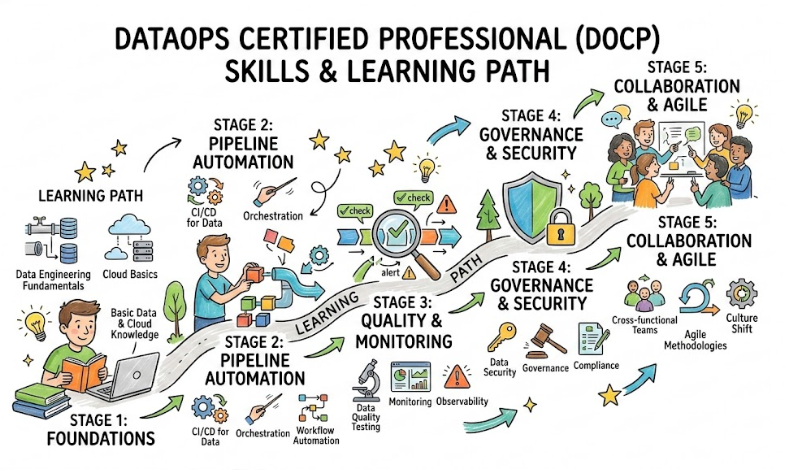
- Mastery of automated data pipeline orchestration: You will learn how to make different data tools work together without manual intervention.
- Implementation of continuous integration and continuous delivery (CI/CD) for data: You will understand how to push updates to your data systems safely and quickly.
- Knowledge of data version control and environment management: You will be able to track changes in your data just like you track changes in your code.
- Ability to perform automated data quality testing and monitoring: You will learn how to set up systems that catch errors in data before they reach the business users.
- Understanding of collaborative data governance and security practices: You will gain the skills to keep data safe and compliant with laws while still making it easy for the right people to access.
Real-world projects you should be able to do after this certification
- End-to-end automated data pipeline: A full system can be built for a large-scale retail application that moves sales data into a dashboard every minute.
- Real-time data monitoring dashboards: Systems can be created to detect anomalies or “bad data” in the flow and alert the team instantly.
- Multi-environment data testing framework: A setup can be deployed to ensure data accuracy in a test environment before it is ever allowed to touch the production environment.
- Version control systems for database schemas: You can implement tools that allow a team of fifty engineers to change database structures without breaking each other’s work.
Preparation plan
- 7–14 days plan: The core concepts of DataOps and the basic tools used for pipeline automation should be reviewed. Focus should be placed on understanding the DataOps manifesto and why it is different from traditional data management. The lifecycle of data projects should be memorized.
- 30 days plan: Hands-on labs should be completed daily to build muscle memory. Time should be spent on configuring CI/CD tools specifically for data and practicing how to write automated tests. Mock exams should be taken once a week to assess where you need more study.
- 60 days plan: In-depth study of data governance and security within DataOps should be conducted. Real-world case studies from successful tech companies should be analyzed to see how they solve problems. Advanced troubleshooting techniques for complex data pipelines should be mastered.
Common mistakes to avoid
- Skipping the Labs: Relying only on theory and reading books without performing hands-on lab exercises is the biggest reason people fail to use the skills at work.
- Rushing the Basics: Skipping the fundamentals of data engineering before jumping into high-level automation will lead to confusion later on.
- Ignoring Culture: Ignoring the cultural aspect of DataOps is a mistake. DataOps is about people working together, not just the technical tools you use.
- Lack of Real Practice: Failing to practice with real-world, “messy” datasets during the preparation phase can leave you unprepared for real job challenges.
Best next certification after this
- Same track: DataOps Expert or Master level certifications focusing on specific big data tools.
- Cross-track: MLOps Certified Professional or AIOps Certification to handle the machine learning side.
- Leadership / management: Certified Data Operations Manager or ITIL for Data Leaders for those who want to move into high-level strategy.
Choose Your Learning Path
- 1. DevOps Path: This path is best for those who already manage servers and cloud infrastructure but want to apply those skills to data teams. It focuses on the bridge between software operations and data delivery.
- 2. DevSecOps Path: Security-minded engineers should follow this path. It ensures that data pipelines are not only fast but also secure and follow global privacy laws like GDPR.
- 3. Site Reliability Engineering (SRE) Path: This is ideal for professionals focused on the uptime and reliability of data systems. It teaches how to manage data at a massive scale without the systems crashing.
- 4. AIOps / MLOps Path: Best for those working with Artificial Intelligence. It covers how to automate the lifecycle of AI models so they can be updated as easily as a simple app.
- 5. DataOps Path: This is the core path for Data Engineers. It provides a deep dive into every single aspect of the data lifecycle from start to finish.
- 6. FinOps Path: This path is best for those who need to manage the high cost of data in the cloud. It focuses on making sure the company isn’t wasting money on storage or processing.
Role → Recommended Certifications Mapping
- DevOps Engineer: Dataops Certified Professional and Docker/Kubernetes Certification are suggested.
- Site Reliability Engineer (SRE): SRE Foundation and Dataops Certified Professional are the best combination.
- Platform Engineer: A Cloud Platform Certification mixed with DataOps Professional training is recommended.
- Cloud Engineer: AWS or Azure Solution Architect and Dataops Certified Professional should be taken.
- Security Engineer: DevSecOps Professional and Data Governance Certification are needed for this role.
- Data Engineer: Dataops Certified Professional and a Big Data Engineering Certification are the standard.
- FinOps Practitioner: FinOps Certified Professional and Cloud Cost Management are essential.
- Engineering Manager: Agile Leadership and Dataops Certified Professional will help in managing modern teams.
Next Certifications to Take
For any learner who has completed the Dataops Certified Professional, the following moves are suggested:
- Same-track: Advanced Data Engineering with a focus on tools like Snowflake or Databricks should be considered.
- Cross-track: MLOps Certification to handle machine learning workflows is a great next step.
- Leadership-focused: Certification in Digital Transformation or IT Strategy is recommended for those looking at director-level roles.
Training & Certification Support Institutions
DevOpsSchool
Complete training for DataOps is provided by this institution. A mix of live sessions and recorded videos is offered to suit different learning speeds. Career guidance and interview preparation are also included to help students find the right job.
Cotocus
Customized training programs for large corporate teams are offered by Cotocus. The focus is kept on high-end technical skills and the actual implementation of DataOps in very large enterprises with complex needs.
ScmGalaxy
A large community and a wealth of free resources are maintained by ScmGalaxy. Support for various DevOps and DataOps tools is provided through thousands of tutorials and expert blogs that are updated daily.
BestDevOps
Specialized bootcamps for intensive learning are conducted here. It is preferred by those who want to gain deep technical knowledge in a very short amount of time through immersive training.
devsecopsschool.com
A focus on the security aspects of the development lifecycle is maintained. Training is provided on how to integrate security into every stage of the data and software process to prevent data leaks.
sreschool.com
Reliability and performance of large-scale systems are the primary focus areas. Courses are designed to help engineers build systems that are resilient, easy to monitor, and never go down.
aiopsschool.com
Training on the use of AI for improving IT operations is provided. It covers how machine learning can be used to predict and fix technical issues before they happen.
dataopsschool.com
This is a dedicated platform for everything related specifically to DataOps. In-depth training on data pipelines, data quality, and automation is offered here for all levels.
finopsschool.com
The financial management of cloud services is taught. It is aimed at professionals who want to master cloud cost optimization and make sure every dollar spent on the cloud is useful.
FAQs Section
1. What is the difficulty level of the Dataops Certified Professional exam?
The exam is considered to be of moderate difficulty. A good understanding of how data flows through a system and how automation tools work is required.
2. How much time is required to prepare for this certification?
Usually, 30 to 60 days of preparation are sufficient if a consistent study schedule of one or two hours a day is maintained.
3. Are there any prerequisites for this course?
A basic knowledge of how databases work and some familiarity with basic computer commands or scripting is recommended for the best experience.
4. What is the best sequence for taking these certifications?
It is suggested that the Dataops Certified Professional be taken first as a foundation. After that, more specialized certifications in MLOps or specific cloud tools can be pursued.
5. Does this certification help in getting a higher salary?
Yes, certified professionals are often offered higher salaries. This is because companies are desperate for people who can prove they know how to handle modern data problems.
6. Is the exam conducted online?
Yes, the exam can be taken from the comfort of your home or office as long as there is a stable internet connection.
7. Can an Engineering Manager benefit from this?
Absolutely. It helps managers understand the technical challenges their teams face and how to build a culture that values speed and data quality.
8. What kind of job roles can be applied for after certification?
Roles such as DataOps Engineer, Senior Data Engineer, and Data Pipeline Automation Specialist can be pursued with this certification on your resume.
9. Is hands-on experience mandatory for the exam?
While not strictly mandatory, having practical experience from the labs is highly beneficial for passing the exam and actually doing the work in a real job.
10. How long is the certification valid?
The certification is generally valid for two to three years. After this, taking an advanced course or a renewal exam is recommended to stay up to date.
11. Are study materials provided by the institution?
Yes, comprehensive study guides, practice questions, and full access to lab environments are provided by training partners like DevOpsSchool.
12. Is DataOps different from DevOps?
Yes, while both use automation and collaboration, DataOps specifically focuses on the unique problems of data, like keeping it clean, safe, and accurate.
Dataops Certified Professional FAQs
13. Why is DataOps becoming popular now?
The massive growth of data in the last few years has made it impossible to manage data using old, manual methods. Companies now have no choice but to automate.
14. Does the course cover cloud platforms like AWS or Azure?
Yes, learning how to implement DataOps on major cloud providers like AWS, Azure, and Google Cloud is a core part of the curriculum.
15. What is the pass percentage for the exam?
A score of 70% or higher is typically required to pass the certification exam and receive the official certificate.
16. Are there any community groups for DataOps learners?
Yes, large communities like ScmGalaxy provide forums where learners can ask questions, share tips, and network with other professionals.
17. Is Python used in DataOps?
Yes, Python is the most common language used for writing scripts and automating various tasks in a data pipeline.
18. Can a fresher take this certification?
Yes, fresh graduates can take it, but they should spend extra time on the basics of data and cloud to get the most out of the professional-level content.
19. How does DataOps improve data quality?
Quality is improved by using automated “tests” that check the data at every single step. If the data is wrong, the system stops it before it reaches the end user.
20. Is this certification recognized globally?
Yes, certifications from DevOpsSchool are recognized by top tech companies and consulting firms around the world.
Testimonials
Amit S.
The way data pipelines are managed was completely changed for me after this course. My confidence in handling large datasets was greatly improved and I feel much more prepared for daily tasks.
Priya K.
The real-world projects were the best part of the training. Practical application of DataOps principles was learned, and it directly helped me secure a better role in my current company.
John D.
Clarity on how to bridge the gap between data engineering and operations was gained. It is a must-have certification for any professional working in the data space today.
Robert M.
The training provided by the mentors was excellent and very easy to follow. My skill set was expanded from simple coding to building full-scale automation systems for big companies.
Sanjay V.
As a manager, a deeper understanding of how to implement agile practices in my data teams was achieved. The career value of this certification is very high for leaders.
Conclusion
The Dataops Certified Professional certification is a vital step for anyone looking to excel in the modern data landscape. It provides the essential skills needed to automate complex workflows and ensure that data is delivered with both speed and accuracy. By focusing on the entire data lifecycle, this program prepares you for the real challenges of the industry.
Long-term career benefits include access to high-paying roles and the ability to lead major digital transformation projects. Strategic learning should be planned, and this certification should be seen as a strong foundation for a long and successful career in the data and cloud ecosystem.