Introduction
In the current digital economy, the infrastructure is expected to be invisible yet invincible. The Google Cloud Professional Engineer is the architect of this invisibility. This role is not just about using tools; it is about adopting a philosophy where reliability is a shared responsibility across the entire organization. When a system is built correctly, the end-user never notices the complex machinery working behind the scenes. This guide serves as a manual for those who wish to build such systems.
What is Google Cloud Professional Engineer?
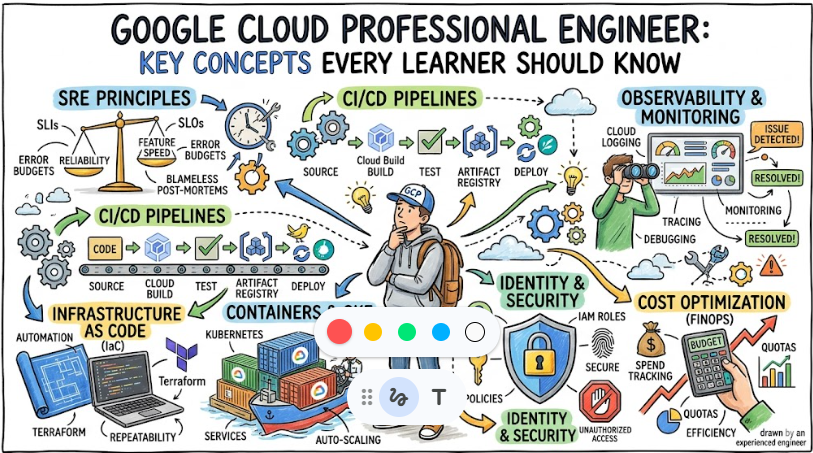
The Google Cloud Professional Engineer is a specialist who is tasked with the creation of automated, scalable, and secure delivery patterns. By using the Google Cloud Platform, the balance between rapid feature release and system integrity is maintained. This role involves deep knowledge of how code is packaged, how it is deployed, and how it is monitored in a live environment. It is a fusion of software engineering and traditional system administration, elevated to the scale of the cloud.
Why it matters in today’s software, cloud, and automation ecosystem
Complexity is the enemy of speed. As systems grow from single servers to hundreds of microservices, the risk of failure increases exponentially. A disciplined approach to automation is required to manage this complexity. When Google Cloud tools are mastered, the “human error” element is removed from deployments. This allows businesses to innovate without the fear of breaking production. In a world where “Software is eating the world,” the Google Cloud Professional Engineer is the one ensuring the software remains healthy and available.
Why certifications are important for engineers and managers
For the individual, a certification is a signal of technical maturity. It proves that the “hard way” of learning through mistakes has been supplemented by industry best practices defined by Google itself. It provides a structured way to fill gaps in knowledge that may not be covered in daily work. For management, a certified team is a protected team. It ensures that the cloud budget is spent wisely, that the architecture is optimized for cost, and that the security of the data is never compromised. It provides a standard metric to measure the technical health of the engineering department.
Why Choose DevOpsSchool?
When a career is being built, the quality of the foundation is everything. DevOpsSchool is chosen by thousands of professionals because the focus is placed heavily on “learning by doing.” The complex layers of Google Cloud are peeled back through real-world scenarios that mimic actual industry outages and deployment hurdles. Guidance is provided by mentors who have spent over 20 years in the trenches of IT, ensuring that the knowledge gained is practical, survival-tested, and not just academic theory. Comprehensive support is offered to ensure that every student not only passes the exam but also thrives in a high-pressure job environment.
Certification Deep-Dive: Google Cloud Professional Engineer
What is this certification?
This professional credential is used to validate the skills required to balance service reliability and delivery speed. It is deeply rooted in the Site Reliability Engineering (SRE) principles pioneered by Google to manage their own global infrastructure.
Who should take this certification?
This path is recommended for those who are responsible for the “health” and “uptime” of an application. It is perfect for Platform Engineers, Cloud Architects, and SREs who want to automate their way out of manual toil and move toward a more strategic, code-driven operational model.
Certification Overview Table
| Track | Level | Who it’s for | Prerequisites | Skills Covered | Recommended Order |
| DevOps | Professional | Automation Leads | 3+ Yrs Experience | CI/CD, GKE, Jenkins | 1 |
| DevSecOps | Professional | Security Architects | DevOps Knowledge | Compliance, IAM, Scanning | 2 |
| SRE | Professional | Reliability Leads | Systems Admin | SLIs, SLOs, Error Budgets | 1 |
| AIOps/MLOps | Professional | ML Engineers | Data Science | Pipeline Automation, Vertex AI | 3 |
| DataOps | Professional | Data Architects | BigQuery Knowledge | Data Governance, Dataflow | 2 |
| FinOps | Professional | Cloud Financials | Billing Access | Cost Visibility, Quotas | 4 |
Skills you will gain
- Pipeline Standardization: The deployment process is standardized through advanced CI/CD techniques, ensuring every piece of code is tested before it hits production.
- SRE Metrics: The implementation of Service Level Objectives (SLOs) and Service Level Indicators (SLIs) is used to provide a mathematical basis for reliability.
- Deep Observability: Mastery over the Google Cloud operations suite (formerly Stackdriver) is gained for deep monitoring, logging, and performance tracing.
- Incident Management: Techniques for performing “blameless” post-mortems and incident response are learned to improve system resilience after every failure.
- Infrastructure Management: All infrastructure is managed through code-based templates, allowing for the rapid recreation of environments in any region.
Real-world projects you should be able to do
- Self-Healing Architecture: The design of a system that automatically detects a failed instance and replaces it without human intervention.
- Advanced Deployment: Creation of an automated “Canary” deployment strategy where new features are rolled out to only 5% of users to test stability.
- Security Integration: Building a centralized logging system that uses machine learning to detect unauthorized access attempts across the cloud network.
- Scaling Optimization: Developing a cost-efficient auto-scaling policy that scales down resources during off-peak hours to save thousands in cloud costs.
Preparation Plan
7–14 Days Plan:
- A heavy focus is placed on the SRE workbook chapters provided by Google.
- Quick labs are used to practice basic GKE cluster management and pod deployment.
- The official exam guide is reviewed daily to identify and bridge specific knowledge gaps.
30 Days Plan:
- The first two weeks are spent on advanced monitoring and logging configurations within the GCP console.
- The third week involves building full deployment pipelines from scratch using Cloud Build.
- The final week is used for simulated exams, focusing on analyzing why incorrect answers were chosen.
60 Days Plan:
- Deep dives into Google Cloud whitepapers are performed to understand the “under the hood” mechanics of the platform.
- A complex, multi-service environment is built and intentionally broken to practice advanced troubleshooting.
- Community case studies from global tech giants are studied to understand common failure patterns in the cloud.
Common mistakes to avoid
- Ignoring Culture: Underestimating the importance of the “Culture” aspect of DevOps; tools alone do not solve problems.
- Console Dependency: Spending too much time on the visual console instead of mastering the Command Line Interface (gcloud SDK).
- Financial Neglect: Forgetting to study the financial impact of different cloud architectures, which is a key part of professional responsibility.
Best next certification after this
- Same Track: Google Cloud Professional Cloud Architect for a broader design perspective.
- Cross-Track: Professional Cloud Network Engineer to master the plumbing of the cloud.
- Leadership/Management: Cloud Digital Leader to understand high-level business strategy and digital transformation.
Choose Your Learning Path
1. DevOps Path
This is best for those who want to eliminate silos between teams. The focus is on the seamless flow of code from a developer’s local machine to the end customer. It is the path of speed and agility.
2. DevSecOps Path
This is designed for professionals who believe security is a core feature, not a hurdle. Security checks are moved to the “left” of the lifecycle, ensuring that vulnerabilities are caught during the build phase.
3. Site Reliability Engineering (SRE) Path
This path is chosen by those who treat operations as a software problem. It is about building systems that manage themselves, allowing engineers to focus on innovation rather than fire-fighting.
4. AIOps / MLOps Path
This is for the next generation of engineers who use artificial intelligence to predict outages before they happen and automate the delivery of complex machine learning models.
5. DataOps Path
This is best for engineers who manage the “bloodline” of the modern company: the data. It ensures data is clean, fast, and accessible for business intelligence and decision-making.
6. FinOps Path
This is for the fiscally-minded engineer. It ensures that every dollar spent on the cloud provides maximum business value through rigorous cost-tracking and optimization.
Role → Recommended Certifications Mapping
| Role | Primary Certification | Next Step |
| DevOps Engineer | Google Cloud Prof. Engineer | Professional Cloud Developer |
| Site Reliability Engineer | Google Cloud Prof. Engineer | Professional Network Engineer |
| Platform Engineer | Professional Cloud Architect | Professional Engineer |
| Cloud Engineer | Associate Cloud Engineer | Professional Engineer |
| Security Engineer | Professional Security Engineer | Professional Engineer |
| Data Engineer | Professional Data Engineer | DataOps Specialist |
| FinOps Practitioner | FinOps Certified | Professional Cloud Architect |
| Engineering Manager | Cloud Digital Leader | Professional Engineer |
Next Certifications to Take
For the Data-Focused Learner:
- One same-track: Advanced Big Data Analytics and Visualization.
- One cross-track: Google Cloud Professional Engineer (to operationalize the data).
- One leadership: Data Strategy and Governance for Executives.
For the Security-Focused Learner:
- One same-track: Professional Cloud Security Engineer.
- One cross-track: Professional Cloud Architect (to understand the broader attack surface).
- One leadership: Cybersecurity Risk Management for Leaders.
Training & Certification Support Institutions
DevOpsSchool
This institution is globally recognized for its rigorous training and job-oriented approach. Practical labs are used to ensure that students are prepared for the high-pressure realities of the IT industry.
Cotocus
Specialized training is provided here with a heavy emphasis on consulting-led learning. It helps professionals understand the underlying business “why” behind every technical “how.”
ScmGalaxy
A vast repository of technical resources and community forums is maintained here. It is used by engineers worldwide to stay updated on the latest trends in software configuration and cloud management.
BestDevOps
The training programs here are designed to be concise, impactful, and direct. The focus is on getting the learner certified and proficient in the shortest time possible without sacrificing depth.
devsecopsschool.com
A dedicated focus on the security aspect of the automated cloud is maintained. It is the primary resource for those looking to protect their CI/CD pipelines from modern threats.
sreschool.com
The core principles of reliability and system health are taught here. It is used by engineers who want to master the art of maintaining extreme uptime for global applications.
aiopsschool.com
The future of cloud operations is explored through AI and ML training. It is designed for forward-thinking engineers who want to use data to drive operational decisions.
dataopsschool.com
Data management and delivery are the core pillars of this specialized school. It ensures that data engineers have the operational skills required for modern big data environments.
finopsschool.com
Financial accountability in the cloud is the primary subject here. It is used to bridge the gap between the technical engineering team and the corporate finance department.
FAQs Section
- How is the “Professional” level different from the “Associate” level?
The Professional level is used to test the ability to design, manage, and troubleshoot complex systems, whereas the Associate level is about executing specific technical tasks. - Does this certification focus on Google-specific tools or general principles?
Both are covered. Google-specific tools are used as the medium to implement general DevOps and SRE principles that are applicable across the entire industry. - How are “Error Budgets” handled in the exam questions?
Questions are designed to test if the balance between taking risks (releasing new features) and maintaining stability is understood by the candidate. - Is multi-regional deployment covered in the syllabus?
Yes, the ability to design for high availability and disaster recovery across different geographical regions is a core requirement of the certification. - How is “Toil” defined and addressed in this certification?
Toil is defined as manual, repetitive work that provides no long-term value. The certification validates the ability to identify and eliminate this through smart automation. - What is the value of this certification for a Freelancer?
It serves as a globally verified “stamp of quality,” allowing for higher consulting rates and access to premium projects in the international market. - How does the exam handle incident management scenarios?
The entire lifecycle of an incident—from detection and response to the blameless post-mortem—is assessed as a critical professional skill. - Is there a focus on cost-efficient scaling?
Yes, the knowledge of how to scale resources vertically and horizontally without exceeding the budget is tested thoroughly. - Can this help in transitioning from a traditional SysAdmin role?
It is the perfect bridge for those moving from manual server management to modern, code-based cloud operations (Infrastructure as Code). - How often is the exam content updated by Google?
The exam is refreshed periodically to include the latest features of the Google Cloud Operations Suite and changes in industry best practices. - What is the significance of “Infrastructure as Code” in the exam?
The use of tools like Terraform or Deployment Manager to manage environments is considered a non-negotiable core skill for any professional. - Are the questions based on real business case studies?
- Yes, scenarios are presented where a specific business problem (like a sudden traffic spike) must be solved using cloud architecture.
Google Cloud Professional Engineer Specific FAQs
- Why is GKE (Google Kubernetes Engine) so prominent in this exam?
GKE is the primary vehicle for modern containerized operations, making its mastery a requirement for any engineer working in the Google ecosystem. - How is the “Post-Mortem” culture tested?
The ability to conduct a blameless analysis focused on system flaws rather than human errors is assessed as a leadership and SRE skill. - Is binary authorization important for the exam?
Yes, it is used to ensure that only trusted, verified code is allowed to be deployed into the production environment. - What is the role of Cloud Build in this certification?
Cloud Build is the primary CI/CD tool used to automate the software delivery lifecycle from code commit to deployment. - How is the “Operations Suite” utilized in real-world scenarios?
It serves as the central hub for monitoring, logging, and tracing, and its correct configuration is essential for maintaining full observability. - Are SLIs and SLOs mandatory to learn for the exam?
They are considered the “language” of the exam. Without understanding these metrics, the sections on reliability and performance cannot be passed. - How are deployment strategies like “Blue-Green” tested?
Candidates are asked to choose the most appropriate strategy to minimize downtime and risk during a major version update. - Does the exam cover legacy migration concepts?
Basic concepts of moving older, monolithic workloads into a modern, managed cloud environment are included to test architectural flexibility.
Testimonials
Kavya
The way I view system failures has completely changed. Instead of fear, a structured approach to problem-solving and automation was developed during the training.
Arjun
The hands-on labs helped me bridge the gap between reading about the cloud and actually running it. My confidence in the production environment has grown significantly.
Vihaan
This certification path provided the clarity needed to move from a junior role to a leadership position. The focus on SRE principles was a game-changer for my team.
Saira
Security is no longer an afterthought for me. It is now integrated into every pipeline I build, thanks to the deep-dive training provided by the mentors.
Rohan
As an engineering manager, I now have the technical vocabulary to guide my team effectively. The certification has brought a new level of standard to our operations.
Conclusion
The Google Cloud Professional Engineer certification is the definitive standard for those who wish to master modern cloud operations. It is not merely a badge of honor; it is a commitment to the principles of reliability, automation, and security. By following this structured path, a long-term career is secured in an industry that never stops evolving. Strategic planning and a focus on operational excellence will ensure that you remain a vital asset to any organization in the global market.