Introduction
Small daily purchases may look harmless, but they can quietly weaken monthly savings when they are repeated without review. A food delivery fee, unused subscription, impulsive online order, banking charge, or unnecessary upgrade may not create immediate financial pressure, yet together they can consume a meaningful part of a household budget. Beginners often feel confused because they track major bills but overlook small transactions and recurring costs. Learning how to build a monthly money leak report creates a clear picture of where money is going, why certain expenses keep appearing, and which costs can be reduced without damaging daily life. This guide will help salaried employees, students, families, freelancers, and small business owners examine their spending practically, avoid emotional decisions, and create a more disciplined monthly financial system.
Understanding a Monthly Money Leak Report
A monthly money leak report is a structured review of expenses that identifies money being spent without delivering enough value.
A money leak is not always a completely useless expense. It may be an expense that is:
- Repeated more often than necessary
- Higher than expected
- No longer required
- Caused by poor planning
- Triggered by emotion or convenience
- Automatically charged without regular review
- Difficult to notice because each transaction is small
For example, a person may spend ₹150 several times each week on delivery charges, convenience fees, and small add-ons. Each payment looks manageable, but the total could become significant by the end of the month.
The purpose of the report is not to make someone feel guilty about spending. It is to separate valuable spending from expenses that can be reduced, replaced, renegotiated, delayed, or eliminated.
How the report works
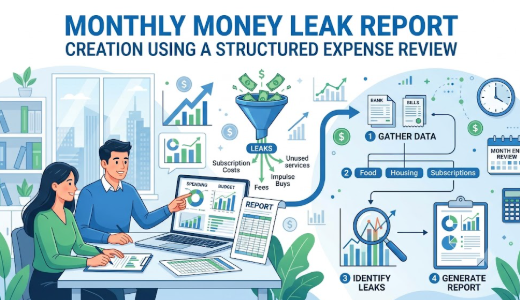
The process usually involves collecting transaction records, grouping expenses, comparing planned and actual spending, identifying avoidable costs, and assigning an action to each leak.
A completed report should answer questions such as:
- Which expenses were unexpected?
- Which subscriptions were not used?
- Where did convenience increase the cost?
- Which spending was emotionally driven?
- Were any penalties or late fees paid?
- Which expenses can be reduced next month?
- How much money could realistically be redirected?
Why people search for it
Many people know that they are spending too much but cannot identify the exact reason. Their income may appear adequate, yet little money remains at the end of the month.
A monthly expense audit replaces assumptions with transaction-level evidence.
Common misunderstanding
A money leak report is sometimes misunderstood as an extreme cost-cutting exercise. It does not require removing every enjoyable purchase.
The better approach is to protect necessary expenses, preserve selected lifestyle priorities, and reduce spending that provides little benefit.
Practical takeaway
Do not begin by asking, “What can I stop buying?” Begin by asking, “Which expenses are not supporting my needs, values, or financial goals?”
Why a Monthly Money Leak Report Is Important
A money leak report improves financial awareness by showing the difference between visible bills and hidden spending patterns.
It protects savings
Savings often decline because unplanned expenses are paid before money is transferred to a savings account. Identifying recurring leaks allows a person to redirect money toward an emergency fund, investment goal, education plan, or major purchase.
It reduces unnecessary borrowing
Poor expense visibility can lead to credit card dependence or short-term borrowing. A person may borrow for an urgent expense even though part of the monthly income was previously lost through avoidable spending.
It improves investment discipline
Investing requires consistent surplus money. Reducing genuine waste can create room for regular investments without forcing unrealistic lifestyle cuts.
Investment choices still require risk assessment. A money leak report should not encourage someone to move essential or emergency money into risky investments.
It supports tax and record management
Freelancers and small business owners may mix personal and business expenses. A monthly review helps them maintain cleaner records, identify duplicate software subscriptions, and prepare more accurate documents for accounting or tax review.
It reduces emotional decision-making
A written report helps people recognize spending triggers such as boredom, stress, social pressure, discount notifications, or the desire for instant convenience.
Practical scenario
A salaried employee believes that household bills are responsible for low savings. After reviewing transactions, the employee discovers that frequent food delivery, unused digital subscriptions, and late-payment charges are the bigger problem. Reducing those leaks is more practical than trying to cut essential groceries or insurance.
The Real Problem Readers Face With Monthly Money Leaks
The main challenge is not always low income. It is often weak visibility.
Many people remember rent, loan payments, school fees, utility bills, and insurance premiums. However, they do not remember every small card transaction, automatic renewal, app purchase, platform charge, delivery fee, or impulse order.
Lack of awareness
Digital payments make spending fast and convenient. The payment process may take only a few seconds, reducing the time available to consider whether the purchase is necessary.
Too much confusing advice
Online budgeting advice often promotes extreme rules that may not suit different incomes, family responsibilities, locations, or financial goals.
A better system should use the person’s actual transaction history rather than a universal spending formula.
Emotional spending
Stress, celebration, boredom, fear of missing out, and social comparison can influence purchases. Emotional spending becomes difficult to recognize when each transaction is reviewed separately.
Poor comparison
Consumers may continue paying expensive mobile plans, insurance add-ons, software subscriptions, bank charges, or delivery memberships because they have not compared alternatives.
Unrealistic expectations
Some beginners expect to remove every unnecessary expense immediately. When they cannot maintain an extremely restrictive budget, they abandon the entire process.
A better approach is gradual improvement. One or two meaningful changes maintained over several months may be more valuable than an unrealistic one-week spending ban.
Ignoring terms and conditions
Free trials, introductory prices, credit card charges, renewal clauses, minimum balances, and loan penalties may create avoidable costs when conditions are not reviewed.
Depending only on social media advice
A creator’s budget may not reflect the reader’s income, dependents, debt, health needs, location, or responsibilities. A monthly money leak report must remain personal and evidence-based.
How to Build a Monthly Money Leak Report Step by Step
Step 1: Choose a Clear Review Period
Start with one complete calendar month or one salary-to-salary cycle. A clear period ensures that income and expenses are compared consistently. Collecting random transactions from different dates can create an inaccurate picture. For example, a salaried employee paid on the twenty-fifth may review spending from one salary date to the next. A common mistake is reviewing only the last week because those expenses are easiest to remember. The better approach is to use the same complete period every month so that trends can be compared fairly.
Step 2: Collect Every Financial Record
Gather bank statements, credit card statements, digital wallet histories, cash notes, loan records, subscription invoices, and business payment records. This matters because money leaks often exist across several payment methods. Someone may carefully review a bank account while ignoring small wallet payments and cash purchases. A common mistake is relying on memory, which usually captures major bills but misses minor transactions. The better approach is to use actual records and note any cash spending during the month.
Step 3: Categorize Every Expense
Group expenses into categories such as housing, food, transport, debt, healthcare, education, entertainment, subscriptions, shopping, business costs, fees, savings, and investments. Categorization makes patterns visible. For example, ten separate food delivery transactions may appear harmless until they are viewed as one monthly total. A common mistake is creating too many categories, making the report difficult to maintain. Use broad categories first, and create subcategories only where a spending problem needs closer examination.
Step 4: Separate Essential, Valuable, and Leaking Expenses
Mark each expense as essential, valuable, adjustable, or avoidable. Essential spending includes basic housing, groceries, healthcare, insurance, and required debt payments. Valuable spending supports genuine priorities, even if it is not essential. Adjustable spending can be reduced, while avoidable spending offers little benefit. A common mistake is labeling every non-essential expense as waste. A better approach is to judge value honestly. A family outing may be valuable, while a forgotten subscription may be a genuine leak.
Step 5: Identify Repeated and Recurring Charges
Search for subscriptions, memberships, auto-renewals, bank fees, software plans, insurance add-ons, and repeat purchases. Recurring charges deserve attention because they continue until someone actively changes them. For example, a user may be paying for three streaming services while regularly using only one. A common mistake is focusing only on the monthly amount. The better approach is to calculate the annual impact and compare it with actual usage.
Step 6: Identify Spending Triggers
Review when, where, and why unplanned expenses occurred. Common triggers include stress, late-night browsing, weekend social pressure, salary-day confidence, discount messages, and lack of meal planning. This step matters because removing one purchase does not solve the behaviour causing it. A common mistake is blaming poor discipline without examining the situation. A better approach is to create a practical barrier, such as disabling shopping notifications, preparing meals, or using a waiting period before buying.
Step 7: Calculate the Total Monthly Leakage
Add the expenses classified as avoidable and the reducible portion of adjustable expenses. Do not assume that the entire category must be removed. If a household spends ₹6,000 on dining out but considers ₹3,500 reasonable, the potential leak is ₹2,500 rather than ₹6,000. A common mistake is exaggerating possible savings to create an impressive number. The better approach is to calculate a realistic recoverable amount that can be maintained.
Step 8: Create an Action Plan for the Next Month
Assign one action to every major leak: cancel, reduce, replace, renegotiate, automate, limit, or monitor. Decide where recovered money will go, such as an emergency fund, debt repayment, planned purchase, or long-term savings goal. A common mistake is identifying leaks without changing the system. The better approach is to schedule actions immediately and review whether they worked during the next monthly financial review.
Key Factors That Influence Monthly Money Leaks
Income timing
People may spend more immediately after receiving income and become restrictive near the end of the month. Dividing money into planned categories early can reduce this pattern.
Fixed expenses
Rent, insurance, school fees, loan payments, and similar obligations may not be easy to reduce immediately. However, they should still be reviewed periodically for errors, unnecessary add-ons, or better alternatives.
Variable expenses
Groceries, transport, dining, shopping, and entertainment change from month to month. These categories usually require limits rather than complete elimination.
Needs versus wants
A need supports basic living, safety, work, health, or an essential responsibility. A want improves comfort or enjoyment. Wants are not automatically bad, but they should be chosen consciously.
Recurring payments
Automatic payments can continue without active approval each month. They should be reviewed for current usage, price increases, duplicate services, and cancellation terms.
Debt obligations
High-interest debt can reduce monthly flexibility. Late fees, minimum-only payments, and new purchases on an unpaid balance can increase financial pressure.
Lifestyle inflation
When income increases, spending may rise at the same speed. Better housing, devices, travel, dining, and memberships can gradually become normal, leaving savings unchanged.
Emotional triggers
A person may spend to reduce stress, reward effort, follow friends, or avoid feeling excluded. Recognizing these triggers is necessary for lasting improvement.
Household communication
Money leaks can continue when family members use different accounts without a shared spending plan. A monthly discussion can improve visibility without creating blame.
Monthly review habits
A report is most useful when prepared consistently. Irregular reviews make it difficult to see whether spending is improving or simply moving between categories.
Detailed Breakdown of a Monthly Money Leak Report
Income tracking
Begin with net income actually available for spending, saving, debt repayment, and investing. Include salary, freelance payments, business drawings, interest, rental income, and other legitimate receipts.
Do not treat borrowed money or credit card limits as income. Borrowing creates an obligation rather than increasing financial capacity.
Expense categories
Use categories that reflect real life. A simple structure may include:
- Housing and utilities
- Food and groceries
- Transport
- Healthcare
- Education
- Debt repayments
- Insurance
- Personal care
- Entertainment
- Subscriptions
- Shopping
- Family support
- Business expenses
- Savings and investments
- Fees and penalties
The category names matter less than consistency.
Needs, wants, and low-value expenses
Some expenses fall between needs and wants. A smartphone may be necessary for work, but upgrading it frequently may not be necessary. Internet access may be essential, while paying for unused premium features may be a leak.
Judge the value of the specific choice rather than the general category.
Small spending leaks
Common small leaks include:
- Delivery charges
- Convenience fees
- Unplanned snacks
- In-app purchases
- Unused subscriptions
- Duplicate cloud storage
- ATM charges
- Late-payment penalties
- Frequent cab upgrades
- Impulse marketplace purchases
These costs matter because of repetition, not necessarily because of individual size.
Emergency funds
An emergency fund helps prevent unexpected expenses from becoming credit card debt or urgent loans. Money recovered from leaks can be redirected gradually toward this reserve.
Emergency money should remain accessible and should not be placed in highly volatile assets.
Debt control
Review interest charges, late fees, overdue balances, and avoidable borrowing. A spending leak may also be a behaviour that creates debt, such as using credit for non-essential purchases without a repayment plan.
Goal-based planning
Recovered money becomes more meaningful when attached to a purpose. A person may allocate it to:
- Emergency savings
- Education
- Home repairs
- Insurance premiums
- Debt reduction
- Retirement planning
- A planned family expense
A clear destination reduces the chance that the same money will be spent elsewhere.
Regular progress review
Compare the current report with previous months. Ask whether a leak was genuinely reduced, temporarily delayed, or shifted into another category.
For example, cancelling a gym membership does not improve finances if the same amount is immediately spent on impulse shopping.
Common Mistakes Beginners Make With Monthly Money Leak Reports
Tracking only major expenses
Major bills are easy to remember, but repeated small payments may be the real source of overspending. Review every transaction, including cash and wallet payments.
Treating all enjoyable spending as waste
A budget that removes every source of enjoyment may be difficult to maintain. Protect selected priorities and reduce low-value spending instead.
Following random advice
Someone else’s ideal grocery, travel, or entertainment budget may be unsuitable for your family. Build decisions from your actual income and responsibilities.
Ignoring recurring renewals
Subscriptions may increase in price or remain active after usage stops. Review them individually rather than accepting the total as fixed.
Focusing only on purchase price
Delivery charges, taxes, interest, maintenance, renewal costs, and add-ons may increase the real expense. Consider the complete cost.
Making emotional cuts
Cancelling essential insurance or delaying healthcare to improve a monthly figure can create larger risks. Reduce genuine waste before cutting protections.
Ignoring hidden banking and credit charges
Late fees, minimum balance penalties, annual fees, cash withdrawal charges, and interest can quietly increase expenses. Read account and card terms carefully.
Using emergency money for risky activities
Money needed for rent, medical care, loan payments, or emergencies should not be used for speculative stocks, leveraged trading, crypto speculation, or gambling.
Sharing sensitive information
A money report may contain account numbers, transaction details, income records, and personal information. Store it securely and avoid uploading it to unknown platforms.
Stopping after one month
One report provides a snapshot. Several monthly reports reveal patterns, seasonal expenses, and lasting improvements.
Don’t Do This Checklist
- Do not depend entirely on memory.
- Do not ignore cash or wallet payments.
- Do not cancel essential protection without review.
- Do not classify every want as a financial mistake.
- Do not use unrealistic savings assumptions.
- Do not hide expenses from other responsible household members.
- Do not move emergency funds into risky assets.
- Do not borrow merely to maintain optional spending.
- Do not share financial statements with unverified services.
- Do not abandon the process after one imperfect month.
Practical Real-Life Examples of Monthly Money Leaks
Example 1: Salaried Employee Facing Month-End Pressure
A salaried employee regularly runs short of money during the final week of each month. The review shows frequent food deliveries and cab upgrades immediately after salary day. The employee sets a weekly dining limit and uses public transport on planned days. The learning is that income timing influenced spending more than income amount.
Example 2: Family Paying for Unused Subscriptions
A family has several entertainment, learning, fitness, and storage subscriptions. Each charge is small, so no single payment appears concerning. After checking usage, the family cancels two services and downgrades another. The learning is that automatic renewals require active review.
Example 3: Freelancer Mixing Personal and Business Costs
A freelancer pays for software, cloud storage, internet, personal shopping, and travel from the same account. This makes business costs difficult to understand. Separate categories and payment methods improve visibility. The learning is that clear records support both budgeting and tax preparation.
Example 4: Credit Card User Paying Avoidable Charges
A cardholder pays after the due date several times and receives late fees and interest charges. Calendar alerts and an automatic minimum payment are introduced as safeguards, while the full balance is planned separately. The learning is that payment systems can prevent avoidable penalties.
Example 5: Small Business Owner Making Frequent Convenience Purchases
A small business owner repeatedly buys low-cost supplies from nearby retailers at higher prices because stock is not reviewed. A monthly inventory checklist and scheduled bulk purchase reduce emergency buying. The learning is that poor planning can create operational money leaks.
Table 1: Common Money Leaks and Practical Responses
| Money Leak Category | Typical Sign | Practical Response |
|---|---|---|
| Unused subscriptions | Regular charge with little or no usage | Cancel, pause, share legally, or move to a lower plan |
| Food delivery costs | High fees and frequent small orders | Plan meals and set fixed ordering days |
| Banking penalties | Repeated late or minimum-balance charges | Use alerts, automation, and suitable account products |
| Impulse shopping | Purchases made soon after seeing offers | Apply a 24- or 48-hour waiting period |
| Duplicate services | Multiple products performing the same function | Keep the most useful option and remove overlap |
| Convenience transport | Frequent premium rides without necessity | Plan routes and use lower-cost alternatives |
| Credit card interest | Balance carried without a repayment plan | Stop new optional spending and create a repayment schedule |
| Business emergency buying | Repeated urgent purchases at higher prices | Maintain inventory records and reorder points |
Table 2: Weak Budgeting Approach Versus Better Approach
| Weak Approach | Why It Fails | Better Approach |
|---|---|---|
| Cutting every non-essential expense | Creates an overly restrictive budget | Protect high-value priorities and reduce low-value spending |
| Estimating expenses from memory | Misses small and recurring transactions | Use statements, invoices, and written cash records |
| Setting one monthly limit | Does not control timing or category overspending | Use weekly and category-based limits |
| Cancelling essential protection | Creates larger financial exposure | Review genuine waste before insurance or healthcare |
| Treating credit as extra income | Hides future repayment pressure | Record borrowing separately as a liability |
| Identifying leaks without action | Produces information but no improvement | Assign an owner, action, and deadline to every major leak |
| Expecting immediate perfection | Encourages frustration and abandonment | Improve the largest leaks gradually |
| Ignoring previous reports | Prevents trend recognition | Compare results across several months |
Tools, Methods, and Frameworks Readers Can Use
Expense sheet
An expense sheet records the date, amount, category, payment method, purpose, and leak classification of each transaction.
Beginners can start with a notebook or basic spreadsheet. The main mistake it prevents is relying on memory.
Budget tracker
A budget tracker compares planned and actual spending by category. It helps users notice overspending before the month ends.
Choose a method that you understand and can maintain. A complex application provides little value when it is not updated.
Subscription inventory
Create one list of every subscription, renewal date, price, payment method, usage level, and cancellation process.
This prevents forgotten renewals and duplicate services.
Waiting-period rule
Introduce a waiting period before non-essential purchases. It may be 24 hours for small purchases and several days for expensive items.
This method separates genuine need from temporary excitement.
Weekly money review
A short weekly review allows a person to correct spending before the end of the month. It is especially useful for food, shopping, fuel, and entertainment categories.
Monthly money review system
A complete monthly system should include:
- Collecting records
- Updating categories
- Identifying leaks
- Calculating recoverable money
- Assigning actions
- Redirecting the recovered amount
- Comparing progress with previous months
Goal planner
A goal planner gives recovered money a purpose. Without a defined destination, the amount may return to unplanned spending.
Risk checklist
A risk checklist helps prevent harmful cuts. Before reducing an expense, check whether it affects health, safety, insurance, work, education, debt obligations, or legal compliance.
Expert Tips to Make Better Decisions
1. Review transactions, not just account balances
An account balance shows how much money remains, but it does not explain where the money went. Review individual transactions to understand behaviour and recurring patterns.
2. Start with the largest controllable leaks
Do not spend excessive time examining tiny expenses while ignoring a costly unused membership or repeated credit card interest. Prioritize leaks by monthly impact and ease of correction.
3. Calculate annual impact
A ₹500 monthly charge becomes ₹6,000 over twelve months. Annualizing recurring costs makes their long-term effect easier to understand.
4. Protect essential expenses
Rent, basic food, healthcare, insurance, education, utilities, and required debt payments should not be reduced carelessly. Financial improvement should not create larger risks.
5. Separate personal and business spending
Freelancers and business owners should use separate records and, where practical, separate accounts. This makes profitability, taxation, and expense review clearer.
6. Review the reason behind the expense
The same purchase may be valuable for one person and wasteful for another. Judge whether the expense supports your work, wellbeing, responsibilities, or priorities.
7. Use weekly limits for flexible spending
Monthly limits can feel distant at the beginning of the month. Weekly limits make food, transport, entertainment, and shopping easier to control.
8. Automate useful actions
Automatic savings transfers, payment reminders, and scheduled bill payments can reduce forgotten savings and late charges. Automation should still be reviewed regularly.
9. Remove shopping triggers
Unsubscribe from unnecessary promotional messages, remove saved cards from shopping platforms, and disable non-essential notifications. Creating friction can reduce impulse purchases.
10. Keep emergency money separate
A separate emergency reserve reduces the temptation to spend it and prevents confusion between available spending money and financial protection.
11. Compare before renewing
Before renewing insurance, internet, mobile service, software, or memberships, compare the current price, features, usage, and alternatives. Do not choose solely on price when quality or coverage matters.
12. Read financial terms carefully
Review interest rates, penalties, renewal conditions, processing fees, and cancellation rules. A low advertised price may not represent the full cost.
13. Track mistakes without self-blame
The purpose of the report is improvement, not punishment. Record what happened, identify the trigger, and change the system that allowed it.
14. Involve the household respectfully
A shared budget works better when everyone understands the priorities. Avoid blaming one person for every leak; focus on decisions and solutions.
15. Review the report every month
Regular review helps distinguish a one-time expense from a repeated pattern. Consistency is more important than creating a perfect report.
Case Studies: How Better Understanding Changes Decisions
Case Study 1: The Salary-Day Spending Pattern
Profile: Rohan is a salaried employee with stable monthly income.
Situation: He saves very little despite believing that his income should cover his needs comfortably.
Problem: Most optional spending happens during the first ten days after salary is credited.
Wrong approach: Rohan initially decides to stop all entertainment and dining, but the restriction lasts only one week.
Better approach: He reviews three months of transactions, creates weekly spending limits, schedules an automatic savings transfer on salary day, and keeps a reasonable entertainment budget.
Result or learning: The improvement comes from controlling the timing of spending rather than eliminating every enjoyable activity.
Key takeaway: A sustainable system is usually more effective than an extreme restriction.
Case Study 2: The Subscription Overload
Profile: Meera works remotely and uses several digital services.
Situation: Her card statement contains many small recurring payments.
Problem: Some plans overlap, and several are rarely used.
Wrong approach: She ignores them because each monthly charge appears too small to matter.
Better approach: Meera prepares a subscription inventory, checks usage, annualizes the cost, cancels two plans, and downgrades one service.
Result or learning: She reduces recurring expenses without affecting her work or important entertainment preferences.
Key takeaway: Small automatic payments require regular active approval.
Case Study 3: The Small Business Convenience Leak
Profile: Arjun manages a small service business.
Situation: Cash flow remains tight even though sales are reasonably consistent.
Problem: Urgent supply purchases, duplicate software, express delivery charges, and late vendor payments increase operating costs.
Wrong approach: Arjun assumes that all business expenses are necessary and focuses only on increasing sales.
Better approach: He separates fixed and variable costs, creates inventory reorder points, reviews software access, and adds payment reminders.
Result or learning: Better expense planning improves cash-flow visibility and reduces avoidable operational costs.
Key takeaway: Revenue growth does not replace the need for expense control.
Risk Awareness: What Readers Must Check First
Financial security risk
Cutting insurance, healthcare, basic maintenance, or emergency savings may improve a monthly figure temporarily but create greater future exposure.
Reduce low-value spending before essential protection.
Debt risk
Using credit cards or short-term loans to support optional spending can create interest and repayment pressure. Review the full repayment cost before borrowing.
Fraud risk
Unknown budgeting services may request bank credentials, identity documents, card information, or account access. Use reputable tools and avoid sharing passwords, PINs, one-time passwords, private keys, or security codes.
Data privacy risk
A money leak report contains sensitive financial information. Protect files with strong passwords, restrict access, and avoid storing unprotected documents on shared devices.
Emotional risk
Extreme budgeting can cause guilt, anxiety, family conflict, or rebound spending. Use realistic limits and focus on progress.
Investment risk
Recovered money should not automatically be placed in volatile stocks, leveraged trades, crypto assets, or speculative products. Investments must match the person’s goals, time horizon, emergency needs, and risk capacity.
Tax and compliance risk
Freelancers and business owners should maintain accurate supporting documents. Personal expense reduction is different from claiming a business or tax deduction.
Consult a qualified tax professional when classification or compliance is unclear.
Misinformation risk
Financial advice from social media may omit risk, fees, taxes, or individual circumstances. Verify important details through reliable sources or qualified professionals.
Checklist Before Taking Action
- I have selected a complete review period.
- I have collected bank, card, wallet, cash, and subscription records.
- Every expense has been categorized.
- Essential expenses are protected.
- Recurring charges have been checked individually.
- I have identified emotional and convenience-based spending.
- Potential savings are realistic rather than exaggerated.
- Loan, card, banking, and subscription terms have been reviewed.
- Emergency money remains separate.
- Personal financial data is protected.
- Tax or business classifications have been checked where relevant.
- I have assigned an action to every major leak.
- Recovered money has a clear purpose.
- I have scheduled the next monthly review.
- Professional advice will be considered for major financial decisions.
Use this checklist before cancelling, reducing, transferring, investing, or redirecting money. The objective is to remove low-value costs without weakening essential financial protection.
Strategic Insights for Better Decision-Making
Lifestyle inflation
Lifestyle inflation occurs when spending rises after income increases. A better salary may lead to a more expensive home, frequent dining, upgraded devices, and premium services.
Choose in advance how future income increases will be divided between lifestyle improvement, savings, debt repayment, and long-term goals.
Spending triggers
Identify the situations that commonly lead to unplanned purchases. A trigger may be emotional, social, environmental, or digital.
Create a response for each trigger. For example, replace late-night shopping with a saved wish list that is reviewed after two days.
Saving automation
Automatic transfers can move money toward savings before it becomes available for casual spending. The amount should remain realistic enough to avoid repeated withdrawals.
Emergency fund planning
Build emergency savings gradually using recovered money. The appropriate amount depends on income stability, family responsibilities, insurance coverage, health needs, and fixed obligations.
Goal-based budgeting
Instead of cutting expenses without direction, connect each improvement to a goal. A category named “future education” may feel more meaningful than a general “savings” category.
Habit-based money management
Financial behaviour improves when helpful actions become routine. Weekly transaction reviews, shopping lists, payment reminders, and planned ordering days reduce dependence on willpower.
Cost-per-use analysis
Divide the total cost of an item or service by the number of times it is genuinely used. This can help evaluate memberships, clothing, software, appliances, and other repeat-use purchases.
Cost per use should not be the only factor. Quality, safety, convenience, and personal value may also matter.
Friction-based spending control
Make unnecessary spending slightly more difficult. Remove saved cards, sign out of shopping applications, turn off notifications, and require a written reason for expensive purchases.
Sinking funds
A sinking fund is money saved gradually for a predictable future expense such as insurance renewal, school fees, travel, repairs, or festivals.
It prevents predictable expenses from being treated as emergencies.
Trend comparison
Compare several months rather than judging one month in isolation. Seasonal festivals, medical costs, annual renewals, and travel can temporarily change spending.
The real question is whether the underlying pattern is improving.
Key Terms Explained for Beginners
- Money leak: An expense that provides little value, continues unnoticed, or is higher than necessary.
- Fixed expense: A payment that remains relatively stable, such as rent, insurance, or a scheduled loan instalment.
- Variable expense: A cost that changes from month to month, such as groceries, fuel, entertainment, or dining.
- Recurring payment: A charge collected automatically at regular intervals until it is changed or cancelled.
- Discretionary spending: Spending that is optional rather than required for basic needs or obligations.
- Expense category: A group used to organize similar transactions, such as food, transport, housing, or subscriptions.
- Budget variance: The difference between the amount planned and the amount actually spent.
- Lifestyle inflation: The gradual increase in spending that often follows an increase in income.
- Impulse purchase: An unplanned purchase made quickly, usually without comparison or consideration.
- Emergency fund: Money kept for genuine unexpected needs such as urgent medical care, essential repairs, or temporary income loss.
- Sinking fund: Money saved gradually for a known future expense.
- Cash flow: The movement of money into and out of a household or business during a particular period.
- Opportunity cost: The benefit given up when money is used for one choice instead of another.
- Annualized cost: The estimated twelve-month cost of a recurring expense.
- Financial trigger: A situation, emotion, message, or environment that encourages unplanned spending.
Who Should Read This Blog
Beginners
Beginners can use this process to understand spending without starting with complicated financial formulas.
Students
Students can identify food, entertainment, transportation, app, and shopping expenses while learning basic money management.
Salaried employees
Employees can review salary-day spending, subscriptions, credit card charges, and month-end pressure.
Small business owners
Business owners can identify duplicate tools, emergency purchasing, payment penalties, and mixed personal expenses.
Freelancers
Freelancers can improve cash-flow visibility when income changes from month to month.
New investors
New investors can create genuine surplus money without using emergency funds for risky investments.
Traders
Traders can separate household finances from trading capital and avoid using essential money for speculative decisions.
Loan seekers
Loan seekers can review existing expenses and repayment capacity before accepting a new obligation.
Crypto learners
Crypto learners can protect essential funds and understand why recovered money should not automatically enter volatile assets.
Casino content creators
Content creators can understand the importance of responsible financial language and avoid presenting gambling as a budgeting or income solution.
Finance bloggers
Finance bloggers can use the framework to create practical, reader-focused personal finance content.
People improving money awareness
Anyone who frequently wonders where their income went can use a monthly money leak report to replace assumptions with evidence.
Frequently Asked Questions
1. What is a monthly money leak report?
A monthly money leak report is a review that identifies unnecessary, repeated, overpriced, or low-value expenses. It uses real transaction records to show where money can be saved, redirected, or managed more effectively.
2. How do I build a monthly money leak report?
To learn how to build a monthly money leak report, collect all financial records, categorize transactions, identify recurring and avoidable expenses, calculate realistic savings, and create actions for the following month.
3. Why is a monthly money leak report important for beginners?
It helps beginners understand their actual spending instead of depending on memory. It also shows which expenses can be reduced without cutting essential needs or creating an unrealistic budget.
4. How often should I review my money leaks?
A complete review should normally be performed once a month. A short weekly check can also help identify overspending early and prevent small problems from becoming larger by month-end.
5. Are all non-essential expenses money leaks?
No. An expense may be optional but still provide meaningful enjoyment, convenience, learning, or wellbeing. A money leak usually provides little value, is poorly planned, or continues without active review.
6. What is the biggest money leak for most people?
There is no single answer for everyone. Common leaks include unused subscriptions, food delivery costs, impulse shopping, banking penalties, credit interest, duplicate services, and convenience purchases.
7. Can a money leak report help salaried employees save more?
Yes. It can show whether spending increases after salary day, which recurring costs are unnecessary, and which categories are causing month-end pressure. The recovered amount can then support savings or debt reduction.
8. Should I use an application or spreadsheet?
Either can work. A spreadsheet offers flexibility, while an application may automate categorization. Choose a secure method that you understand and will review consistently.
9. Can I include cash expenses in the report?
Yes. Cash expenses should be included because frequent small cash purchases can create an incomplete picture when ignored. Record them in a notebook or mobile note soon after payment.
10. Should recovered money be invested immediately?
Not necessarily. First consider overdue debt, emergency savings, insurance, upcoming obligations, and short-term goals. Investments should match your time horizon and risk capacity.
11. How can I build a monthly money leak report for a small business?
Separate personal and business transactions, review subscriptions and supplier costs, identify urgent purchasing, check fees and penalties, and assign an action to each avoidable operational expense.
12. What should I do after completing the report?
Complete the easiest high-impact actions first, redirect recovered money toward a defined goal, monitor spending weekly, and compare the next report with the current one. Improvement should be measured over several months.
Conclusion
Learning how to build a monthly money leak report helps you understand where your income is being spent and which expenses can be reduced without affecting essential needs. By reviewing bank statements, subscriptions, daily purchases, fees, and spending habits each month, you can identify hidden costs and make better financial decisions. Focus on realistic changes, protect emergency funds, avoid unnecessary debt, and redirect recovered money toward savings or important goals. Regular monthly reviews can strengthen financial discipline, improve budgeting, and help you build healthier money habits over time.