Introduction
What exactly is a Certified DevOps Architect (CDA)?
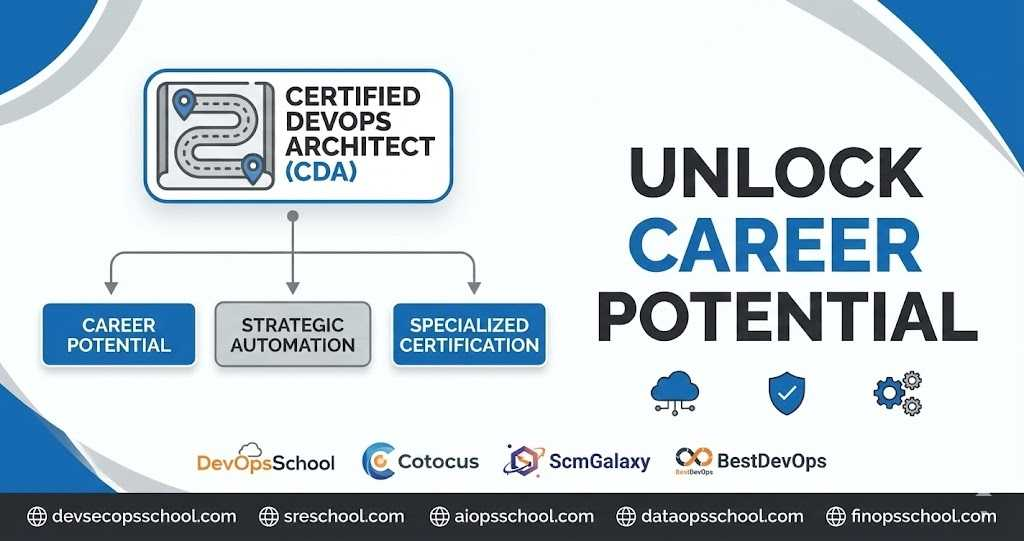
A Certified DevOps Architect is the master strategist of the software world. While others are focused on fixing a single line of code or managing a specific cloud server, the Architect is looking at the entire landscape. This professional designs the framework that allows code to flow from a developer’s laptop to a global user base without friction. It is a role that combines deep technical knowledge with the foresight to predict and prevent system failures before they happen.
The Strategic Power of Modern Automation
We are living in an era of “hyper-automation.” Companies are no longer satisfied with simple scripts; they need intelligent, self-healing systems that can scale up during a massive traffic spike and scale down to save costs. An Architect is the one who builds these intelligent highways. By earning a CDA, you prove that you understand how to use automation to drive business value, reduce waste, and increase the speed of innovation.
Why Specialized Certification is Your Best Career Hedge
Market volatility isn’t just for stocks; it happens in job markets too. When technologies shift, those with broad, unverified skills are often the most vulnerable. However, a certification like the CDA acts as a hedge against this volatility. It provides a globally recognized stamp of approval on your expertise. For engineers and managers alike, it is the most reliable way to signal to the market that you are ready for high-stakes, high-reward leadership roles.
The Architect’s Roadmap: Core Program Details
| Career Track | Complexity | Best For | Prerequisites | Key Mastery Areas | Typical Duration |
| Architectural Leadership | Elite | Senior Leads & Managers | Cloud & Linux Fundamentals | Design Patterns, Security, CI/CD Strategy | Strategic Mastery |
Why DevOpsSchool is the Ultimate Training Partner
If you are going to invest your time and money, you should do it where the returns are highest. DevOpsSchool is the premier choice because their training goes beyond the screen. They focus on the “architectural mindset.” While many platforms just show you how to click buttons in a dashboard, DevOpsSchool forces you to think about the “why.” Their mentors bring decades of real-world battle experience to the classroom, ensuring that when you finish the program, you don’t just have a certificate—you have the confidence to lead a multi-million dollar project.
An In-Depth Look at the CDA Certification
Defining the CDA Program
The CDA is a comprehensive journey into the heart of modern IT infrastructure. It covers the logic of microservices, the complexity of container orchestration, and the critical importance of secure delivery. It is designed to turn a senior technologist into a visionary who can lead an entire organization through a digital transformation.
Who is the Ideal Candidate?
- Software Engineers who want to move away from daily coding and into high-level system design.
- Platform Engineers who are ready to take ownership of the entire delivery ecosystem.
- IT Managers who need the technical depth to lead specialized DevOps and SRE teams.
Compounding Your Skillset
- Elite System Design: Learn to build architectures that are not just functional but “resilient.” This means they can withstand attacks, traffic surges, and hardware failures.
- Code-Driven Infrastructure: Master the art of managing your entire environment through code (IaC). This allows for perfect consistency across development, testing, and production.
- Advanced Security Pipelines: Integrate security protocols directly into the automation flow, ensuring that every piece of software is checked for vulnerabilities before it ever goes live.
- Observability and Feedback: Go beyond basic monitoring to “observability,” where you can understand the internal state of your system just by looking at the data it produces.
- Economic Infrastructure Management: Learn how to design systems that are not just technically sound, but also financially efficient, helping your company maximize its cloud budget.
Practical Application and Hands-on Projects
- Designing a Self-Healing Cloud Network: Build a system that automatically detects a server failure and replaces it in seconds without the user ever noticing.
- End-to-End DevSecOps Implementation: Create a pipeline for a financial application that includes automated security scanning and compliance reporting.
- Global Traffic Management: Setup a multi-region deployment that routes users to the nearest server to ensure lightning-fast performance.
- Legacy Modernization Strategy: Plan and execute the breaking down of a massive “monolith” application into agile, cloud-native microservices.
The Preparation Blueprint
- Phase 1 (Days 1-14): The Foundation. Focus on the “First Principles” of DevOps. Review your networking, security, and Linux basics. Understand the high-level goals of the CDA exam and identify your weakest areas.
- Phase 2 (Days 15-30): The Lab Phase. This is where you get your hands dirty. Set up complex environments on AWS or Azure. Practice using Terraform to build and destroy infrastructure. The goal here is “muscle memory.”
- Phase 3 (Days 31-60): The Optimization Phase. Start looking at the “edge cases.” What happens when a deployment fails? How do you roll back safely? Take mock exams and focus specifically on the scenario-based questions that test your decision-making.
Frequent Errors to Side-Step
- The “Tool-Only” Trap: Don’t just memorize Jenkins or Docker. Learn the architectural pattern that these tools fulfill. Tools change, but the need for CI/CD or containerization is permanent.
- Ignoring the Human Element: Architecture isn’t just about servers; it’s about how teams interact. If your design is too complex for your team to use, it will fail.
- Over-Engineering: Sometimes the simplest solution is the best. An Architect’s job is to find the most efficient path, not the most complicated one.
Career Progression Opportunities
- Vertical Growth: Principal Architect or Chief Architect.
- Lateral Growth: Specialized roles in MLOps, DataOps, or FinOps.
- Executive Growth: VP of Engineering or Chief Technology Officer (CTO).
Customizing Your Professional Path
- DevOps Excellence: The core path for those who want to be the ultimate authority on software delivery.
- Security Integration (DevSecOps): A high-demand path focusing on making software “secure by design.”
- Reliability and Performance (SRE): The perfect path for those who enjoy the challenge of making massive systems run perfectly 24/7.
- AI-Driven Operations (AIOps): Using machine learning to automate the management of IT systems—the future of the industry.
- Data Lifecycle Management (DataOps): Focusing on the speed and quality of data delivery for analytics and AI.
- Cloud Financial Governance (FinOps): Combining technical skill with financial strategy to manage the cost of the cloud.
Role-to-Certification Mapping for Success
- Senior DevOps Specialist: CDA + Advanced Kubernetes.
- Infrastructure Lead: CDA + Multi-Cloud Strategy.
- Release Manager: CDA + CI/CD Specialist.
- Cybersecurity Architect: DevSecOps + CDA.
- ML Infrastructure Engineer: MLOps + CDA.
- Head of Engineering: CDA + Strategic Leadership modules.
The Next Frontier: Post-CDA Learning
To stay at the top of the market in 2026 and beyond, consider:
- The Next Step: Serverless and Event-Driven Architecture.
- The Cross-Skill: MLOps for managing AI model deployments.
- The Leadership Move: Digital Transformation Strategy.
Trusted Institutions for Your Certification Journey
- DevOpsSchool: The industry leader in providing deep-dive, practical training that actually prepares you for the realities of being an Architect.
- Cotocus: Excellent for those who need focused, high-intensity training with a strong emphasis on enterprise-grade projects.
- ScmGalaxy: A massive resource hub that offers everything from community support to expert tutorials on every DevOps tool imaginable.
- BestDevOps: A great choice for streamlined, high-impact learning paths designed for busy professionals.
- devsecopsschool.com: The gold standard for learning how to integrate high-level security into your automation.
- sreschool.com: Specialized training for those who want to master the art of building “always-on” systems.
- aiopsschool.com: The place to learn how AI and Machine Learning are revolutionizing the way we manage IT infrastructure.
- dataopsschool.com: Dedicated to teaching the automation and management of high-speed data pipelines.
- finopsschool.com: Essential for learning the business and financial side of cloud management.
Your Questions Answered (FAQs)
Broad Career Questions
- Does this certification help with salary negotiations?
Yes, CDA holders are among the highest-paid professionals in the IT sector. - Is it better to get a Cloud cert or a CDA?
The CDA is often seen as “above” a cloud cert because it teaches you how to design the system, regardless of which cloud you use. - How much experience do I need?
Ideally, 3-5 years in a technical role will give you the best foundation. - Is there a lot of coding involved?
You will need to write scripts (Python/YAML), but you don’t need to be a full-stack developer. - What is the passing score?
It varies by provider, but usually, you need around 70-75%. - Can I take the training while working full-time?
Yes, most programs are designed with flexible hours for working professionals. - What are the most common job titles for CDA graduates?
DevOps Architect, Infrastructure Architect, and SRE Lead. - Does it cover automation of security?
Yes, that is a core part of the modern CDA curriculum. - How does this certification view Kubernetes?
It treats Kubernetes as a critical piece of the modern architectural puzzle. - Is the certification exam hard?
It is challenging because it tests your ability to solve problems, not just remember facts. - Will this help me move into management?
Absolutely. It provides the technical authority needed to lead teams. - Is it recognized in Europe and North America?
Yes, it is a global standard.
CDA-Focused FAQs
13. Why is the Architect level so important?
Because it represents the transition from “doing” to “designing.”
14. How do I start my preparation?
Begin by reviewing the official exam blueprint from DevOpsSchool.
15. Does the CDA cover Microservices?
Yes, designing for microservices is a major module.
16. How much does the training cost?
It’s an investment in your career; check the official site for current pricing.
17. Is there a community I can join? Y
es, ScmGalaxy has a very large and active community for CDA students.
18. Do I get a digital badge?
Yes, you can share your achievement directly on LinkedIn.
19. Does the CDA cover Terraform?
Yes, Infrastructure as Code is a fundamental part of the course.
20. What is the single biggest benefit?
The shift in your mindset from being a “worker” to being a “leader.”
Success Stories & Closing Thoughts
- Anjali R., Lead Cloud Architect: “The CDA didn’t just give me a new title; it gave me a seat at the table during board-level technical discussions.”
- David K., SRE Manager: “I’ve hired several CDA graduates from DevOpsSchool. Their ability to understand the ‘big picture’ is what makes them stand out.”
- Karthik S., DevOps Engineer: “I used the 60-day plan provided in the course. It was structured, intense, and exactly what I needed to pass the exam.”
- Monica T., DevSecOps Specialist: “Learning to architect with security as a priority changed my career path. I’m now a lead in my firm’s security division.”
- Suresh V., Engineering Manager: “This program is the best investment I’ve made for my team. Our deployment reliability has skyrocketed since we adopted these principles.”
Conclusion
The Certified DevOps Architect (CDA) is the “Blue Chip” of technical certifications. In a world where technology is the engine of every business, the person who can design that engine is the most valuable person in the room. By following this path, you aren’t just getting a certificate; you are building long-term career equity that will pay dividends for years to come.