Introduction
Machine learning models are being developed at a rapid pace by organizations across the globe. However, it is often found that these models stay confined to experimental environments and never reach the production stage. This gap is addressed by the field of MLOps. For those who wish to lead this transformation, the MLOps Certified Professional (MLOCP) is considered the gold standard.
Understanding the MLOps Certified Professional (MLOCP)
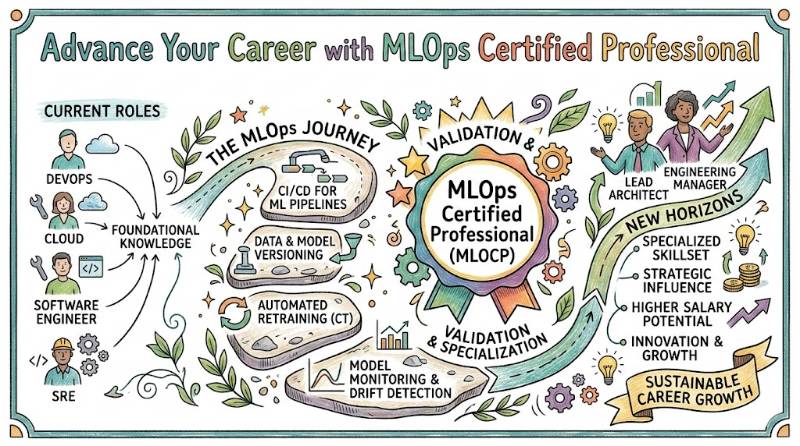
The MLOps Certified Professional (MLOCP) is a specialized training and certification track. It is designed to ensure that the principles of DevOps are applied to machine learning workflows. The entire lifecycle of a model—from data preparation and training to deployment and monitoring—is covered under this program. It is recognized as a bridge that connects the experimental world of data science with the stable world of software operations.
The Significance of MLOCP in the Current Ecosystem
In the modern world of cloud computing and automation, speed and reliability are highly valued. It is widely understood that manual processes for deploying models are prone to errors and do not scale. By adopting MLOps, businesses are enabled to release models faster and with higher quality. For engineers and architects, being certified in MLOCP means that the skills required to handle complex, AI-driven infrastructure are possessed.
The Value of Certification for Career Growth
Certifications are often viewed as a benchmark for professional excellence. For individual engineers, a structured path is provided so that no critical skills are missed. For engineering managers, a team of certified professionals ensures that industry best practices are followed. In competitive markets like India and the US, having a specialized certification like MLOCP is often the deciding factor for high-level roles and salary negotiations.
Certification Overview Table
| Track | Level | Who it’s for | Prerequisites | Skills Covered | Recommended Order |
| MLOps | Advanced | Software & DevOps Engineers | Basic Linux & Python | CI/CD for ML, Data Versioning, Monitoring | After Cloud Fundamentals |
Why Choose DevOpsSchool?
DevOpsSchool is frequently chosen by professionals because a very practical approach to learning is offered. The trainers are individuals who have spent decades in the industry solving real-world problems. The curriculum is not just theoretical; it is built around the actual challenges faced by modern tech companies. Furthermore, continuous support is provided to students even after the course is completed, ensuring that the knowledge is applied correctly in their jobs.
Certification Deep-Dive: MLOps Certified Professional (MLOCP)
What is this certification?
This certification is an intensive program where the focus is placed on the operationalization of machine learning. It is not just about writing code; it is about building systems that can handle data at scale and keep models running accurately over time.
Who should take this certification?
- DevOps Engineers: Those who want to move into the high-growth area of AI infrastructure.
- Data Engineers: Professionals who want to ensure that their data pipelines are integrated with model deployment.
- Site Reliability Engineers (SREs): Individuals who need to maintain the uptime and performance of machine learning services.
- Technical Leads: Managers who need to oversee the transition from traditional software to AI-powered applications.
Skills you will gain
- Automated ML Pipelines: The ability to build workflows that move code and data through training and testing automatically.
- Data and Model Versioning: Techniques to track changes in datasets and model files so that any version can be rolled back if needed.
- Continuous Training (CT): The setup of systems where models are automatically retrained as new data becomes available.
- Model Monitoring: The implementation of tools to detect “model drift,” where the accuracy of a model starts to drop over time.
- Infrastructure as Code (IaC): The use of tools to manage the servers and cloud resources required for machine learning.
Real-world projects you should be able to do
- End-to-End CI/CD for ML: A project where every change to a machine learning script triggers an automatic test and deployment.
- Drift Detection System: A system that sends alerts when the input data changes significantly, which could affect the model’s output.
- Scalable Model Serving: The deployment of a model using containers so that it can handle thousands of requests per second.
- Feature Store Implementation: The creation of a central place where data features are stored and reused across different models.
Preparation plan
7–14 days plan (The Foundation)
- The first week is spent on understanding the core philosophy of MLOps.
- Simple pipelines are built using basic automation tools.
- The official documentation for MLOCP is reviewed to understand the exam structure.
30 days plan (The Practical Phase)
- Focus is shifted toward containerization and cloud deployment.
- Hands-on labs are completed every day to master data versioning tools.
- Weekly mock tests are taken to identify areas where more study is needed.
60 days plan (The Mastery Phase)
- Complex, multi-stage pipelines are constructed from scratch.
- Advanced monitoring and security practices are integrated into the projects.
- Final revisions are done, and full-length practice exams are completed.
Common mistakes to avoid
- Neglecting Data Quality: It is often forgotten that bad data leads to bad models, regardless of how good the automation is.
- Ignoring Cost Management: ML infrastructure can be expensive; the financial side of operations should not be overlooked.
- Manual Interventions: The goal of MLOps is automation; relying on manual steps is a mistake that prevents scaling.
Best next certification after this
- Same track: MLOps Architect Expert.
- Cross-track: DevSecOps Professional (to secure the ML pipelines).
- Leadership: Engineering Management for AI Teams.
Choose Your Learning Path
- DevOps Path: This is suitable for those who love automation and want to manage the entire delivery process of software and ML.
- DevSecOps Path: This path is chosen by those who want to ensure that security is baked into every stage of the automated pipeline.
- Site Reliability Engineering (SRE) Path: This is for engineers who are passionate about system performance, scaling, and making sure services never go down.
- AIOps / MLOps Path: This is the most modern path, where AI is used to manage operations, and operations are used to manage AI.
- DataOps Path: This is the perfect choice for professionals who want to focus on the flow, quality, and governance of data within a company.
- FinOps Path: This path is designed for those who want to bridge the gap between engineering and finance by optimizing cloud costs.
Role → Recommended Certifications Mapping
- DevOps Engineer: MLOCP + Kubernetes Certification.
- Site Reliability Engineer (SRE): MLOCP + SRE Advanced Practitioner.
- Platform Engineer: MLOCP + Cloud Infrastructure Expert.
- Cloud Engineer: MLOCP + AWS/Azure/GCP Professional Architect.
- Security Engineer: DevSecOps Professional + MLOCP.
- Data Engineer: DataOps Professional + MLOCP.
- FinOps Practitioner: FinOps Certified + MLOCP.
- Engineering Manager: AI Strategy + MLOps for Leaders.
Next Certifications to Take
- For a Technical Learner:
- Same-track: Advanced Automation Specialist.
- Cross-track: DevSecOps Certified Professional.
- Leadership: Technical Team Lead Program.
- For a Management Learner:
- Same-track: Strategic AI Management.
- Cross-track: FinOps for Managers.
- Leadership: Director of Engineering Track.
Training & Certification Support Institutions
- DevOpsSchool: This institution is widely known for its career-focused training. A deep emphasis is placed on practical labs, and students are guided by mentors who have extensive field experience.
- Cotocus: Corporate teams are often trained here. The focus is on providing high-quality, up-to-date content that helps organizations adopt modern engineering practices quickly.
- ScmGalaxy: A massive repository of knowledge is found here. It is used by thousands of engineers to learn about configuration management and continuous integration through blogs and tutorials.
- BestDevOps: This platform is used to compare and identify the best practices in the industry. It serves as a guide for professionals who want to stay ahead of the curve.
- devsecopsschool.com: Security is the main priority at this school. Engineers are taught how to protect their pipelines and data from modern cyber threats.
- sreschool.com: The art of reliability is mastered here. The courses are designed to help engineers build systems that are both fast and incredibly stable.
- aiopsschool.com: The future of IT operations is explored here. Students are taught how to use machine learning to predict and solve infrastructure issues before they happen.
- dataopsschool.com: The management of data pipelines is the core focus. It is ensured that data is delivered with high quality and speed to the teams that need it.
- finopsschool.com: Financial accountability in the cloud is taught here. It is an essential destination for those who want to control and optimize cloud spending.
FAQs Section
General Career FAQs
- What is the difficulty of this program?
It is an intermediate to advanced program that requires a solid technical base. - How long does it take to get certified?
Most professionals complete the journey in 2 to 3 months. - What are the basic requirements?
A background in software engineering and basic coding skills are needed. - Is there a specific order of certifications?
Starting with DevOps and then moving to MLOps is generally recommended. - What is the market demand?
The demand is extremely high as more companies move their AI projects to production. - What roles can be applied for?
Roles such as MLOps Architect or Lead Automation Engineer are common. - Is the certification globally valid?
Yes, it is recognized by top tech firms around the world. - How is the exam conducted?
The exam is usually conducted online and consists of both theory and practical scenarios. - Are there renewal requirements?
Certifications are typically updated every few years to keep up with technology. - Can I transition from a non-tech role?
It is possible, but a foundational course in coding and Linux is advised first. - Are group discounts available? Corporate training programs often offer group rates for teams.
- What kind of salary increase can be expected?
Many professionals report a 30% to 50% increase after gaining these specialized skills.
MLOps (MLOCP) Specific FAQs
- Is deep learning knowledge required?
A basic understanding is helpful, but the focus is on the operations, not the math. - Which tools are taught in MLOCP?
Popular tools for orchestration, versioning, and monitoring are covered. - Does it cover multi-cloud environments?
Yes, the principles are designed to work across AWS, Azure, and GCP. - How much coding is involved?
Medium-level coding in Python is usually required for automation scripts. - Is Kubernetes a big part of the course?
Yes, container orchestration is a fundamental part of scaling ML models. - Will I learn about security in ML?
Basic security practices for data and model endpoints are included. - Is a project submission required?
Many training providers require a capstone project to be completed. - How does this differ from a Data Science course?
Data Science focuses on building models; MLOCP focuses on running them in production.
Testimonials
- Rohan: A much better understanding of automated pipelines was gained. The career path for moving into AI infrastructure is now very clear.
- Priya: The training at DevOpsSchool was very practical. The labs helped in understanding how to manage model drift in a real environment.
- Karthik: A huge boost in confidence was felt after completing the projects. The mentors were always there to help with technical doubts.
- Sana: The complex concepts were explained in very simple terms. This certification has helped in getting a promotion to a senior role.
- Deepak: As an SRE, the MLOps track was exactly what was needed to handle the new AI workloads in my company.
Conclusion
The MLOps Certified Professional (MLOCP) certification is more than just a credential; it is a gateway to the future of engineering. It is recognized that as AI continues to grow, the need for professionals who can manage these systems will only increase. Long-term career stability and growth are ensured for those who invest time in mastering these skills. A strategic approach to learning is recommended so that these modern challenges can be turned into career opportunities.