Introduction
Understanding the financial landscape of the tech industry is a critical step for anyone navigating a career in DevOps, Cloud, or Site Reliability Engineering (SRE). As businesses accelerate their digital transformation, the demand for professionals who can bridge the gap between development and operations remains consistently high, positioning these roles among the most lucrative in the IT sector.
The field has evolved rapidly, branching into specialized domains like Platform Engineering, DevSecOps, and FinOps. Because these roles are central to a company’s infrastructure and product delivery, compensation reflects the high stakes and specialized expertise required to maintain resilient, scalable systems.
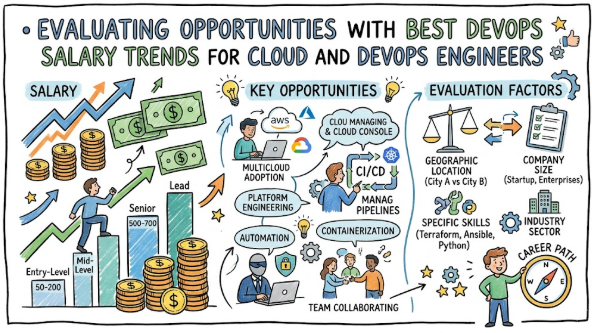
Salary figures are never static; they fluctuate based on a complex interplay of your geographic location, your specific technical stack, your years of hands-on experience, and the size or industry of your employer. This guide provides a comprehensive look at the DevOps compensation landscape to help you set realistic expectations and craft a strategy for professional growth.
What Does “DevOps Salary” Mean?
When discussing “DevOps salary,” it is essential to look beyond the base pay listed on a job offer. Total compensation in the modern tech market is a layered package. A competitive offer often includes several components that can significantly impact your annual take-home pay and long-term financial security.
- Base Salary: The fixed, guaranteed amount paid for your services, usually expressed as an annual figure.
- Performance Bonuses: Annual or quarterly payments tied to individual or company-wide performance targets.
- Equity/Stock Options: Common in startups and big tech, these provide a stake in the company’s growth.
- Sign-on Bonuses: A one-time payment offered to entice top-tier talent to join a firm.
- Retirement & Benefits: Contributions to 401(k) or pension schemes, health insurance coverage, and professional development budgets.
- Allowances: Stipends for remote work setups, travel, or continuous learning certifications.
DevOps Salary Overview
The global demand for DevOps proficiency has created a seller’s market. On average, professionals in this space command significantly higher salaries than standard IT support or traditional system administration roles. The compensation scale is broad, reflecting the massive difference between an entry-level professional learning the ropes and a Principal Engineer architecting global-scale cloud infrastructure.
- Premium on Expertise: Roles requiring specialized knowledge—such as Kubernetes orchestration or multi-cloud architecture—frequently command a 20–30% salary premium.
- Market Maturity: Mature markets like the USA and Australia generally offer higher nominal salaries, while emerging tech hubs in India and Eastern Europe are seeing the fastest percentage growth in pay.
- Role Inflation: Titles like “DevOps Engineer” are becoming increasingly commoditized; differentiation now comes from the ability to automate complex security or observability pipelines.
Table 1 – DevOps Salary by Experience Level
| Experience Level | Average Base Salary | Range | Typical Responsibilities |
| Entry-Level / Junior | $85k – $105k | $70k – $120k | CI/CD maintenance, basic scripting, monitoring support |
| Mid-Level DevOps | $120k – $150k | $110k – $170k | Cloud architecture, automation, incident response |
| Senior DevOps | $160k – $190k | $150k – $210k | System scaling, multi-cloud strategy, team mentoring |
| Lead / Principal | $200k – $250k+ | $190k – $300k+ | Tech stack decisions, high-level design, strategy |
| SRE / Platform Lead | $180k – $240k | $170k – $280k | Reliability engineering, SLIs/SLOs, platform tooling |
Factors That Influence DevOps Salary
Your compensation is rarely tied to a single metric. Instead, it is the result of a “skill-experience-demand” equation. Understanding these factors allows you to pivot your career path toward high-value areas.
- Geographic Region: Cost of living and local talent supply dictate base ranges. A professional in Silicon Valley faces a different cost-of-living index than one in Bangalore or Berlin.
- Company Size & Industry: Large enterprises often offer stability and benefits, while fintech and high-growth SaaS startups typically offer higher base salaries and aggressive equity packages.
- Cloud Proficiency: Expertise in AWS, Azure, or Google Cloud Platform (GCP) is the baseline. Multi-cloud architecture skills are highly valued and lead to higher pay.
- Containerization & Orchestration: Skills in Kubernetes (K8s) and Docker remain the most sought-after competencies, directly impacting your leverage in salary negotiations.
- Infrastructure as Code (IaC): Mastery of Terraform, Ansible, or Pulumi shows you can automate processes rather than just perform them manually.
- DevSecOps & Security: Integrating security into the pipeline is a high-demand skill that commands a significant pay premium.
- Observability: Knowledge of tools like Prometheus, Grafana, and Datadog demonstrates your ability to troubleshoot production issues—a skill critical to high-salary SRE roles.
Regional Salary Comparisons
DevOps pay varies drastically across the globe due to economic disparities and local market saturation. While remote work is blurring these lines, many companies still adjust compensation based on the local market rate.
- USA: Continues to lead with the highest salary brackets, driven by a massive concentration of tech giants and startups.
- Europe (UK, Germany, Netherlands): Salaries are generally lower than in the US but are balanced by better social safety nets and a high demand for privacy-focused infrastructure talent.
- India: The fastest-growing market. While base salaries are lower in USD terms, high-end specialized DevOps talent in major cities now commands competitive global-standard compensation.
- Australia: Offers strong salary ranges for DevOps engineers, driven by a shortage of skilled infrastructure talent.
Table 2 – DevOps Salary Comparison by Region
| Region | Average Salary | Cost of Living Adj. | Key Demand Skills |
| USA | $160,000 | High | AWS, K8s, Python, DevSecOps |
| Canada | $120,000 | Medium | Azure, Terraform, CI/CD |
| UK | £75,000 | Medium/High | GCP, Ansible, Observability |
| India | ₹25,00,000 | Low | AWS, Jenkins, Docker |
| Australia | $145,000 | High | Cloud Automation, Security |
Step-by-Step Guide to Increase Your DevOps Salary
To climb the salary ladder, you must move from “operator” to “architect.”
- Master the Fundamentals: Build a rock-solid foundation in Linux, Bash/Python scripting, and Git.
- Focus on Cloud: Obtain professional-level certifications from AWS, Azure, or GCP.
- Specialize in K8s: Kubernetes is the industry standard. Earning a CKA (Certified Kubernetes Administrator) is a proven way to boost your market value.
- Adopt IaC: Shift from manual clicks to Infrastructure as Code. If you aren’t using Terraform, start today.
- Build a Portfolio: Contribute to open-source projects or build a complex, multi-tier application architecture on GitHub to demonstrate real-world competence.
- Learn Observability: Learn how to monitor and alert on system health effectively.
- Ace the Interview: System design interviews are where high-salary offers are won. Practice how to architect a scalable, secure system from scratch.
- Negotiate with Data: Use platforms like Levels.fyi or local salary surveys to provide evidence of your market value during negotiations.
Skills That Maximize DevOps Salary
- Cloud-Native Architecture: Designing for high availability and serverless environments.
- Advanced Terraform/Ansible: Writing reusable, modular automation code.
- DevSecOps: Managing secrets, vulnerability scanning, and compliance-as-code.
- SRE Principles: Implementing Error Budgets, SLIs, and SLOs.
- Soft Skills: Mentoring juniors and communicating technical trade-offs to business stakeholders.
Real-World Salary Growth Scenarios
- The Graduate: Starts at $85k with basic Linux and CI/CD skills. After 2 years, by learning Terraform and AWS, they jump to $120k by moving to a mid-market company.
- The Cloud Migrator: A traditional admin earning $90k transitions to Cloud Engineering. After acquiring GCP certifications and 3 years of hands-on experience, they command $155k in a senior role.
- The Principal Specialist: A senior engineer specializing in Kubernetes and DevSecOps architecture can transition into a Lead role, seeing total compensation jump to $230k+ through base increases and stock grants.
Common Mistakes to Avoid
- The “Certificate Collector” Trap: Earning five certifications but having zero experience in building or deploying real systems.
- Neglecting Soft Skills: Refusing to document your work or communicate with developers, which stalls your promotion potential.
- Ignoring Negotiation: Accepting the first offer without researching market rates for your specific tech stack.
- Static Skillset: Relying on tools that are falling out of favor rather than learning the next generation of cloud-native technologies.
FAQs
1. What is the average DevOps salary worldwide?
While it varies significantly, the global average ranges between $90,000 and $150,000 depending on region, experience, and the specific cloud-native stack involved.
2. How much do entry-level DevOps engineers earn?
Entry-level professionals typically start between $70,000 and $105,000, depending on the tech hub and company size.
3. Does DevOps salary vary by country?
Yes, significantly. Salary ranges are highly dependent on the local demand for tech talent and the cost of living index in that specific country.
4. Which skills increase DevOps pay the most?
Kubernetes, multi-cloud management, advanced Terraform automation, and DevSecOps (security-as-code) are currently the highest-paying skills.
5. Do certifications improve salary?
Certifications prove a baseline knowledge and can help you pass resume filters, but they provide the biggest salary boost when combined with proven hands-on experience.
6. What is the difference in salary between DevOps and SRE?
SRE roles often pay slightly more than general DevOps roles because they focus on high-scale reliability and system architecture, which is critical for large enterprise revenue.
7. Is cloud expertise necessary to earn more?
Absolutely. Cloud expertise is the foundation of modern DevOps. Without it, you are effectively limited to lower-tier, legacy infrastructure roles.
8. Can I earn more as a DevOps engineer without a degree?
Yes. In the DevOps field, your portfolio, hands-on projects, and ability to solve system-design problems are often valued more than formal academic credentials.
9. What is the salary trend for DevOps in 2026?
The trend is shifting toward “specialist” DevOps—roles that require deep knowledge of security (DevSecOps) and cost-optimization (FinOps) are seeing the largest salary spikes.
10. Do DevSecOps skills increase pay?
Yes. Companies are willing to pay a premium for engineers who can automate security within the CI/CD pipeline, as it reduces the risk of expensive security breaches.
Conclusion
The DevOps career path remains one of the most rewarding trajectories in technology. By focusing on deep-stack proficiency, continuous learning, and mastering the tools that drive infrastructure efficiency, you can position yourself for significant salary growth. Remember that salary is a reflection of the value you bring to the business—whether that is by increasing deployment frequency, ensuring 99.99% system uptime, or securing a global cloud architecture.