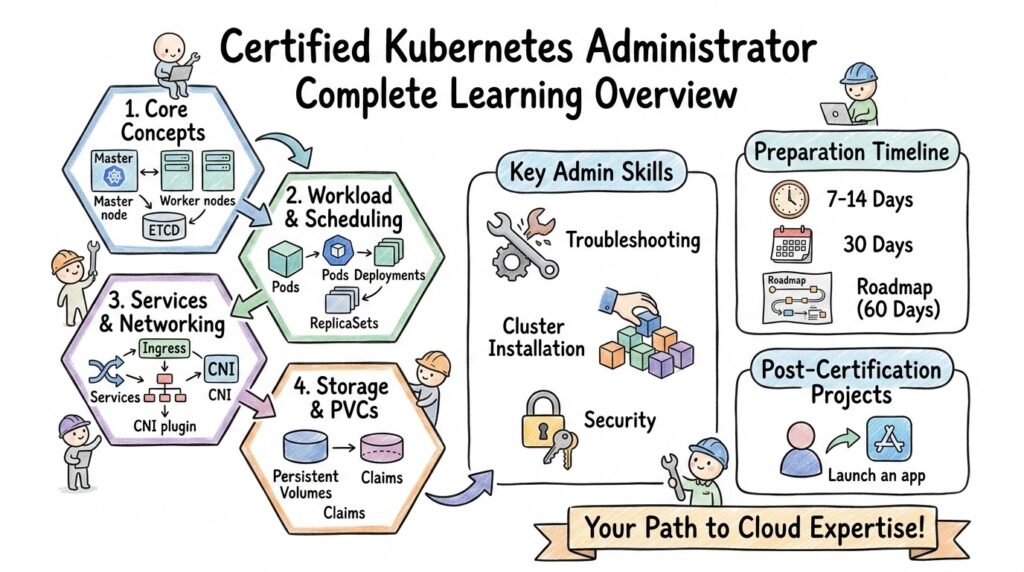
Introduction
The Certified Kubernetes Administrator (CKA) is an official program that proves a person knows how to manage Kubernetes effectively. It is created by the Cloud Native Computing Foundation to set a global standard for cloud professionals. This is not a typical exam with multiple-choice questions. Instead, it is a practical test where tasks must be solved on a real computer system. It shows that you have the hands-on skills to keep a system running in a real-world company environment.
Why it matters in today’s software, cloud, and automation ecosystem
In the world of technology today, almost everything runs in the cloud. Kubernetes acts as the “brain” that manages how software applications are launched and kept alive across hundreds of servers. Because so many companies are using this tool, they need experts who truly understand how to use it without making mistakes. Being a CKA means you are ready to handle the complex parts of modern cloud systems and ensure that websites stay online even when things go wrong.
Why certifications are important for engineers and managers
For an engineer, a certification provides a clear and organized path to learn new things. It acts as a roadmap so you don’t get lost in too much information. It is a way to prove to yourself and others that you have mastered a difficult skill through hard work. For a manager, these certifications make the hiring process much safer. It gives them confidence that the person they are hiring actually knows how to do the work and won’t need constant supervision. In a crowded job market, it helps everyone stay on the same page about what skills are needed for success.
Certification Overview Table
| Track | Level | Who it’s for | Prerequisites | Skills Covered | Recommended Order |
| Admin | Professional | Engineers & Admins | Basic Linux | Setup & Troubleshooting | Start with CKA |
Provider: DevOpsSchool
Why Choose DevOpsSchool?
DevOpsSchool is chosen by many students because they focus on real-world learning rather than just reading books. The lessons are taught by people who use these tools every day in their own professional jobs. The training is kept very simple and easy to follow, even for those who are new to the field. Students are given access to practice labs that feel just like a real work environment at a big tech company. This hands-on approach helps the learning stay in your mind much longer because you are actually doing the work yourself.
Certification Deep-Dive: CKA
What is this certification?
This is a performance-based exam that tests your ability to install, configure, and manage Kubernetes clusters. It focuses on the day-to-day tasks of a system administrator, making it one of the most respected credentials in the cloud industry.
Who should take this certification?
This program is perfect for people who look after servers and networks and want to modernize their skills. Software engineers who want to understand how their code is actually hosted will also find this very useful. It is also the best starting point for anyone looking to move into high-paying roles like DevOps or Site Reliability Engineering (SRE).
Skills you will gain
You will learn the art of setting up a cluster from the very beginning using professional tools. This includes understanding how different parts of the system talk to each other. You will also learn the vital skill of fixing problems when things stop working, which is a common task in real jobs.
Additionally, the course covers managing how data is stored in the system so that information is never lost. You will also master the security side by creating secure ways for users to log in and limiting what they can do within the system.
Real-world projects you should be able to do after this certification
After passing, you will be able to build a stable environment for a company’s website that can handle thousands of visitors. You will be capable of setting up automatic backups so that even if a server fails, the data remains safe. You can also lead projects that move applications from old, slow servers to modern, fast containers. Finally, you will be the expert who can troubleshoot why a service is running slowly and fix it quickly to keep customers happy.
Preparation Plan
7–14 Days Plan
This is an intensive practice period meant for those who already have some experience. You should spend several hours every day doing nothing but lab exercises. The goal is to learn the most common commands by heart so you can work quickly during the actual exam without searching for help.
30 Days Plan
This is a balanced approach for most working professionals. You spend the first two weeks reading and watching videos to understand how the system works. The last two weeks are dedicated entirely to practicing every task on a live system until you feel completely comfortable.
60 Days Plan
This plan is for total beginners who want deep mastery. You take your time in the first month to learn about Linux and how containers work. In the second month, you practice every single topic in the exam guide over and over again until the commands feel like second nature.
Common mistakes to avoid
One common mistake is wasting too much time on a single hard question. If you get stuck, it is better to move on and come back later. Another mistake is typing out every single word. You should use shortcuts and aliases so you can work faster. Also, never forget the documentation. You are allowed to use the official Kubernetes website during the test, so you must know exactly where the examples are located.
Best next certification after this
Once you master administration, the next step is often the Certified Kubernetes Security Specialist (CKS) to learn how to defend your cluster. You might also look at the Terraform Associate certification to learn how to build cloud servers automatically. For those who want to lead teams, the DevOps Leader certification is a great choice.
Choose Your Learning Path
DevOps
This path is for those who like to automate work and save time. It is about making the journey from writing code to launching it as smooth as possible using tools that work alongside Kubernetes.
DevSecOps
This path is for people who care about safety and protection. It is about making sure every part of the system is locked down and safe from hackers or internal threats.
Site Reliability Engineering (SRE)
This is for those who love to keep things running perfectly. The focus is on using data to make sure the system is always fast, healthy, and never crashes for the users.
AIOps / MLOps
This is a path for the future of technology. It is about using the power of Kubernetes to run smart software and Artificial Intelligence models at a very large scale.
DataOps
This path is for people who work with lots of information and databases. It is about managing data pipelines so they never get stuck and always provide accurate information.
FinOps
This is about managing the money and the budget. You learn how to run a very powerful system while making sure the company does not spend more money on the cloud than is necessary.
Role → Recommended Certifications Mapping
For a DevOps Engineer, the best path is combining the CKA with certifications in CI/CD tools.
A Site Reliability Engineer (SRE) should focus on the CKA along with professional monitoring tools like Prometheus.
A Platform Engineer needs the CKA plus a deep understanding of Cloud Architecture.
Cloud Engineers usually combine the CKA with a certification from a provider like AWS or Azure.
Security Engineers always follow the CKA with the CKS.
Data Engineers find value in combining Kubernetes with Big Data tools.
FinOps Practitioners use the CKA to understand resource costs, and Engineering Managers use it to provide better technical leadership to their teams.
Next Certifications to Take
If you are a technical learner, your next step should be the CKS to master security. You could also take the Terraform Certification to learn about infrastructure. For those interested in management, the Agile Service Management course is a great addition.
If you are a career builder looking for a promotion, consider a Cloud Provider Professional cert or becoming a Google Cloud Engineer. The DevOps Leader (DOL) certification is also highly recommended for moving into a senior role.
Training & Certification Support Institutions
DevOpsSchool
This is a very popular choice for people who want hands-on training. They provide a lot of personal support and help you understand the core concepts in a very simple way that is easy to remember.
Cotocus
This institution focuses on helping professionals move from traditional IT roles into the world of cloud technology. They offer great guidance for those who feel a bit overwhelmed by new tools.
ScmGalaxy
This is a great community where you can find thousands of free tutorials. It is a very helpful place to find answers when you encounter a specific problem during your study.
BestDevOps
They offer very focused bootcamps that help you learn a specific skill, like Kubernetes, in a very short amount of time. Their labs are designed to be very simple and effective.
devsecopsschool.com
This is a dedicated site for learning how to keep your cloud systems safe. They focus entirely on the security side of the DevOps world.
sreschool.com
A specialized school for those who want to learn how to keep systems reliable. They teach you how to measure system health and fix issues before they become big problems.
aiopsschool.com
This site is perfect for learning how Artificial Intelligence can be used to manage computer systems more efficiently in the modern world.
dataopsschool.com
A great place for data professionals to learn how to use Kubernetes to manage their data projects and large databases.
finopsschool.com
This school teaches you the financial side of the cloud. You will learn how to look at a cloud bill and find ways to save your company a lot of money.
FAQs Section
- Is the CKA exam hard for beginners?
It can be a challenge because it is practical, but if you practice every day, it is definitely something you can pass. - How much time should I set aside?
Most working professionals find that two months of steady study is the perfect amount of time. - Do I need a computer degree?
No, you do not need a degree, but knowing how to use a Linux terminal is very important for the exam. - In what order should I take the tests?
Most people start with the CKA because it gives you the strongest foundation for everything else. - Will this help me get a better salary?
Yes, the CKA is one of the most respected certifications and often leads to much better job offers. - Can I use notes during the exam?
You cannot use personal notes, but you can open one extra tab to look at the official Kubernetes documentation. - What kind of jobs will I be qualified for?
You will be ready for roles like Cloud Engineer, DevOps Specialist, and System Administrator. - How long does the certificate last?
Your certification will be valid for three years, after which you can take a shorter exam to renew it. - What score do I need to get?
You need to successfully complete enough tasks to get a score of at least 66%. - Is this certification popular in India?
Yes, almost all the big technology companies in India look for CKA-certified engineers. - What if I don’t pass the first time?
Don’t worry, most exam vouchers come with one free retake so you can try again. - Is it a written or typing test?
It is a typing test where you enter commands into a computer to fix or set up systems.
CKA Specific FAQs
13. How much time do I have?
You are given exactly two hours to complete all the tasks in the exam.
14. What is the main focus?
The main focus is on being able to manage, fix, and set up Kubernetes clusters correctly.
15. How important is Kubeadm?
It is very important because it is the main tool used to build the system during the test.
16. Is the networking section difficult?
It is one of the more complex parts, so it is a good idea to practice it more than other topics.
17. Do I need to be a professional coder?
You do not need to write software code, but you must be comfortable typing commands into a black screen. 18. Will I have to do a backup?
Yes, learning how to save and restore the system’s main database is a very common task in the exam.
19. Can I take the exam from my bedroom?
Yes, you can take it from home as long as the room is quiet and your desk is clear of any papers.
20. What happens if my internet breaks?
The people watching the exam will try to help you reconnect so you don’t lose your progress.
Testimonials
- Amit: “The training at DevOpsSchool was so simple. I used to be afraid of the command line, but now I handle large clusters every day with total confidence.”
- Sonal: “I finally got the job I wanted in a big tech firm. The practical skills I learned during my CKA prep were exactly what the interviewers wanted to see.”
- Rohan: “The labs were the best part of my journey. I felt like I was working on a real company project, which made the actual exam feel much less scary.”
- Priya: “I understand how my company’s cloud works so much better now. I can find and fix problems in minutes that used to take my whole team hours.”
- Karan: “Being a Certified Kubernetes Administrator gave me a lot of respect at my workplace. I feel like a true expert in my field now.”
Conclusion
The Certified Kubernetes Administrator (CKA) certification is a fantastic way to build a strong and lasting career in technology. It proves that you have the real, practical skills that companies are looking for right now. By taking it one step at a time and practicing on a computer every day, anyone can master this tool. It is a rewarding journey that leads to better job security, higher pay, and a very bright future in the cloud.