Introduction
Imagine waking up on the first of the month to find your bank balance significantly lower than expected. You haven’t made any large purchases, yet the money has vanished. This is the reality for millions of people today. We have transitioned from an economy of ownership to an economy of access. While streaming services, app memberships, and cloud storage offer convenience, they have introduced a subtle financial leak that quietly erodes your net worth.
Why subscription spending is the new budget problem lies in its “set it and forget it” nature. When payments are automated, they stop feeling like real money. A $9.99 charge here and a $14.99 fee there may seem trivial, but compounded over twelve months, these “micro-expenses” can add up to hundreds or even thousands of dollars. This guide is for anyone who feels like their paycheck disappears too quickly. By understanding the psychology behind recurring payments and applying rigorous tracking, you can shift from passive consumerism to proactive financial management. Mastering your subscriptions is not about depriving yourself; it is about ensuring your money goes toward things that actually bring value to your life.
What Is Subscription Spending?
Subscription spending refers to recurring payments made at regular intervals (monthly, quarterly, or annually) for access to products, services, or content. Unlike traditional budgeting where you actively choose to spend money at the point of sale, subscription models rely on “autopay.” This disconnects the act of paying from the act of consuming, often leading to “zombie subscriptions”—services you pay for but rarely or never use.
Why This Topic Matters
This topic is critical because subscription models are designed to maximize retention, not necessarily user satisfaction. Without intentional monitoring, your budget becomes a collection of automated leaks. Understanding this helps you:
- Identify unnecessary expenses.
- Allocate capital toward high-yield savings or investments.
- Prevent lifestyle inflation.
Practical Example: If you have four streaming services you rarely watch, you are effectively paying a “convenience tax” of potentially $500 per year for content you don’t consume.
Detailed Breakdown
Budgeting is the bedrock of personal finance. To manage subscriptions effectively, you must categorize your expenses into:
- Fixed Needs: Necessary utilities, rent, or insurance.
- Variable Wants: Entertainment, specialized apps, and premium memberships.
Managing these requires a shift in mindset. You are the CEO of your household finances; subscriptions are your “vendor contracts.” If a vendor (service provider) isn’t providing a return on investment, the contract should be terminated.
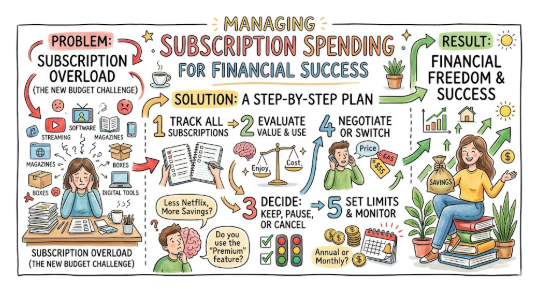
Step-by-Step Practical Guide
- Consolidate: Gather all bank and credit card statements from the last three months.
- Inventory: Create a list of every active subscription, including their cost and billing cycle.
- Evaluate: For each, ask: “If I had to sign up for this today, would I?”
- Prioritize: Keep the ones you use daily. Cancel the “maybe” ones.
- Unsubscribe: Use official cancellation methods. Do not just delete the app.
- Review: Set a recurring calendar reminder to audit these expenses every three months.
Practical Real-Life Examples
- Situation: You signed up for a free trial of a fitness app but forgot to cancel.
- Mistake: Ignoring the “subscription renewal” email.
- Better Action: Set a reminder on your phone the day before the trial ends.
- Situation: Multiple family members pay for the same cloud storage tier separately.
- Mistake: Lack of communication.
- Better Action: Switch to a single “Family Plan” to reduce total costs.
- Situation: Paying for premium news sites you never read.
- Mistake: Keeping the subscription for “prestige.”
- Better Action: Cancel and use free alternatives.
- Situation: Maintaining an annual subscription that costs more than monthly usage.
- Mistake: Assuming annual is always cheaper.
- Better Action: Calculate usage frequency; if you use it twice a year, pay-per-use is cheaper.
- Situation: Forgotten subscriptions after moving or changing devices.
- Mistake: Thinking closing an account deletes the subscription.
- Better Action: Check your App Store or Play Store “Subscriptions” menu.
Common Problems Readers Face
- The “Convenience Trap”: Thinking that because it’s only $5, it doesn’t matter.
- Emotional Decision-Making: Keeping subscriptions because of a fear of missing out (FOMO).
- Lack of Visibility: Failing to monitor bank statements, leading to hidden fee accumulation.
Mistakes to Avoid
- Don’t Do This: Letting free trials roll over into paid subscriptions without evaluation.
- Don’t Do This: Linking too many accounts to a single credit card, making auditing difficult.
- Don’t Do This: Ignoring price hikes on long-term subscriptions.
Subscription Impact: A Comparative Overview
| Feature | Passive Subscription Approach | Active Financial Management |
| Tracking | None; automated payments | Quarterly audit of all charges |
| Budget Impact | High (leaks) | Low (optimized) |
| Decision Logic | Emotional/Convenience | Value-based/Necessity |
| Account Health | Declining due to hidden fees | Stable and growing |
Tools, Methods, or Frameworks
- The “Audit Sheet”: A simple spreadsheet tracking Subscription Name, Monthly Cost, and Last Used Date.
- The 24-Hour Rule: Before signing up for a new subscription, wait 24 hours to see if you still feel the need for it.
Expert Tips
- Use virtual credit cards for trials.
- Check your phone’s “Subscriptions” settings directly.
- Opt for ad-supported tiers if you don’t mind occasional interruptions.
- Rotate streaming services monthly rather than keeping all active.
- Negotiate long-term subscriptions for discounts.
- Check for “bundled” services (e.g., phone plan including streaming).
- Look for student or military discounts.
- Set up email alerts for upcoming charges.
- Delete unused accounts immediately after canceling.
- Prioritize debt repayment over luxury subscriptions.
Case Studies
- Case 1: A student paying for three music services. They audited their spending, consolidated to one, and saved $240/year, which was then directed into a high-yield savings account.
- Case 2: A professional with $100+ in monthly “ghost subscriptions.” By cancelling, they saved $1,200 annually, effectively giving themselves a small raise.
- Case 3: A family that switched to shared plans for cloud storage and entertainment, reducing their monthly digital overhead by 40%.
Risk Awareness
The primary risk here is financial slippage. While subscriptions aren’t “high-risk” investments, they contribute to the “death by a thousand cuts” phenomenon. Always ensure your payment methods are secure, and never share login credentials with unverified third parties to “save” on costs.
Checklist Before Taking Action
- Verify the last six months of bank statements.
- Categorize subscriptions into “Necessary” and “Discretionary.”
- Cancel services that haven’t been used in 30 days.
- Check for annual vs. monthly billing options for items you must keep.
- Remove saved payment methods from apps you no longer use.
Key Terms Explained
- Subscription Creep: The gradual increase in monthly costs due to forgotten or unnecessary subscriptions.
- Autopay: A feature where payments are deducted automatically.
- Retention Marketing: Strategies used by companies to keep you subscribed.
- Zombie Subscription: A service you are paying for but haven’t used in months.
- Tiered Pricing: Different subscription levels offered by a service.
Frequently Asked Questions
- Why subscription spending is the new budget problem for my family?
It creates a “hidden” outflow of cash that bypasses your conscious spending decisions, making it harder to track true disposable income. - How often should I audit my subscriptions?
Ideally, conduct a review every 90 days to ensure you are still getting value for your money. - Is it better to pay annually or monthly?
If you are certain you will use the service for the full year, annual is often cheaper; otherwise, monthly offers more flexibility. - How do I stop free trials from becoming paid subscriptions?
Set an alarm for 24 hours before the trial ends or use a prepaid card with no funds. - Does cancelling a subscription affect my credit score?
No, cancelling a subscription does not impact your credit score. - What is the best way to track my recurring expenses?
A simple Excel sheet or a dedicated personal finance app works best for visibility. - Why subscription spending is the new budget problem for students?
Students often have limited income, and multiple small subscriptions can consume a significant portion of their monthly budget. - Can I negotiate a subscription price?
Sometimes, especially with internet, cable, or premium software services; call support and ask for a retention offer. - What if I forget to cancel?
Contact customer support immediately; they may issue a refund for the current month if you have not used the service. - How can I identify hidden subscriptions?
Check your linked accounts in the App Store/Google Play settings and look at your bank’s recurring payment history. - Are bundled subscriptions worth it?
They can be, but only if you actually use all the components of the bundle. - Should I use a separate bank account for subscriptions?
Yes, this is a great way to isolate “fun” spending from your essential living expenses.
Conclusion
Subscription services have revolutionized convenience, but they have also created a financial blind spot. By recognizing that subscription spending is the new budget problem, you are already ahead of the curve. Your next step is to perform a comprehensive audit today—not tomorrow. Take control of your automated payments, align your spending with your actual priorities, and watch how quickly your savings rate improves when you plug those small, silent leaks. Remember, financial freedom is built on the accumulation of many small, intentional choices.