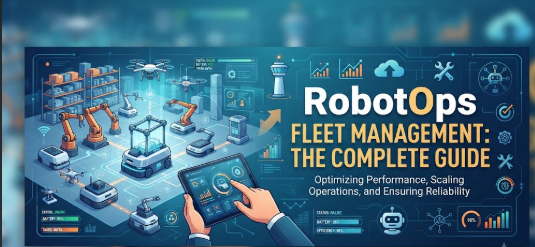
In the early stages of a robotics project, engineers focus heavily on the physical machine. They build the chassis, mount the sensors, wire the actuators, and write low-level control loops. A single robot working in a controlled laboratory environment is an achievement.
However, transitioning that single machine into a fleet of hundreds deployed across commercial warehouses, manufacturing plants, or healthcare facilities changes the entire operational paradigm.
Hardware is only half the equation. The real challenge lies in keeping those machines running reliably, updating their software without physical intervention, monitoring their health in real-time, and recovering gracefully when things fail. This is where RobotOps—the discipline of applying modern software engineering, DevOps, automation, and observability to robotic systems—becomes critical.
What is RobotOps?
RobotOps is an emerging framework that bridges the gap between traditional software deployment and physical robotics. Just as DevOps revolutionized how web applications and cloud infrastructure are deployed, monitored, and scaled, RobotOps brings similar rigor to the physical world.
A modern robotic system is a distributed computer network on wheels or legs. It includes:
- Embedded software and middleware (such as ROS 2) managing internal communication.
- Perception systems processing high-throughput sensor data from LiDAR, cameras, and depth sensors.
- Navigation stacks handling localization, mapping, and path planning.
- Cloud and edge systems orchestrating tasks and storing diagnostic telemetry.
Operating these components at scale requires moving away from manual, physical intervention toward centralized, automated infrastructure management.
Core Pillars of Robotics Operations
Successful Robotics Operations span the entire operational lifecycle, from the moment code is written to the day hardware is retired. Key operational areas include:
1. Deployment and Provisioning
Setting up a new robot involves flashing firmware, installing operating system images, configuring local network security certificates, and loading the correct software stack. Automating this provisioning process ensures consistency across every unit entering the fleet.
2. Configuration and Software Updates
Robots require continuous software improvements. Pushing an update to a fleet of Autonomous Mobile Robots (AMRs) running on a factory floor cannot be done manually via USB drives. Safe over-the-air (OTA) updates require staged rollouts, canary testing on subset fleets, and automated rollback strategies if a software regression occurs.
3. Monitoring and Telemetry
A robot generates massive amounts of telemetry data—battery voltage, CPU utilization, motor temperatures, wheel slip, and localization confidence scores. Collecting, streaming, and aggregating this data into a centralized dashboard allows operations teams to spot degraded hardware or network bottlenecks before they cause costly downtime.
Scaling Up: Robot Fleet Management
Managing a single robot requires troubleshooting right beside the machine. Managing a fleet of 500 robots requires treating them as an asynchronous, distributed system.
Effective Robot Fleet Management focuses on coordination, resource allocation, and continuous health tracking:
- Task Distribution: Assigning jobs efficiently based on robot battery levels, current location, and proximity to the task.
- Traffic Control: Preventing deadlocks and collisions in narrow warehouse aisles where multiple Autonomous Mobile Robots operate concurrently.
- Health and Battery Management: Automatically routing robots to charging stations before power critical thresholds are reached, and flagging abnormal battery degradation patterns.
When an incident occurs—such as a robot getting stuck or suffering a sensor failure—the fleet management system must isolate the affected unit, notify operators, and safely reroute surrounding traffic.
The Role of ROS 2 in Modern Robotics Software
At the heart of many modern robotic architectures is ROS 2 (Robot Operating System 2). Unlike its predecessor, ROS 2 was designed from the ground up for production environments, real-time control, and distributed systems.
ROS 2 relies on a Data Distribution Service (DDS) middleware layer, allowing Robotics Software nodes to communicate securely and reliably across networks without a centralized master node. Key concepts include:
- Nodes: Modular executable processes performing specific tasks (e.g., image processing or motor control).
- Topics: Asynchronous publish-subscribe communication channels for streaming sensor data or status updates.
- Services and Actions: Synchronous request-response and long-running goal-oriented communication patterns for command execution.
Integrating ROS 2 into a RobotOps pipeline enables engineers to inspect node graphs, monitor topic health, and trace communication latency across distributed fleets.
Robot Simulation: Testing Before Reality
Physical testing is expensive, time-consuming, and carries the risk of hardware damage. This makes Robot Simulation an indispensable part of the RobotOps workflow.
Virtual environments allow development teams to test navigation algorithms, sensor failure conditions, and multi-robot coordination scenarios in software before deploying code to physical hardware.
Why Simulation Matters:
- Edge Case Testing: Simulating rare obstacle configurations or network drops that are difficult to reproduce physically.
- CI/CD Integration: Automatically running regression tests on navigation and perception code whenever developers push changes to the repository.
The Reality Gap:
While powerful, simulation cannot completely replace physical testing. Simulated physics engines, friction coefficients, and lighting conditions rarely match the messy reality of a dynamic warehouse floor. A robust testing pipeline uses simulation for rapid iteration, followed by controlled staging on physical hardware.
Industrial Robotics and Autonomous Mobile Robots
While software principles remain consistent, operational priorities shift depending on the form factor and deployment environment:
- Industrial Robotics: Fixed robotic arms, welding cells, and automated inspection units operate in structured factory environments. The primary operational focus here is maximizing uptime, preventing mechanical wear-and-tear, executing precise cycle times, and maintaining strict safety interlocks.
- Autonomous Mobile Robots (AMRs): Mobile units operating in dynamic warehouses, hospitals, and fulfillment centers must continuously adapt to moving human workers, changing layouts, and unpredictable obstacles.
In both domains, centralized visibility through a Robotics Operations Center is vital for tracking overall productivity, monitoring error logs, and coordinating human intervention when automated recovery fails.
Common RobotOps Mistakes to Avoid
As organizations scale their automation efforts, certain operational missteps frequently appear:
- Treating Robots Solely as Hardware: Ignoring software version control, automated testing, and configuration management until deployment day.
- Flying Blind on Telemetry: Failing to collect essential health metrics, making it impossible to diagnose intermittent navigation failures or hardware degradation.
- Unchecked Software Rollouts: Pushing updates to an entire fleet simultaneously without staging or automated rollback mechanisms.
- Neglecting Network Reliability: Assuming factory Wi-Fi or local wireless connections are always stable, leading to unexpected robot lockups when connectivity drops.
The Educational Platform: RobotsOps.com
For engineers, developers, and automation professionals looking to deepen their expertise, platforms like RobotsOps.com serve as focused educational hubs. They provide technical insights, tutorials, and knowledge resources dedicated specifically to the intersection of modern software engineering and robotics operations—covering everything from ROS 2 middleware architecture to large-scale fleet telemetry and incident management.
Frequently Asked Questions
What is RobotOps?
RobotOps is the practice of applying software engineering, DevOps, and automation methodologies to the deployment, monitoring, updating, and lifecycle management of robotic systems.
Why is robot telemetry important?
Telemetry provides continuous visibility into a robot’s internal state—including battery health, CPU load, and sensor accuracy—enabling teams to detect issues proactively before they lead to hardware failure.
How does ROS 2 differ from traditional software frameworks?
ROS 2 is a middleware framework built specifically for distributed robotic applications, offering real-time communication capabilities, security features, and a decentralized architecture using DDS.
Why cannot simulation completely replace physical testing?
Simulation models physics, lighting, and sensor noise, but it cannot fully replicate the unpredictable variables of the physical world, such as floor friction anomalies or unexpected hardware wear.
Conclusion
Robotics is no longer limited to isolated machines performing pre-programmed routines. Modern automation requires managing complex fleets operating in dynamic, unpredictable environments.
By embracing RobotOps, organizations can bridge the gap between software development and physical operations. Through robust telemetry, automated fleet management, reliable software updates, and rigorous simulation, engineering teams can scale their robotics deployments safely, efficiently, and sustainably.