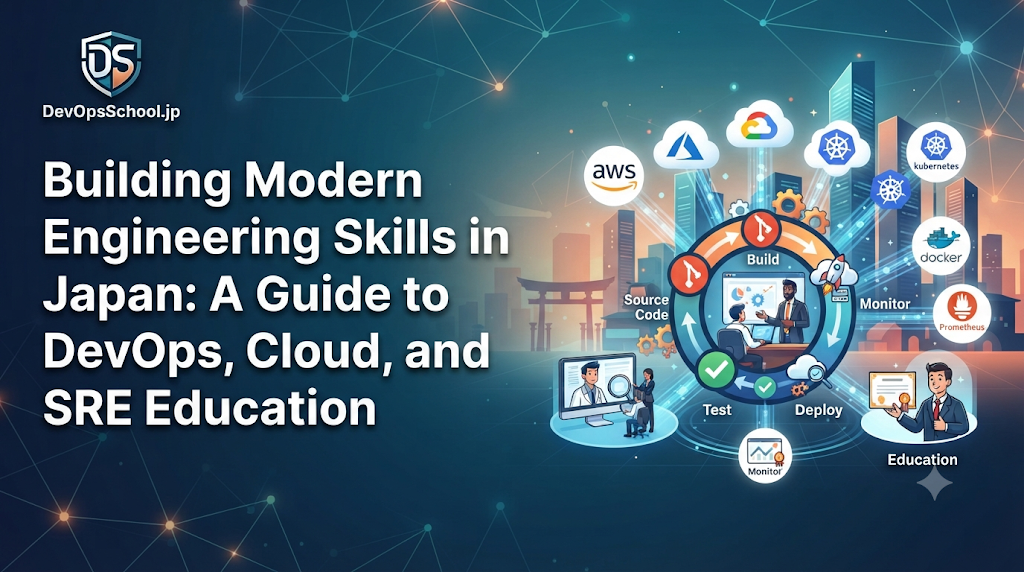
Introduction
Many engineering teams face a common headache: developers write software quickly, but releasing updates to users feels slow, risky, and stressful. Building solid applications is no longer enough on its own. Modern engineering also demands expertise in automation, cloud infrastructure, containers, Infrastructure as Code, system reliability, security, continuous monitoring, and machine learning operations. Bridging these distinct disciplines requires structured education and practical experience. DevOpsSchool.jp operates as a Japan-focused technical education and advisory platform that addresses these operational hurdles through targeted corporate programs, technical consulting, system implementation, and operational guidance. By organizing structured DevOps 研修 alongside specialized curricula, the platform helps engineering groups across Japan transition from manual system administration to reliable, automated delivery pipelines.
What Is DevOpsSchool.jp?
DevOpsSchool.jp is an educational and technical support platform created specifically for organizations and engineering teams operating in Japan. It functions as a specialized knowledge hub covering modern software operations, infrastructure automation, and engineering methodologies.
The platform provides four main capabilities:
- Technical Training: Structured learning programs focused on practical skills rather than passive theory.
- Consulting Services: Technical assessments, architecture planning, and transformation guidance for teams modernizing their toolsets.
- Implementation Assistance: Hands-on engineering support to set up pipelines, configure cloud platforms, and organize clusters.
- Ongoing Technical Support: Continued advisory work and troubleshooting assistance to keep production environments healthy over time.
Who Can Benefit from Its Technology Focus?
Different roles encounter different obstacles when modern software delivery practices are introduced:
- Software Developers: Programmers who write clean application code often lack hands-on experience with production infrastructure, deployment pipelines, or container networking.
- IT Managers: Engineering managers need an objective framework to evaluate tool choices, reduce release bottlenecks, and coordinate collaboration across traditionally isolated teams.
- DevOps Professionals and System Administrators: Operations engineers shifting away from manual system maintenance require deeper skills in automated provisioning, observability, and cluster operations.
- Enterprise Engineering Teams: Large organizations moving away from legacy infrastructure must adopt standardized practices so multiple distributed teams can ship software without breaking dependencies.
- Organizations Modernizing Delivery: Companies aiming to accelerate release frequency need clear paths to modernize their workflows without sacrificing stability.
Core Technical Areas and Disciplines
Modern software engineering is an interconnected chain of technical practices. DevOpsSchool.jp structures its work across several foundational disciplines:
- DevOps and Automation: Standardizing continuous integration and continuous delivery (CI/CD) pipelines to test and deploy software automatically.
- Container Orchestration: Managing containerized workloads systematically across distributed compute clusters.
- Infrastructure as Code (IaC): Defining and provisioning networks, storage, and computing instances using declarative configuration files.
- Site Reliability Engineering (SRE): Applying software engineering mindsets directly to system administration, uptime tracking, and incident remediation.
- DevSecOps: Moving security controls directly into the developer workflow so code is checked for vulnerabilities before release.
- Machine Learning Operations (MLOps): Managing the lifecycle, deployment, and ongoing evaluation of production artificial intelligence models.
Together, these fields form a cohesive framework that helps teams build scalable, resilient platforms.
Why Practical Skills Matter in Modern Engineering
Understanding technical definitions does not prepare an engineer to resolve an outage or fix a broken production deployment. Reading about automated testing is easy, but configuring a pipeline that tests code, builds container images, and safely deploys them to production takes practical experience.
This is why structured DevOps 研修 provides genuine value to engineering organizations. When engineers practice in realistic sandbox environments, they learn how to handle unexpected configuration errors, coordinate release rollouts, and configure live system monitoring. For businesses planning team-wide modernization, selecting a tailored DevOps corporate training Japan program ensures that developers and operations staff share identical vocabulary, understand common tooling, and work toward shared reliability goals.
How Cloud-Native Skills Fit Into a DevOps Environment
Cloud-native engineering centers on building systems designed from day one to run on flexible, elastic cloud infrastructure. Two major technical pillars support this approach:
[ Code Repository ]
        │
        ▼
[ Automated Testing & Build ]
        │
        ▼
[ Terraform: Provision Cloud Infrastructure ]
        │
        ▼
[ Kubernetes: Schedule & Manage Containers ]
Container Management
Containers package an application alongside all the libraries it needs to execute predictably. When hundreds of containers run at once, teams need an orchestration system to schedule workloads, manage networking, and balance traffic. Completing structured Kubernetes 研修 gives engineers the skills needed to design clusters, handle workload scaling, and debug pod communication issues effectively.
Infrastructure as Code
Creating servers or cloud storage buckets manually inside web consoles leads to human error and undocumented environments. Infrastructure as Code solves this by storing infrastructure specifications in plain text files. Participating in hands-on Terraform 研修 teaches infrastructure teams how to write reusable modules, manage environment state safely, and deploy predictable cloud environments automatically.
Connecting Reliability, Security, and Automation
Fast delivery is useless if the underlying software crashes frequently or exposes sensitive customer information. Speed must be balanced with operational stability and automated security validation.
Site Reliability Engineering
SRE treats operational reliability as a core software feature. Instead of striving for unrealistic 100% uptime, SRE teams use Service Level Objectives (SLOs) and Error Budgets to balance feature releases against system stability. Undertaking comprehensive SRE 研修 teaches engineers how to capture meaningful metrics, organize actionable alerts, and conduct blameless post-mortems after production incidents.
DevSecOps
Traditional workflows often left security reviews to the end of a project, creating friction right before a scheduled launch. DevSecOps embeds security checks directly into the daily pipeline. Enrolling teams in practical DevSecOps 研修 helps developers learn how to scan dependencies for vulnerabilities, analyze container configurations, and catch flaws automatically before code merges.
How MLOps Extends Modern Engineering Practices
Machine learning systems introduce unique operational challenges that standard software workflows cannot address alone. A typical software release changes when code changes. In contrast, machine learning models change when code changes, when training data changes, or when real-world user behavior drifts over time.
Deploying an AI model requires reproducible pipelines for data preparation, model training, validation, artifact versioning, and live prediction serving. Participating in specialized MLOps 研修 helps data engineers and platform teams adapt proven DevOps practices—such as automated testing, container deployment, and telemetry monitoring—to machine learning pipelines. This operational rigor ensures models perform reliably long after deployment.
Understanding Training, Consulting, and Technical Support
Skill development, technical advice, and ongoing maintenance solve different organizational challenges. Understanding their boundaries helps teams select the right support model:
- Training: Focuses on human knowledge. It builds internal competence so engineers can operate systems independently.
- Consulting: Focuses on technical strategy and workflow design. Engaging an experienced DevOps consultant Japan helps leaders evaluate existing architecture, design migration paths, and establish standard engineering guidelines. A structured DevOps コンサルティング engagement gives organizations clear visibility before committing to major tooling overhauls.
- Implementation: Involves direct engineering work to configure repositories, write automation manifests, set up monitoring clusters, and launch initial pipelines.
- Technical Support: Focuses on ongoing operational stability. Relying on dedicated DevOps support Japan provides teams with accessible troubleshooting advice, emergency guidance, and maintenance expertise when production issues arise.
Five-Step Process for Planning a Technical Skill Development Program
Building internal technical capability works best when approached sequentially rather than all at once.
- Identify Current Skills and Problems: Map out release bottlenecks, deployment frequencies, and incident histories. Pinpoint whether failures stem from manual provisioning, lack of tests, or poor monitoring.
- Define the Required Skills: Determine which specific disciplines match your architectural needs. Decide if your current priority is basic containerization, cloud provisioning, or advanced reliability engineering.
- Build a Practical Learning Plan: Select a training curriculum that pairs core principles with extensive lab work. Avoid courses that rely entirely on lecture slides without real terminal exercises.
- Apply the Skills to Real Work: Immediately assign engineers to modernize a small, non-critical internal service using their newly learned tools. Practical application cements knowledge.
- Measure and Improve: Evaluate whether deployment frequency, build reliability, or incident resolution times improve. Adjust training tracks as new technical needs surface.
Common Mistakes Organizations Should Avoid
- Focusing on Tools Instead of Workflows: Adopting complex tools without streamlining the underlying software deployment process only creates automated confusion.
- Relying Solely on Theory: Watching video lectures without building, configuring, and breaking environments in real cloud sandboxes creates a false sense of readiness.
- Treating DevOps as an Isolated Team: Assigning DevOps responsibilities to a separate silo defeats the goal of shared responsibility across development and operations.
- Ignoring Security Automation: Postponing security checks until software is ready for production creates costly release delays.
- Neglecting Production Observability: Rolling out applications without metrics, central logging, and tracing makes troubleshooting active failures nearly impossible.
- Adopting Too Many Technologies at Once: Introducing containers, new cloud providers, service meshes, and GitOps all in one quarter overwhelms engineering staff.
- Skipping Infrastructure Automation: Managing cloud resources through web consoles while running modern containers leads to unrepeatable configurations.
Real-Life Example: Modernizing a Tokyo Logistics Platform
A medium-sized logistics software company based in Tokyo managed an order-tracking web platform. The development team wrote features smoothly, but releases occurred only once a month during late-night maintenance windows. Deployments required manual server configuration, and unexpected database connection errors routinely disrupted service.
The company tackled this challenge in clear phases:
- Assessment: Leadership audited their delivery path and discovered that manual server patching was the root cause of deployment failures.
- Foundational Education: The engineering team completed hands-on coursework covering container fundamentals, CI/CD pipeline automation, and declarative cloud setup.
- Internal Implementation: Rather than overhauling the core billing engine immediately, the team automated the deployment of a smaller internal reporting portal using automated containers and scripted infrastructure.
- Reliability and Security: Once comfortable with automated releases, the team introduced automated dependency scanners and established baseline service level alerts to track uptime.
Within six months, the engineering group shifted from stressful midnight deployments to automated daytime updates, freeing developers to spend their energy on core software features.
Technical Disciplines and Practical Outcomes
| Engineering Discipline | Primary Focus Area | Practical Knowledge Acquired |
| DevOps | CI/CD and Team Collaboration | Automated testing, build triggers, and repeatable deployment workflows |
| Kubernetes | Container Orchestration | Workload scheduling, cluster administration, and service networking |
| Terraform | Infrastructure as Code | Declarative cloud provisioning, state management, and reusable infrastructure modules |
| SRE | Service Reliability | Monitoring setup, SLO design, alerting hygiene, and post-incident reviews |
| DevSecOps | Pipeline Security | Automated vulnerability scanning, secrets management, and compliance checks |
| MLOps | AI/ML Lifecycle | Model tracking, automated pipeline deployment, and data drift monitoring |
Service Models Compared
| Service Model | Primary Objective | Best Suited For |
| Technical Training | Skill acquisition and internal independence | Teams needing to upgrade practical engineering skills |
| Consulting | Technical architecture and strategic planning | Organizations planning major cloud or pipeline migrations |
| Implementation | Hands-on setup of tools and pipelines | Groups needing direct help establishing initial production clusters |
| Ongoing Support | Troubleshooting and operational guidance | Teams running production workloads requiring backup technical advice |
Frequently Asked Questions
What is DevOpsSchool.jp?
It is a Japan-focused technical platform offering practical education, consulting, system implementation, and ongoing engineering support across cloud-native and DevOps disciplines.
What does structured DevOps training cover?
It covers version control strategies, automated build systems, continuous integration, continuous delivery (CI/CD), infrastructure automation, and team communication practices.
Why are Kubernetes skills useful for engineering teams?
Kubernetes automates the deployment, scaling, and health monitoring of containerized applications, reducing manual server administration across large cloud environments.
What is the purpose of Terraform education?
It teaches engineers to write declarative configuration files that define servers, networks, and cloud storage, making infrastructure provisioning versionable, safe, and repeatable.
How does Site Reliability Engineering connect with DevOps?
DevOps focuses on accelerating the flow of changes from development to production. SRE provides the engineering framework, metrics, and operational disciplines to keep those releases stable and reliable.
What does DevSecOps add to the software delivery workflow?
DevSecOps embeds automated security assessments, image scanning, and compliance checks directly into early pipeline stages, catching vulnerabilities before software reaches production.
Why is MLOps necessary for machine learning initiatives?
Machine learning models rely on changing data and complex algorithms. MLOps introduces automated pipelines to test, deploy, monitor, and retrain these models reliably in production.
What does DevOps consulting typically involve?
A consulting engagement reviews an organization’s existing software delivery pipeline, identifies release bottlenecks, recommends suitable architecture, and maps out a modernization strategy.
What does corporate DevOps training mean in Japan?
It refers to customized technical training designed for Japanese enterprises and engineering departments, helping internal teams adopt modern automation practices while respecting local workplace processes.
When should an organization consider ongoing technical support?
Companies benefit from ongoing support when managing production clusters with lean teams, adopting unfamiliar cloud-native technologies, or requiring expert escalation paths for critical infrastructure challenges.
Conclusion
Modern software engineering requires deep coordination across multiple technical disciplines. Delivering value smoothly to users depends on continuous collaboration between development, infrastructure automation, container orchestration, systems reliability, proactive security, and machine learning operations. Platforms like DevOpsSchool.jp help organizations navigate this technical landscape by offering structured training, advisory consulting, and operational support designed for teams in Japan. By carefully identifying internal skill gaps, combining theoretical principles with hands-on practice, and selecting the appropriate mix of training and technical assistance, engineering teams can build resilient platforms that ship software safely and sustainably.