Introduction
The gap between creating a machine learning model and running it in a production environment is often quite large. Many models are built by data scientists but are never successfully deployed because the operational side is ignored. This is why a new field has been created to bridge this gap. This field is known as Machine Learning Operations, or MLOps. A professional who masters this area is called a Certified MLOps Engineer. In this guide, the path to becoming an expert in this field is explored in detail.
What is Certified MLOps Engineer?
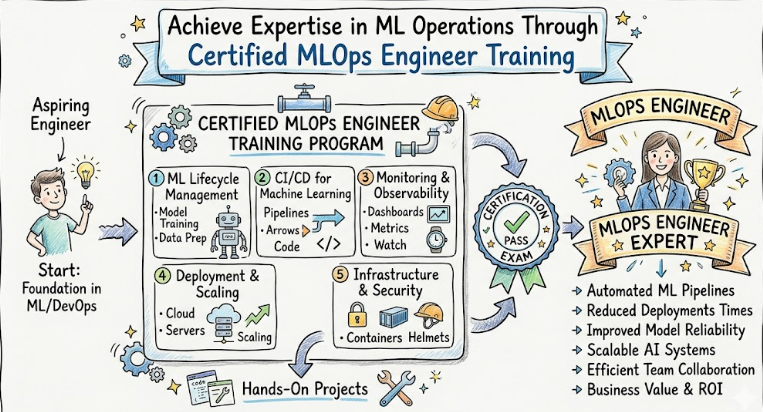
A Certified MLOps Engineer is a professional who has been trained to handle the entire lifecycle of machine learning. The focus is shifted from just writing code to building automated systems that can deploy, monitor, and manage models at scale. It is ensured that machine learning models are treated like high-quality software products. The certification program is designed to validate that an individual can combine data science skills with modern DevOps practices.
Why it matters today?
Machine learning is no longer a research experiment for most companies. It is now a core part of business operations. When models are moved from a laptop to a cloud server, many things can go wrong. Data can change, models can become less accurate over time, and systems can crash. MLOps is required to ensure that these models remain stable and reliable. Without a structured approach, a lot of time and money is wasted on manual tasks that could be automated.
Why Certified MLOps Engineer certifications are important?
Certifications are used to prove that a specific standard of knowledge has been met. In a fast-moving field, it is often hard for hiring managers to know who truly understands the technology. By obtaining a certification, a professional is recognized for their ability to use industry-standard tools. It is also found that certified individuals are more confident in handling complex production issues. Standardized training ensures that everyone on a team is speaking the same technical language.
Why choose AIOps School?
AIOps School is chosen by many because the curriculum is focused on real-world application rather than just theory. The content is updated frequently to reflect the latest changes in the tech industry. It is ensured that every student gets hands-on experience through specialized labs. Support is provided by experts who have spent years working in high-pressure engineering environments. The certification from this institution is highly respected by global employers.
Certification Deep-Dive
What is this certification?
This is a professional validation program focused on the intersection of Machine Learning and DevOps. It is designed to teach the automation of model deployment and the management of data pipelines.
Who should take this certification?
This program is intended for software engineers, data scientists, and DevOps professionals. It is also highly recommended for cloud architects who want to specialize in AI-driven infrastructure.
Certification Overview Table
| Track | Level | Who it’s for | Prerequisites | Skills Covered | Recommended Order |
| MLOps | Professional | Software Engineers | Basic Python & DevOps | CI/CD for ML, Monitoring | 1 |
| AIOps | Advanced | SREs | MLOps Foundation | AI-driven Ops | 2 |
| DataOps | Specialized | Data Engineers | SQL & Cloud | Data Pipelines | 1 |
Skills you will gain
- The automation of machine learning workflows is mastered.
- Deep knowledge of CI/CD pipelines for models is acquired.
- Data versioning and model tracking techniques are learned.
- Monitoring of model performance in real-time is understood.
- The ability to scale ML infrastructure using Kubernetes is developed.
Real-world projects you should be able to do after this certification
- An automated pipeline for retraining models based on new data is built.
- A monitoring system that detects when a model starts losing accuracy is created.
- A scalable API for serving machine learning predictions is deployed.
- A secure environment for managing sensitive training data is managed.
Preparation plan
7–14 days plan
The focus is placed on understanding the core concepts of MLOps. The official documentation is read daily. Basic labs for model deployment are completed.
30 days plan
More complex automation tasks are practiced. Time is spent learning how to integrate version control with data pipelines. Mock exams are taken to test knowledge levels.
60 days plan
Advanced topics like multi-cloud deployment and model security are explored. Large-scale projects are built from scratch. Peer reviews are used to improve project quality.
Common mistakes to avoid
- The importance of data quality is often ignored.
- Too much focus is placed on the model and not enough on the infrastructure.
- Monitoring is treated as an afterthought instead of a priority.
- Automation is skipped in favor of manual deployments.
Best next certification after this
- Same track: Advanced AIOps Specialist.
- Cross-track: Certified DataOps Professional.
- Leadership / management: Engineering Manager for AI Teams.
Choose Your Learning Path
DevOps Path
This path is best for those who already understand software deployment but want to learn how to handle ML models. The focus is placed on expanding standard CI/CD pipelines to include data and model artifacts.
DevSecOps Path
This path is chosen by security-conscious professionals. It is learned how to protect training data and ensure that models are not tampered with during deployment.
Site Reliability Engineering (SRE) Path
The focus here is on the uptime and reliability of AI systems. It is best for those who want to ensure that ML services stay running under high traffic.
AIOps / MLOps Path
This is the core path for those dedicated to artificial intelligence. It is learned how to use AI to improve operations and how to manage the AI itself.
DataOps Path
This path is best for data engineers. The flow of data from sources to the training environment is optimized and automated.
FinOps Path
This path is designed for those who want to manage the high costs of cloud computing for AI. It is learned how to run models efficiently without wasting money.
Role → Recommended Certifications Mapping
| Role | Recommended Certification | Primary Goal |
| DevOps Engineer | Certified MLOps Engineer | Automating ML lifecycles |
| SRE | Certified AIOps Specialist | Reliability for AI systems |
| Platform Engineer | Certified Cloud Architect | Building AI platforms |
| Cloud Engineer | Certified MLOps Engineer | Managing ML in the cloud |
| Security Engineer | Certified DevSecOps | Protecting AI data |
| Data Engineer | Certified DataOps | Managing data pipelines |
| FinOps Practitioner | Certified FinOps | Managing AI cloud costs |
| Engineering Manager | AI Leadership Program | Managing AI/ML teams |
Next Certifications to Take
One same-track certification
The Advanced AIOps Specialist certification is recommended. It is used to deepen the understanding of how artificial intelligence can be used to manage IT operations automatically.
One cross-track certification
The Certified DataOps Professional program is suggested. A broader view of how data is managed before it even reaches the machine learning model is provided.
One leadership-focused certification
The AI Strategy for Engineering Managers course is chosen by many. The skills needed to lead technical teams through complex AI transitions are developed.
Training & Certification Support Institutions
DevOpsSchool
This institution is known for its extensive library of technical courses. A wide range of training is provided for those looking to master automation and cloud tools.
Cotocus
A focus is placed on corporate training and customized learning paths. High-quality support is given to teams that need to upgrade their technical skills quickly.
ScmGalaxy
This is a popular community-driven platform for software configuration management. Valuable resources and tutorials are shared by experts in the field.
BestDevOps
Practical, hands-on learning is the main focus here. It is ensured that students can apply what they learn to their daily jobs immediately.
devsecopsschool.com
Security is integrated into the heart of the DevOps process at this school. Special programs are offered to help engineers build more secure software.
sreschool.com
The principles of reliability and system stability are taught here. It is chosen by those who want to specialize in keeping complex systems running smoothly.
aiopsschool.com
This is the primary destination for AI and Machine Learning operations. The most modern certifications for the future of IT are provided.
dataopsschool.com
Everything related to the automation of data pipelines is covered. It is used by data professionals to bring order to messy data environments.
finopsschool.com
The intersection of finance and cloud operations is explored. Skills for managing and optimizing cloud budgets are taught by industry veterans.
FAQs Section
1. What is the difficulty level of the exam?
The exam is considered moderate to high in difficulty. A mix of theoretical knowledge and practical skills is required for success.
2. How much time is required for preparation?
Approximately 30 to 60 days are usually spent on preparation by most professionals. This depends on prior experience with cloud tools and Python.
3. Are there any prerequisites?
A basic understanding of Python and cloud computing is recommended. Knowledge of standard DevOps practices is also helpful.
4. What is the recommended certification sequence?
It is suggested that MLOps is taken first, followed by AIOps for advanced operational knowledge.
5. How is the career value measured?
Value is seen through higher salary offers and more opportunities for senior roles in top tech companies.
6. Which job roles can be applied for?
Roles such as MLOps Engineer, Machine Learning Architect, and AI Infrastructure Engineer can be pursued.
7. Is the certification recognized globally?
Yes, the certification is recognized by companies across India, the US, Europe, and other major markets.
8. Does the program include hands-on labs?
It is confirmed that hands-on labs are a core part of the training program.
9. Can an Engineering Manager benefit from this?
Yes, the technical depth needed to lead AI teams effectively is gained through this program.
10. Is help provided for the registration process?
Support is provided by the administrative team of the certification provider to ensure a smooth registration.
11. Are the exams taken online?
The exams are conducted in a secure online environment.
12. How long is the certification valid?
The certification is typically valid for two years, after which a renewal is encouraged to stay current.
Additional FAQs for Certified MLOps Engineer
1. What makes a Certified MLOps Engineer different from a Data Scientist?
A Data Scientist is focused on building models, whereas an MLOps Engineer is focused on the deployment and management of those models.
2. Is Kubernetes covered in this certification?
Yes, the use of Kubernetes for scaling machine learning models is taught in detail.
3. Is knowledge of big data tools required?
A basic understanding is helpful, but the core tools for data versioning are taught during the course.
4. How are the real-world projects evaluated?
Projects are reviewed based on their automation, scalability, and security features.
5. Is the certification helpful for freelancers?
Yes, it provides a verified credential that can be used to attract high-paying clients in the AI space.
6. Are cloud platforms like AWS or Azure used?
The principles are taught in a way that can be applied to any major cloud platform.
7. What is the primary focus of the curriculum?
The primary focus is placed on the automation of the machine learning lifecycle.
8. Can a beginner in IT take this course?
It is recommended that a foundation in software engineering is built before attempting this specialized track.
Testimonials
- Aarav: A huge improvement in my technical skills was noticed after I completed the program. Complex pipelines are now handled with much more ease.
- Priya: The real-world application of the labs was incredible. A lot of confidence was gained in how I approach machine learning in production.
- Rohan: Complete career clarity was achieved through this certification. It is now understood how to bridge the gap between data science and operations.
- Ananya: Confidence growth was the biggest benefit for me. I am now able to lead discussions on AI infrastructure with my entire engineering team.
- Kabir: This was the best investment in my learning. The skills gained are used every day to keep our company’s models running smoothly.
Conclusion
The Certified MLOps Engineer certification is a vital step for any professional who wants to work at the forefront of technology. It is ensured that a standard of excellence is maintained in the deployment of artificial intelligence. Long-term career benefits are seen as companies continue to integrate machine learning into their core business. Strategic learning and careful planning of certifications are encouraged for anyone looking to stay relevant in the changing job market. Success is achieved when technical knowledge is combined with the right professional credentials.