Introduction
Modern industries are experiencing a profound structural shift driven by artificial intelligence. Across healthcare, finance, software development, logistics, and customer operations, computational models are moving from passive analytics tools to active decision-making agents. As algorithmic systems become embedded in daily business workflows, the necessity for structured, continuous learning and structured implementation frameworks has never been greater.
For technical professionals, software engineers, data scientists, and enterprise executives, navigating this fast-evolving domain can feel overwhelming. Technical standards evolve rapidly, software frameworks iterate continuously, and theoretical understanding often fails to translate into stable, production-ready enterprise deployments. Organizations frequently struggle to align business objectives with machine learning capabilities, leading to fragmented pilot projects that fail to scale.
This is where dedicated educational and operational platforms play a pivotal role. AIUniverse was established to bridge the gap between theoretical artificial intelligence knowledge and real-world execution. By combining structured learning pathways, professional certifications, enterprise training solutions, technical tool comparisons, and strategic consulting services, the platform provides a cohesive framework designed to support individuals and organizations at every stage of their artificial intelligence journey.
What is AIUniverse?
AIUniverse is a comprehensive educational ecosystem, resource platform, and professional consulting environment designed to simplify artificial intelligence literacy, skill acquisition, and operational adoption. Built with a clear mission to democratize technical knowledge and bridge enterprise execution gaps, the platform serves as a centralized hub for learners, engineers, and executive decision-makers.
At its core, the platform addresses a fundamental challenge in the modern technology landscape: the fragmentation of learning resources and implementation strategies. Rather than treating machine learning as an isolated academic discipline or purely a software tool, AIUniverse treats it as a multi-dimensional capability requiring alignment across skills, operations, governance, and infrastructure.
The purpose of AIUniverse extends across four primary operational pillars:
- Structured Skill Building: Providing structured learning pathways and specialized certifications that focus on real-world engineering and operational disciplines rather than passive video consumption.
- Enterprise Transformation: Helping organizations assess their operational readiness, upskill existing workforces, and design sustainable technology adoption strategies through customized corporate training and expert consulting.
- Resource and Tool Discovery: Offering rigorous comparisons, architectural analysis, and technical evaluations of modern operational platforms, prompt management environments, and decentralized learning paradigms.
- Knowledge Distribution: Synthesizing technical research into accessible, practical knowledge guides that enable professionals to remain informed about emergent industry standards.
By unifying these dimensions within a single cohesive environment, AIUniverse provides a structured pathway for transitioning from foundational literacy to advanced enterprise implementation.
Why AI Learning Has Become Essential
The modern technological ecosystem is moving past static software systems toward dynamic, model-driven architectures. Automated workflows, predictive analytics, intelligent process orchestration, and generative foundational models are replacing legacy enterprise applications. Consequently, understanding how to build, maintain, monitor, and govern intelligent systems has transitioned from a niche technical specialty to a fundamental requirement across software engineering, data management, and operational leadership.
Despite this rapid shift, many professionals and businesses face significant friction during technical adoption:
- The Production Gap: Building a machine learning prototype in a controlled environment is vastly different from deploying, monitoring, and maintaining a resilient model serving thousands of live queries per second.
- Operational Complexity: Enterprise teams often struggle with data pipeline management, model drift detection, automated retraining workflows, and hardware resource optimization.
- Organizational Misalignment: Non-technical executives and technical engineering teams frequently operate with different expectations regarding project timelines, feasibility, cost structures, and risk boundaries.
- Information Overload: The influx of new open-source models, software libraries, vector databases, and orchestration tools makes it difficult for practitioners to distinguish reliable operational platforms from short-lived technology hype.
Addressing these challenges requires structured learning frameworks rather than piecemeal learning. Structured education provides learners with systematic context, helping them understand not just how a specific tool operates, but where it fits within a reliable production pipeline and why specific architectural decisions matter for long-term sustainability.
Who Should Use AIUniverse?
Because artificial intelligence impacts every tier of an organization, AIUniverse is structured to support diverse user groups with distinct educational and operational requirements.
Students and Beginners
For individuals starting their journey, foundational learning can feel intimidating due to dense mathematics and scattered technical guides. AIUniverse provides beginners with structured learning roadmaps that establish strong foundational concepts without overwhelming them. By explaining foundational principles, core concepts, and basic workflows in simple terms, the platform helps entry-level learners build functional literacy and gain early confidence.
Developers and Software Engineers
Software engineers transitioning into artificial intelligence roles require practical, code-free structural context regarding model integration, API management, prompt architecture, and system orchestration. AIUniverse equips developers with technical implementation knowledge, structured learning paths, and specialized certifications that demonstrate real-world competence in bringing models into application environments.
Data Scientists, ML Engineers, and AI Professionals
Experienced practitioners need advanced content focused on production lifecycle management, model monitoring, autonomous workflow orchestration, and operational reliability. AIUniverse supports advanced professionals with deep technical resources, evaluation guides, and rigorous certification tracks covering advanced operational methodologies like agentic orchestration and production operational frameworks.
Businesses, Startups, and Enterprise Teams
Organizations planning or executing digital transformations require structured workforce training and strategic advisory support. AIUniverse assists startups and enterprise teams by delivering structured corporate training modules, evaluating operational readiness, and offering strategic guidance to align technical capabilities with clear business outcomes.
Technology Leaders and Decision Makers
Chief Technology Officers, IT directors, product leaders, and enterprise architects must make informed software investments, manage risk, and construct scalable governance policies. AIUniverse provides executives with high-level technology breakdowns, strategic planning guides, governance frameworks, and vendor-neutral resource evaluations to support long-term decision-making.
Researchers and Continuous Learners
Educators, technology researchers, and dedicated professionals need reliable insights to stay ahead of rapid industry shifts. AIUniverse functions as an ongoing knowledge engine, offering regularly updated research summaries, deep-dive technology guides, and trend analyses that highlight emerging operational practices.
AIUniverse Ecosystem
The AIUniverse platform is structured around several interconnected components designed to deliver holistic educational and consulting support.
AI Certification Courses
Educational credibility depends on rigor and practical relevance. AIUniverse offers structured AI certification courses online designed to validate technical proficiency across critical emerging domains:
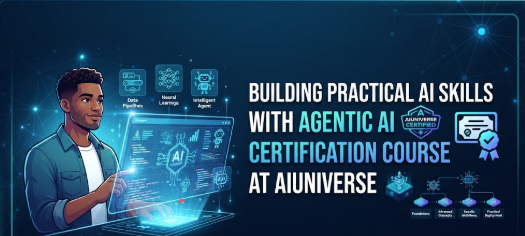
- Agentic AI Certification Course: Teaches the principles of autonomous agent architecture, multi-agent communication protocols, task decomposition, memory systems, and tool integration, enabling professionals to design intelligent autonomous workflows.
- MLOps Certification Course: Focuses on the end-to-end lifecycle of machine learning systems, covering data pipeline automation, experiment tracking, continuous integration and deployment (CI/CD) for models, model registry management, and drift monitoring.
- AIOps Certification Course: Explores the intersection of artificial intelligence and IT operations, teaching practitioners how to utilize machine learning algorithms for system observability, automated anomaly detection, log analysis, and incident remediation.
Corporate AI Training and AI Consulting
To bridge organizational capability gaps, AIUniverse provides tailored corporate AI training and comprehensive AI consulting services. Corporate programs focus on workforce upskilling, ensuring engineering and business teams share a common operational vocabulary and implementation strategy. Consulting engagements assist enterprise leaders in conducting AI readiness assessments, defining technical roadmaps, designing governance frameworks, and selecting optimal software architectures.
AI Learning Resources and Practical Knowledge
Beyond formal training programs, the platform hosts an extensive library of educational resources. These include step-by-step implementation guides, conceptual breakdowns of neural architectures, operational checklists, and project design frameworks. These materials help learners transition seamlessly from conceptual understanding to practical real-world execution.
AI Tools, Comparisons, and Research
Selecting software tools within an expansive vendor landscape presents a major challenge for enterprise architects. AIUniverse provides objective evaluations and comparative analyses of leading platforms, helping technical teams discover the best prompt management tools, analyze federated learning platforms for privacy-preserving computation, and select the best MLOps tools for production monitoring.
Enterprise AI Adoption and Best Practices
Successful deployment requires more than technology; it demands structured governance, security alignment, and ethical safeguards. AIUniverse publishes comprehensive guidelines on responsible system design, data privacy compliance, model explainability, and risk mitigation strategies tailored to enterprise contexts.
Continuous Learning and Future AI Trends
Because the industry evolves rapidly, AIUniverse emphasizes ongoing education. The ecosystem continuously updates its core curriculum and research library to reflect emerging breakthroughs, ensuring learners and enterprise partners remain well-aligned with modern technical standards.
How AIUniverse Supports Different Learning Goals
Every professional enters the artificial intelligence space with distinct objectives and background knowledge. AIUniverse accommodates these varying needs through adaptable learning pathways:
- Mastering Fundamentals: Beginners follow structured modules that clearly define core concepts, mathematical foundations, and basic model mechanics without unnecessary complexity.
- Building Practical Engineering Skills: Software developers learn how to consume model endpoints, structure context windows, manage API rate limits, and construct responsive user applications.
- Constructing Production-Ready Systems: Engineers gain insight into scalable infrastructure design, containerization, load balancing model queries, and fallback strategies for live enterprise systems.
- Optimizing AI Operations: System administrators and DevOps specialists learn how to incorporate automated monitoring, telemetry tracing, and automated incident resolution using modern AIOps strategies.
- Mastering MLOps and Lifecycle Automation: Practitioners learn how to construct reproducible data pipelines, automate model retraining cycles, and maintain reliable registry systems.
- Orchestrating Agentic Architectures: Advanced developers learn to design complex multi-agent environments where autonomous systems collaborate, utilize external software tools, and execute complex business logic.
AIUniverse for Businesses
For modern enterprises, adopting intelligent technologies is no longer an optional innovation experiment—it is a core strategic requirement. However, unstructured adoption often leads to wasted capital, security vulnerabilities, and abandoned pilot projects.
AIUniverse provides a structured methodology to guide businesses through successful digital transformations:
- Corporate Upskilling: Custom training cohorts bring cross-functional teams up to speed, aligning software engineers, product managers, and business analysts on shared operational standards.
- Organizational Readiness: Evaluation frameworks help leadership assess whether their data infrastructure, security postures, and internal processes are sufficiently mature for model integration.
- Strategic Consulting: Senior consultants work directly with enterprise decision-makers to evaluate use cases, select software vendors, and design long-term implementation roadmaps.
- Enterprise Transformation: By combining skill development with strategic consulting, AIUniverse ensures that corporate technology investments deliver measurable, scalable business outcomes.
AIUniverse for Developers
Software developers face the continuous challenge of updating their technical skill sets to keep pace with changing industry standards. AIUniverse supports developers by offering clear, structured pathways to upgrade their application engineering capabilities:
- Hands-On Practical Focus: Learning materials emphasize functional architecture, system integration, and operational design over pure theoretical mathematics.
- Comprehensive Lab Concepts: Structured guidance helps developers understand real-world application environments, model serving architectures, and API handling.
- Production Deployment Standards: Developers learn essential techniques for deploying models safely, including blue-green deployment strategies, canary releases, and rapid rollback mechanisms.
- Continuous Capability Building: By providing access to ongoing resource updates, AIUniverse enables developers to continuously refine their understanding of new frameworks, vector database architectures, and agentic protocols.
AIUniverse for Technology Leaders
Engineering managers, CTOs, and IT directors must balance innovation with risk management, operational cost, and workforce capability. AIUniverse serves as a trusted advisory partner for technology leaders:
- Strategic Planning Support: Executive guides break down complex technical trade-offs, helping leaders choose between commercial proprietary APIs and self-hosted open-source models.
- Governance and Risk Frameworks: Comprehensive resources help leaders build robust data security policies, address copyright considerations, and maintain regulatory compliance.
- Workforce Capability Planning: Structured skill assessments help managers identify skill gaps within their current teams and design targeted upskilling initiatives.
- Long-Term Scalability: By highlighting established operational frameworks, AIUniverse enables technical leaders to build resilient system architectures that scale efficiently over time.
AIUniverse Knowledge Hub
The AIUniverse Knowledge Hub functions as an educational repository featuring deep-dive technical evaluations, vendor-neutral research, and strategic selection guides.
Key focus areas within the Knowledge Hub include:
- Tool Evaluations: Detailed breakdowns analyzing the structural capabilities, security postures, and integration flexibilities of major technology platforms.
- Prompt Management Guides: Practical educational resources explaining how to manage, version-control, test, and secure complex prompt templates across large engineering teams.
- Federated Learning Platform Guides: Educational materials exploring decentralized machine learning models that enable collaborative model training while keeping data localized and secure.
- Comparative Tool Studies: Detailed research guides highlighting the best MLOps tools for workflow automation and identifying the best AI tools for business process management.
Step-by-Step Guide to Getting Started with AIUniverse
To maximize the value of the platform, learners and organizations can follow an structured eight-step onboarding process:
Step 1 – Identify Your Primary Objective
Assess your current role, technical background, and immediate goals. Determine whether you require foundational literacy, specialized software engineering skills, enterprise corporate upskilling, or executive strategic planning.
Step 2 – Explore Suitable Certification Pathways
Select a learning path that aligns with your professional objectives. Review specialized offerings such as an Agentic AI certification course, an MLOps certification course, or an AIOps certification course to find the right skill level and depth.
Step 3 – Build Foundational Understanding
Begin by reviewing foundational learning modules to establish a strong conceptual base. Ensure you thoroughly understand core terminology, system lifecycle stages, and basic model capabilities.
Step 4 – Engage with Hands-On Projects
Apply theoretical knowledge by reviewing conceptual architecture guides and working through practical implementation exercises. Focus on model integration, context handling, and API workflow management.
Step 5 – Explore the Knowledge Hub
Utilize the Knowledge Hub to research modern software infrastructure. Review resource evaluations to understand the strengths, tradeoffs, and ideal use cases for various tools.
Step 6 – Expand into Specialized Domains
Once core concepts are mastered, progress into advanced topics such as multi-agent orchestration, automated model observability, federated learning paradigms, or enterprise governance frameworks.
Step 7 – Apply Knowledge to Real-World Workflows
Implement acquired concepts within your operational environment. Transition project models into production environments, set up observability pipelines, or execute workforce upskilling strategies within your organization.
Step 8 – Commit to Continuous Learning
Stay updated by regularly checking AIUniverse for new research guides, updated tool evaluations, and emerging industry frameworks.
Common Mistakes to Avoid
When learning or adopting artificial intelligence technologies, professionals and enterprise teams often make predictable errors. AIUniverse helps users avoid these common pitfalls by promoting structured methodologies.
| Common Pitfall | Why It Causes Failure | Practical AIUniverse Alternative |
| Focusing Purely on Theory | Abstract mathematical understanding without implementation skills leads to an inability to build functional production systems. | Combine conceptual study with practical architecture guides and practical engineering workflows. |
| Neglecting Production Lifecycle (MLOps) | Deploying models without automated pipelines, registry controls, or drift monitoring results in broken production applications. | Follow structured MLOps frameworks covering model registries, continuous integration, and observability. |
| Selecting Tools Randomly | Adopting trending software tools without evaluating integration compatibility leads to fragmented, unsustainable software stacks. | Consult neutral tool comparison guides and evaluation frameworks to build cohesive technology infrastructure. |
| Adopting Unstructured Learning Paths | Consuming random internet tutorials creates major knowledge gaps in core concepts, security, and architecture. | Follow sequential, structured certification pathways designed by domain experts. |
| Ignoring Governance and Security | Deploying model applications without strict risk boundaries exposes organizations to data leakage and compliance penalties. | Incorporate responsible system design frameworks, data privacy controls, and security standards early. |
| Skipping Operational Monitoring | Assuming a deployed model will perform indefinitely without monitoring leads to unnoticed model drift and degraded outputs. | Implement comprehensive AIOps protocols for continuous performance tracking and anomaly detection. |
| Failing to Update Knowledge | Relying on outdated model management methods causes technical debt as standards and libraries advance rapidly. | Engage with continuous learning resources and regularly updated industry research. |
| Overlooking Enterprise Realities | Attempting large-scale technology overhauls without workforce training or business alignment causes project failure. | Utilize structured corporate training and strategic consulting services to align technology with organizational goals. |
Best Practices for Learning and Implementing AI
Achieving long-term success in artificial intelligence requires disciplined habits and strategic execution.
- Establish a Clear Learning Roadmap: Avoid jumping between unrelated topics. Follow a structured progression from core concepts to specialized production engineering.
- Prioritize Operational Reliability: Focus heavily on system stability, performance tracking, model evaluation, and deployment mechanics rather than model creation alone.
- Emphasize Responsible Design: Integrate security controls, privacy safeguards, and bias detection mechanisms into system architectures from day one.
- Leverage Vendor-Neutral Research: Evaluate software tools based on architectural compatibility, security postures, and cost-efficiency rather than marketing claims.
- Align Technical Implementation with Business Value: Ensure that every engineering project or enterprise adoption initiative addresses a clearly defined operational need.
- Maintain Continuous Education: Reserve dedicated time each month to review emerging research, updated tool evaluations, and evolving operational standards.
Table 1: AIUniverse Core Resources Overview
| AIUniverse Resource | Purpose | Primary Users | Practical Benefit |
| Certification Programs | Deliver structured education on specialized topics like Agentic AI, MLOps, and AIOps | Software Developers, ML Engineers, IT Professionals | Validates technical competence and builds functional production skills |
| Corporate AI Training | Upskill enterprise workforces through customized team learning cohorts | Corporate Teams, Engineering Departments, Business Units | Aligns cross-functional teams on unified standards and execution methods |
| AI Consulting Services | Provide strategic guidance on adoption, vendor selection, and governance | CTOs, IT Leaders, Enterprise Architects | Reduces implementation risk and accelerates technology transformation |
| Knowledge Hub & Tool Guides | Offer neutral evaluations of tools, platforms, and prompt management software | Enterprise Architects, System Designers, Developers | Simplifies technology selection through objective, structured evaluations |
Table 2: Aligning Learning Goals with AIUniverse Resources
| Learning Goal | Recommended AIUniverse Resource | Expected Outcome |
| Understand AI Fundamentals | Foundational Modules & Introductory Guides | Mastery of core terminology, basic model mechanics, and key use cases |
| Master Production Deployment | MLOps Certification Course & Guides | Ability to design reproducible pipelines, model registries, and CI/CD workflows |
| Deploy Autonomous Workflows | Agentic AI Certification Course | Capability to build multi-agent systems with tool integration and reasoning capabilities |
| Enhance System Observability | AIOps Certification Course | Proficiency in using intelligent monitoring for log analysis and anomaly detection |
| Execute Organizational AI Adoption | Corporate Training & AI Consulting Services | A structured digital transformation strategy aligned with clear business objectives |
Key Benefits of AIUniverse
- Centralized Learning Platform: Consolidates learning pathways, certifications, technical guides, and enterprise consulting into a unified ecosystem.
- Industry-Aligned Certifications: Delivers specialized certification courses focused on critical operational disciplines including Agentic AI, MLOps, and AIOps.
- Practical Implementation Focus: Emphasizes real-world system architecture, deployment mechanics, and operational reliability over pure theory.
- Comprehensive Corporate Training: Provides customized upskilling modules designed to build shared capability across enterprise engineering and business teams.
- Expert Strategic Consulting: Offers executive-level guidance on technology readiness, governance, architecture design, and strategic planning.
- Vendor-Neutral Technology Research: Features objective evaluations of modern software infrastructure, prompt management platforms, and operational tools.
- Flexible Learning Pathways: Supports diverse user audiences ranging from complete beginners and software engineers to enterprise executives and researchers.
- Commitment to Continuous Education: Regularly updates its educational content and research repository to reflect shifting industry standards.
Frequently Asked Questions (FAQs)
What is AIUniverse?
AIUniverse is a broad educational platform, resource hub, and consulting ecosystem that provides structured learning pathways, professional certifications, enterprise training, tool evaluations, and strategic advisory services.
Who should use AIUniverse?
The platform serves a wide audience, including students, software developers, data scientists, machine learning engineers, enterprise leaders, technology executives, and research professionals.
What is covered in the Agentic AI certification course?
The course explores the architecture of autonomous intelligent agents, multi-agent orchestration frameworks, tool integration protocols, memory management, and practical task execution design.
What is an MLOps certification course?
An MLOps certification course focuses on the operational lifecycle of machine learning models, covering data pipeline automation, experiment tracking, continuous deployment (CI/CD), model registries, and drift monitoring.
What is an AIOps certification course?
An AIOps course teaches practitioners how to apply machine learning and automated analytics to IT operations, enhancing system observability, automated log analysis, and rapid incident resolution.
How does Corporate AI Training help organizations?
Corporate training upskills enterprise teams, ensuring that software engineers, product managers, and business analysts develop a shared technical foundation and aligned execution strategies.
What industries can benefit from AIUniverse?
Any industry adopting digital automation can benefit, including financial services, healthcare, software development, logistics, retail, manufacturing, and telecommunications.
Does AIUniverse offer consulting services?
Yes, AIUniverse provides consulting services to assist organizations with artificial intelligence readiness assessments, vendor selection, governance framework design, and strategic adoption planning.
How can beginners start learning artificial intelligence?
Beginners can start by reviewing foundational learning modules on AIUniverse, which introduce basic concepts, key terminology, and essential system workflows in simple, accessible language.
Why is structured AI learning important?
Structured learning provides a systematic roadmap, helping learners avoid knowledge gaps, understand production requirements, implement proper security boundaries, and build stable, scalable systems.
Conclusion
As artificial intelligence continues to reshape the global economic and technological landscape, success depends on moving beyond surface-level experimentation toward structured, disciplined execution. For individual practitioners, career progression requires mastering production engineering, operational management, and autonomous systems design. For enterprises, sustainable growth requires aligning technical capabilities with organizational goals, robust governance, and continuous workforce upskilling.
AIUniverse meets these requirements by providing an all-in-one ecosystem that unifies education, professional certification, neutral technology research, and expert enterprise consulting. By replacing fragmented learning with structured pathways and practical guidance, the platform enables learners and organizations to build reliable, scalable, and responsible technological capabilities.