Introduction
The technology world is shifting faster than ever before. We are moving away from simple manual coding and moving toward complex, highly automated systems that run on their own. For a professional, this means the “old ways” of managing teams and projects are no longer enough to stay ahead. To stay valuable in this competitive market, you must understand how to lead in an automated world. This guide explores how the Certified DevOps Manager path can change your career trajectory, increase your earning potential, and turn you into a modern leader.
1. Defining the Leadership Role in Modern Tech
What exactly is a Certified DevOps Manager?
Think of this role as the captain of a high-tech ship. While the engineers are working deep in the engine room on the code and the operations team is navigating the servers and cloud infrastructure, the DevOps Manager ensures everyone is moving in the exact same direction. This person acts as a vital bridge. They take complex technical needs and translate them into clear business value that executives can understand. By earning this certification, you prove to the industry that you can handle the immense pressure of delivering software at high speeds without breaking the system or burning out your team.
The Value of This Role in Today’s Market
In the current software ecosystem, automation is no longer an option; it is the king. Companies across India, the US, and Europe are desperately looking for people who can reduce manual work and increase daily efficiency. A manager who understands the deep connection between Cloud, SRE, and DevSecOps is worth their weight in gold. It is not just about keeping the website running; it is about making the entire business more profitable and agile through better engineering practices and smarter decision-making.
Why Professional Certification Matters for Your Growth
Real-world experience is a great teacher, but a certification provides a structured and globally recognized proof of your specific skills. It tells a hiring manager, a client, or a stakeholder that you have met a high global standard of excellence. For engineers moving into management, it acts as a formal transition. It gives you the necessary confidence to lead teams that might be more technically specialized than you are in certain areas, ensuring you can still guide them effectively toward a common goal.
2. Fast Facts: Certification Details
| Track | Level | Ideal Candidate | Requirements | Knowledge Areas | Path Order |
| Leadership | Expert | Leads & Managers | 5+ Years Experience | Strategy, ROI, Automation | Final Step |
Why Choose DevOpsSchool?
When you are looking for a place to learn, you need much more than just pre-recorded videos or slides. DevOpsSchool is the preferred choice for thousands of professionals because they offer a deep, hands-on experience that you cannot find elsewhere.
- Real-World Focus: They don’t just teach you the “what”—they teach you the “how.” The curriculum is designed around actual industry problems.
- Expert Mentorship: You get direct access to mentors who have spent over two decades in the field, meaning you learn from their mistakes and successes.
- Learning Environment: They provide a lab environment that mimics a real office setting, so what you learn on Monday can be applied to your job on Tuesday.
- Community Power: Once you join, you become part of a massive network of DevOps professionals, giving you a lifetime of support and networking opportunities.
3. A Closer Look: The Manager Certification Journey
What is this program about?
This is an advanced-level training program that focuses specifically on the “Management” side of the DevOps house. It moves far past basic tool knowledge and focuses on high-level orchestration, building a healthy team culture, and ensuring every technical move aligns with the company’s financial goals.
Who should enroll?
- Senior Engineers: If you feel stuck at a technical ceiling and want to move into a role with more influence.
- Team Leads: For those already leading people but who want a structured framework to improve their processes.
- Project Managers: Non-technical managers who want to understand the heart of the software factory.
- Solution Architects: Professionals who want to ensure their designs are manageable and cost-effective for the long term.
Skills you will master
- Strategic Leadership: You will learn how to set long-term goals that actually help the business grow, rather than just hitting short-term technical targets.
- Pipeline Governance: You will master the art of overseeing how code moves from a developer’s laptop to the customer safely, ensuring every check and balance is in place.
- Financial Accountability (FinOps): You will gain a deep understanding of cloud bills and learn the specific techniques to keep costs low while performance stays high.
- Team Scaling: You will learn the secrets of hiring the right talent and growing a high-performing engineering culture where people actually want to work.
Projects you will complete
- The Transformation Roadmap: You will create a comprehensive, step-by-step guide to move a traditional, slow-moving company into a modern, DevOps-first organization.
- Budget Optimization Audit: You will analyze a real-world cloud bill and find specific ways to save 20% or more in costs without losing any speed or reliability.
- Disaster & Incident Planning: You will design a high-level plan for how a team should react when a major site goes down, focusing on communication and rapid recovery.
4. Selecting Your Professional Path
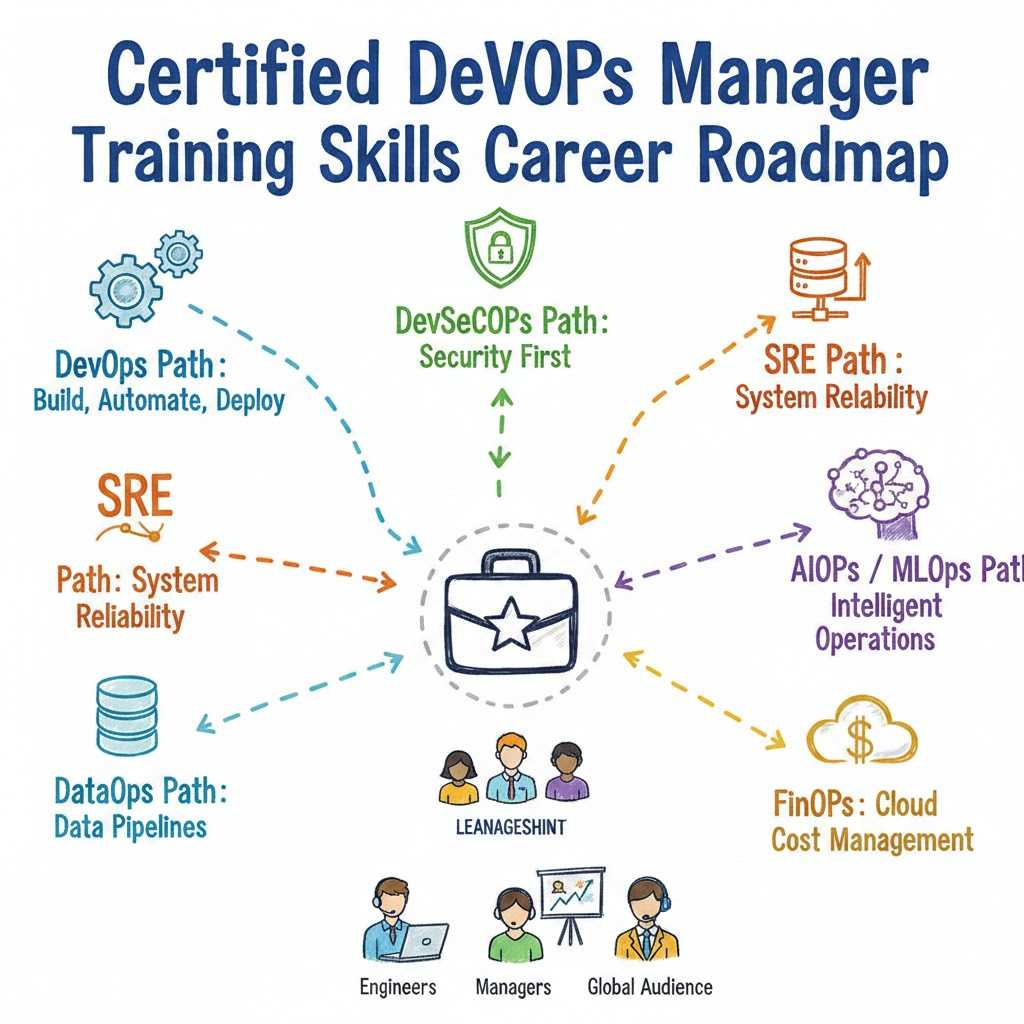
- The Automation Track (DevOps): This is for those who love the “flow” of work. You will focus on making sure the “factory line” of software development never stops moving. This includes mastering continuous integration and ensuring that manual errors are removed from the system entirely.
- The Security Track (DevSecOps): This is for the “guardians” of the digital world. You will learn how to bake security into every single step of the process. It is not about a security check at the end; it is about making security a part of the code from day one.
- The Reliability Track (SRE): If you care about uptime and system performance, this is your home. You will focus on keeping systems stable even when millions of people are using them at the same time. You will learn how to manage “Error Budgets” and balance risk with innovation.
- The Intelligence Track (AIOps/MLOps): This is the future of the industry. You will learn how to use machine learning to predict system problems before they actually happen. You will also learn how to deploy and manage data science models at a massive scale.
- The Information Track (DataOps): This focuses on the flow of data across the company. You ensure that the data scientists and analysts always have high-quality, clean data to work with, using automation to move data safely and quickly.
- The Financial Track (FinOps): This is for the business-minded engineer. You will be the person who ensures the company isn’t wasting money on unnecessary cloud resources. You bring financial accountability to the world of cloud computing.
5. Training & Certification Support Institutions
- DevOpsSchool: Known globally for its intensive, project-based training. They provide a full support system that includes study materials, live sessions, and career guidance for those wanting to reach management levels.
- Cotocus: This institution focuses on helping organizations and individuals master cloud-native technologies. They are great for those who need expert consulting and practical advice on using tools in real production environments.
- ScmGalaxy: This is more than a school; it is a massive community. With thousands of tutorials and a very active forum, it is the best place to go when you have a tricky technical problem that needs a fast answer.
- BestDevOps: They specialize in making the “hard stuff” easy. If you are just starting out or feel overwhelmed by jargon, they break down complex DevOps topics into small, digestible pieces that anyone can understand.
- devsecopsschool.com: The primary destination for anyone wanting to specialize in security. They teach the specific tools and mindsets needed to ensure that speed does not come at the cost of safety.
6. Common Questions (FAQs)
- Is this role only for people who can code every day?
No. While you need to understand how code works, a manager spends more time on strategy, people, and processes than on writing lines of code. - How much time should I invest in the certification?
Most working professionals find that 5 to 10 hours a week for about two months is the perfect balance to master the material. - What are the job prospects like?
The demand is massive. Management roles in DevOps are currently among the highest-paying and most stable jobs in the entire technology sector. - Is it a global certification?
Yes. The principles of the Certified DevOps Manager program are universal and are recognized by companies in every major tech hub worldwide. - Do I need a university degree?
While a degree is helpful, many top tech companies now value skills and specialized certifications like this one over a traditional 4-year diploma. - What is the hardest part of the course?
For many, the hardest part is the shift in mindset—learning to stop “doing” everything yourself and learning how to “lead” others to do it. - Is there a final exam to pass?
Yes, there is a formal assessment designed to prove you have mastered the core management and technical principles taught in the course. - Can I study while working a full-time job?
Absolutely. The programs at DevOpsSchool are designed specifically for busy professionals who need flexible learning schedules. - What tools will I learn to manage?
You will learn the strategy behind tools like Git, Jenkins, Docker, Kubernetes, and Terraform, focusing on how they fit into the bigger business picture. - How does this help my salary?
Certified managers typically see a significant jump in their pay because they can manage both the people and the expensive cloud infrastructure of a company. - Are there any prerequisites?
Ideally, you should have at least 3 to 5 years of experience in some area of IT, whether it’s development, testing, or operations. - Is there a community I can join?
Yes, becoming certified gives you entry into an elite group of professionals who share jobs, advice, and industry news.
7. Insights from the Field (Testimonials)
Arjun Sharma
“I used to spend my days just fixing bugs and following orders. After getting my certification, I started designing the workflows that the whole team uses. It completely changed how my leadership team looks at me and my value to the company.”
Priya Iyer
“The most valuable part of the program for me was learning how to talk about money and security. I finally feel like I have a seat at the table during big stakeholder meetings. I’m no longer just ‘the tech person’; I’m a business leader.”
Rohan Mehta
“I was really worried that my skills were becoming outdated with all the new AI tools coming out. This path gave me a fresh perspective on how to lead a cloud-native team in the modern era. It’s given my career a second life.”
Ananya Verma
“The preparation plan was so easy to follow, even with my busy home life. I could balance my work schedule while still gaining the high-level skills I needed to land my recent promotion to Engineering Manager.”
Vikram Singh
“If you want to move from being ‘the guy who fixes things’ to ‘the leader who builds things,’ this is the roadmap you need. It gave me the strategic confidence I was missing for years.”
Conclusion
The journey to becoming a Certified DevOps Manager is about much more than just a new title on your LinkedIn profile. It is about becoming the type of leader that modern, fast-moving companies are desperate to hire. By focusing on both the technical “how” and the leadership “why,” you set yourself up for a long, successful, and profitable career. Don’t just work in the tech industry—lead it.