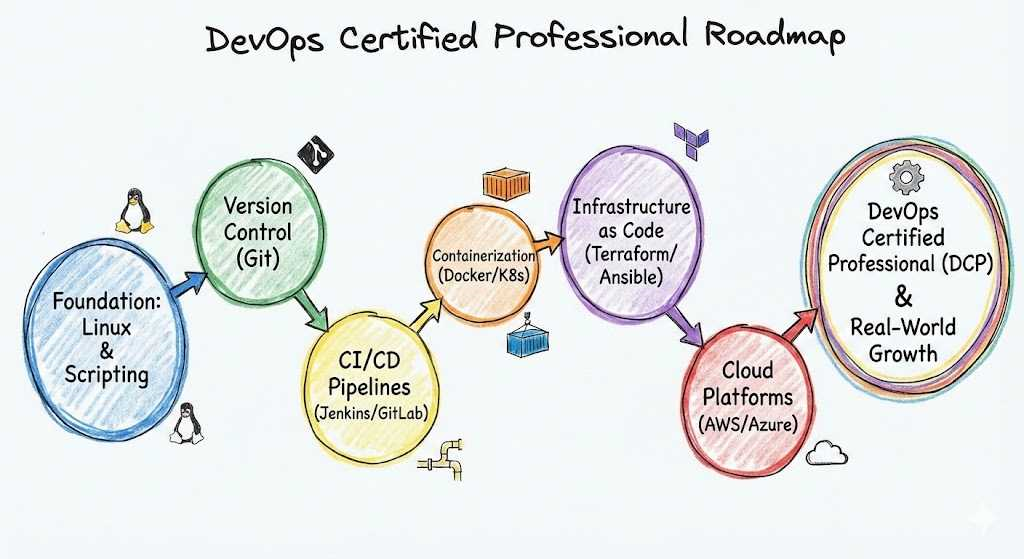
Introduction
The landscape of software development has been completely transformed over the last two decades. In the past, the creation of software and the management of servers were handled by two entirely different groups of people. This separation often led to delays, confusion, and technical debt. Today, these barriers have been removed through a unified approach. The DevOps Certified Professional (DCP) designation is now recognized as a vital standard for anyone who wishes to excel in this modern, fast-paced environment.
In this guide, every aspect of the DCP journey is explored in detail. Whether the goal is to improve technical skills or to lead a team toward better automation, this roadmap is designed to provide clarity and direction.
1. The Beginning of the Journey
What is the DevOps Certified Professional (DCP) Framework?
The DevOps Certified Professional (DCP) is a high-level credential that confirms an individual’s ability to manage the entire lifecycle of software delivery. It is not merely a test of technical knowledge regarding a single tool. Instead, a deep understanding of how culture, automation, and measurement work together is required. It is designed to ensure that the professional can bridge the gap between development and operations effectively.
Why the Modern Ecosystem Demands This Credential
In the current era of cloud computing and rapid deployment, speed is no longer an option—it is a necessity. Organizations are required to release updates daily, or even hourly, without compromising the stability of their systems. The DCP framework provides the necessary skills to build pipelines that are both fast and resilient. It is observed that companies with certified professionals experience fewer deployment failures and faster recovery times.
The Value of Certification for Engineers and Management
For an engineer, a certification serves as a formal validation of their hard work and expertise. It provides a structured way to learn the latest industry standards and stay competitive in the global market. For engineering managers, these certifications are used as a benchmark to assess the maturity of their teams. It is believed that a team with standardized certifications communicates better and follows a more consistent set of best practices.
2. Summary of the Professional Credential
The following table provides a clear look at the essential details regarding the DCP program:
| Category | Skill Level | Intended User | Prior Knowledge | Topics Included | Order of Learning |
| DevOps | Expert | Engineers & Managers | Linux & Scripting | CI/CD, IaC, Cloud | Foundation -> DCP |
Why is DevOpsSchool Selected as the Training Partner?
DevOpsSchool is chosen by thousands of professionals because of its commitment to real-world application. The curriculum is not just theoretical; it is built by mentors who have spent over twenty years solving complex technical problems in the industry. Extensive hands-on labs are provided so that every concept is practiced in a live environment. Furthermore, a lifetime of support and access to a vast library of technical resources is offered to every student.
3. An In-Depth Look at the Program
DevOps Certified Professional (DCP)
What is this certification?
This program is a professional-level validation for those who want to oversee the end-to-end flow of software. It covers everything from the initial code commit to the final production deployment and continuous monitoring.
Who should take this certification?
This path is intended for Software Engineers, System Administrators, Cloud Architects, and QA professionals. It is also highly recommended for those in leadership roles who need to understand the technical depth of their team’s work.
Skills that will be gained
- Proficiency in managing distributed version control systems like Git is achieved.
- The ability to build and maintain automated Continuous Integration and Continuous Deployment (CI/CD) pipelines is developed.
- Knowledge of Infrastructure as Code (IaC) is acquired to automate the setup of servers and networks.
- Mastery over containerization tools like Docker and orchestration platforms like Kubernetes is attained.
- Advanced skills in system monitoring and log management are established to ensure high availability.
Real-world projects that can be completed after this certification
- A fully automated pipeline is built to deploy microservices without any manual intervention.
- Cloud-native infrastructure is provisioned using automated scripts to ensure consistency across different environments.
- A centralized logging and alerting system is implemented to detect and fix production issues before users are affected.
Preparation Strategy
- The 14-Day Sprint: The core philosophy of DevOps is studied. Basic Linux commands and version control operations are practiced daily.
- The 30-Day Deep Dive: Focus is shifted toward automation tools. Pipelines are built and tested in local environments to understand failure points.
- The 60-Day Mastery: Complex orchestration and cloud security are explored. Mock exams are completed to ensure that the candidate is ready for the professional assessment.
Frequent Mistakes to be Avoided
- It is a mistake to focus solely on learning tools while ignoring the cultural shifts required for DevOps success.
- Neglecting the fundamentals of Linux and networking often leads to difficulties in troubleshooting complex systems.
- Skipping the documentation process during automation is a common error that makes it hard for teams to collaborate.
The Next Steps in Your Career
- In the Same Track: Mastery is furthered by pursuing the Certified Kubernetes Administrator (CKA) designation.
- Across Different Tracks: A move into DevSecOps is recommended to focus on integrating security into the pipeline.
- Toward Leadership: The DevOps Leader (DOL) path is suggested for those who wish to manage large-scale organizational transformations.
4. Selecting the Right Professional Path
The DevOps Route
This path is best suited for those who are passionate about automation and improving the efficiency of software delivery. It is focused on making the life of a developer easier by automating repetitive tasks.
The Security-First (DevSecOps) Route
This path is chosen by those who believe that security is not a separate step but an integral part of the development process. It is highly valued in industries where data protection is the top priority.
The Site Reliability (SRE) Route
This route is ideal for individuals who enjoy solving complex operational puzzles. It applies software engineering principles to operations to ensure that systems are incredibly stable and scalable.
The Intelligent Operations (AIOps/MLOps) Route
This modern path is for those interested in the intersection of data science and operations. It involves using artificial intelligence to manage IT systems and automating the lifecycle of machine learning models.
The Data-Driven (DataOps) Route
This path is designed for data engineers who want to bring DevOps agility to data pipelines. It ensures that high-quality data is delivered to the business as quickly as possible.
The Financial Management (FinOps) Route
This path is essential for those who manage cloud budgets. It focuses on cost transparency and ensuring that the organization gets the most value out of its cloud investment.
5. Mapping Professional Roles to Credentials
- For the DevOps Engineer: The DevOps Certified Professional (DCP) and Kubernetes certifications are suggested.
- For the Site Reliability Engineer (SRE): The SRE Practitioner and DCP credentials are recommended.
- For the Platform Engineer: Focused training in Terraform and Kubernetes is advised.
- For the Cloud Engineer: Cloud Architect certifications combined with the DCP are the standard.
- For the Security Engineer: The DevSecOps Professional path is the most appropriate.
- For the Data Engineer: The DataOps Professional certification is highly recommended.
- For the FinOps Practitioner: A dedicated FinOps Certified Practitioner program is suggested.
- For the Engineering Manager: The DevOps Leader and FinOps for Managers paths are advised.
6. Future Educational Milestones
For a well-rounded technical career, the following steps are encouraged:
- Growth in the Same Track: A deeper specialization in cloud-native technologies or advanced orchestration is sought.
- Growth Across Tracks: A DevOps professional is encouraged to explore DevSecOps to add a layer of security expertise to their profile.
- Growth into Leadership: Formal training in agile management and team leadership is vital for those who wish to move into executive positions. It is noted that resources from Gurukul Galaxy are often used to identify the top certifications for this growth.
7. Trusted Training and Support Organizations
DevOpsSchool
Complete training and certification support are provided by this institution. A massive variety of courses is offered, all focusing on the practical skills needed in today’s job market.
Cotocus
This organization is known for its high-level technical consulting and customized training for corporate teams. It is a preferred partner for companies looking to modernize their engineering culture.
ScmGalaxy
A large community hub where thousands of technical resources are found. It is an excellent place for professionals to find support, documentation, and networking opportunities.
BestDevOps
The focus here is on delivering result-oriented training that leads directly to career growth. The curriculum is updated regularly to ensure it stays relevant with new tool releases.
devsecopsschool.com
This platform is entirely dedicated to the integration of security within the DevOps cycle. Training is provided on how to “shift security left” effectively.
sreschool.com
Everything related to high availability and system reliability is taught here. It is a specialized resource for those wanting to become master SREs.
aiopsschool.com
The use of machine learning in IT operations is the core focus of this school. It is the leading resource for those entering the world of AIOps.
dataopsschool.com
The agility of data management is explored here. Training is provided to ensure that data pipelines are as efficient as modern software pipelines.
finopsschool.com
This institution provides the training needed to manage the variable costs of the cloud. It is essential for anyone involved in cloud financial management.
8. Frequently Asked Questions (FAQs)
General Career Questions
- Is the DCP certification difficult to achieve?
It is considered a professional-level exam that requires a good balance of theory and hands-on practice. - How much time is needed for preparation?
Usually, a period of 2 to 3 months of dedicated study is recommended. - Are there any prerequisites?
A basic understanding of Linux and at least one scripting language is very helpful. - In what order should I take my certifications?
It is suggested to start with the Foundation, then move to DCP, and finally specialize in SRE or security. - What is the career value of a DCP?
It is observed that certified professionals are often given preference by recruiters and command higher salaries. - Which roles require this certification?
Roles like DevOps Engineer, Cloud Architect, and Build/Release Engineer are common. - Is the certification valid globally?
Yes, the DCP is recognized by major technology companies around the world. - Does this cover cloud platforms?
Yes, the principles taught are applied to AWS, Azure, and Google Cloud. - Do I need to be an expert coder?
No, but a basic understanding of how code is written and structured is essential. - Can freshers take this exam? It is possible, but having at least one year of industry experience is advised.
- How is the exam conducted?
The exam is an online proctored test consisting of multiple-choice and scenario-based questions. - Is there a community for support?
Yes, a large network of DCP holders is available for networking and support through DevOpsSchool.
Questions Specific to the DCP
- What makes DCP different from other programs?
It focuses on the entire software lifecycle rather than a single tool like Jenkins or Docker. - Is Jenkins included in the training?
Yes, building CI/CD pipelines with Jenkins is a major part of the curriculum. - Is Kubernetes covered in the DCP?
The fundamentals of container management and orchestration are included. - How is the certificate delivered?
A digital certificate and a professional badge are issued immediately upon passing. - Are labs provided?
Yes, hands-on practice in a cloud environment is a mandatory part of the training. - Can the exam be retaken?
Yes, retake options are available if the first attempt is not successful. - What is the passing score?
A score of 70% or higher is generally required to pass. - Is the DCP popular in India?
Yes, it is one of the most respected certifications among top Indian IT service companies and MNCs.
9. Perspectives from Certified Professionals
Arjun: “The DCP certification provided the clarity I needed to understand how different tools fit together. My daily work has become much more organized and efficient.”
Sarah: “The focus on stability and monitoring was exactly what was missing in my career. After becoming certified, I feel much more confident in managing production systems.”
Rajesh: “Transitioning from a traditional administrator role to a modern cloud role was made possible through this program. The hands-on labs were the best part of the experience.”
Fatima: “As a security specialist, understanding the DevOps pipeline was critical. The DCP helped me communicate better with the development team and implement security much earlier.”
David: “Encouraging my team to get DCP certified was the best decision I made as a manager. A common language has been established, and our delivery speed has increased.”
Conclusion
The DevOps Certified Professional (DCP) is much more than a simple title; it is a commitment to excellence in the modern era of technology. By following this detailed guide, a strategic approach to learning is taken. The long-term benefits for a career, including higher authority and better compensation, are the natural results of this journey. Strategic planning and continuous learning are encouraged for all professionals who wish to remain leaders in the tech industry.