Introduction
Machine learning models are being developed at an incredible pace. However, the challenge of moving these models from a laptop to a production environment is where many projects fail. This gap is bridged by MLOps. A structured approach is required to ensure that AI systems are reliable, scalable, and maintainable. This guide is designed to provide a clear path for professionals who want to master the operational side of machine learning through the Certified MLOps Architect program.
What is Certified MLOps Architect
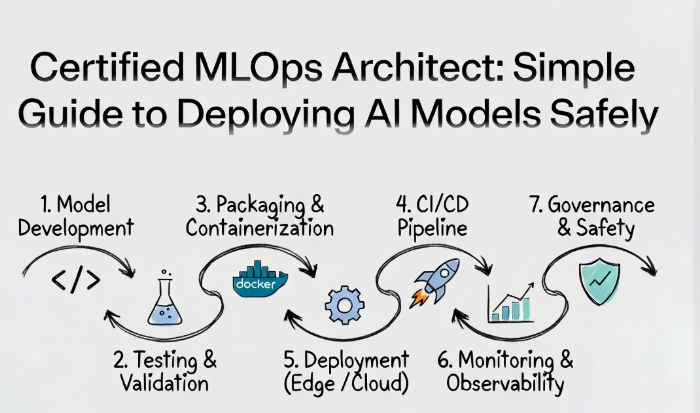
The Certified MLOps Architect is a professional designation focused on the intersection of Data Science, Data Engineering, and DevOps. It is a program where the principles of Continuous Integration and Continuous Deployment (CI/CD) are applied to machine learning workflows. The automation of the entire machine learning lifecycle is emphasized. This includes everything from data ingestion and model training to deployment and monitoring in a production setting.
Why it matters?
Machine learning models are not static like traditional software. They are prone to “drift,” where the accuracy of the model decreases over time as new data is introduced. Without a proper MLOps framework, models are often deployed manually, leading to errors and inconsistencies. High-scale AI systems are difficult to manage without automation. A Certified MLOps Architect ensures that these systems are built with a foundation of stability and repeatable processes.
Why Certified MLOps Architect certifications are important
A certification serves as a formal validation of a professional’s skills. It is often used by hiring managers to identify candidates who possess a standardized level of knowledge. In a competitive market, a certification helps a professional stand out. It provides a structured learning path that covers essential tools and methodologies that might be missed during self-study. For the individual, it builds the confidence needed to lead complex AI infrastructure projects.
Why choose AIOps School?
Specialized knowledge is offered by AIOps School that is specifically tailored for the future of IT operations. Unlike general cloud providers, the focus here is strictly on the marriage of Artificial Intelligence and Operations. Deep technical insights are provided through a curriculum that is updated frequently to match industry shifts. Professionals are given access to a community of experts who are actively working on AI-driven automation. Practical, hands-on learning is prioritized over theoretical lectures, making the transition to real-world roles much smoother.
Certification Deep-Dive: Certified MLOps Architect
What is this certification?
This certification is a comprehensive program that validates the ability to design and manage automated machine learning pipelines. The skills required to handle model versioning, testing, and monitoring at an enterprise scale are confirmed through this credential.
Who should take this certification?
This path is intended for DevOps engineers, data engineers, and software developers who wish to specialize in AI infrastructure. It is also highly beneficial for technical leads who are responsible for overseeing the deployment of machine learning models.
Certification Overview Table
| Track | Level | Who it’s for | Prerequisites | Skills Covered | Recommended Order |
| Foundation | Beginner | New MLOps learners | Basic Linux knowledge | MLOps Basics, Python | 1st |
| Professional | Intermediate | DevOps Engineers | CI/CD experience | Model Pipelines, Docker | 2nd |
| Architect | Expert | Senior Engineers | Cloud & K8s skills | Scalable AI Systems | 3rd |
| Security | Specialist | Security Engineers | MLOps Architect level | Model Governance, IAM | 4th |
| Observability | Specialist | SREs | Monitoring basics | Model Drift & Monitoring | 5th |
Skills you will gain
- The design of automated CI/CD pipelines for machine learning.
- Containerization and orchestration of AI models using Kubernetes.
- Implementation of automated data validation and model testing.
- Monitoring of model performance and detection of data drift.
- Governance and security practices for sensitive data in AI.
- Scaling machine learning workloads on various cloud platforms.
Real-world projects you should be able to do after this certification
- A fully automated pipeline for a recommendation engine is built.
- A model monitoring dashboard that alerts on accuracy drops is created.
- A scalable infrastructure for real-time fraud detection is deployed.
- A version-controlled data lake for large-scale training is managed.
- A secure environment for healthcare data processing is architected.
Preparation plan
7–14 days plan
The core concepts of MLOps are reviewed. The official documentation from the provider is studied daily. Practice quizzes are taken to identify weak areas. Short lab exercises focused on model containerization are completed.
30 days plan
A deeper dive into pipeline automation is conducted. Each major tool mentioned in the syllabus is practiced for at least three hours a week. A small end-to-end MLOps project is built on a local machine or a free cloud tier.
60 days plan
Advanced topics like model governance and complex orchestration are mastered. Mock exams are used to simulate the actual test environment. Detailed notes on troubleshooting common pipeline failures are prepared and reviewed.
Common mistakes to avoid
- Ignoring the importance of data versioning.
- Focusing only on model training while neglecting the deployment phase.
- Overcomplicating the initial pipeline structure.
- Underestimating the role of security in AI environments.
- Failing to monitor the model once it is live.
Best next certification after this
- Same track: Certified AIOps Specialist (to deepen automation skills).
- Cross-track: Certified DataOps Professional (to master the data flow).
- Leadership / management: Engineering Manager Certification (to lead large-scale teams).
Choose Your Learning Path
DevOps Path
The focus is on moving from general software delivery to specialized machine learning delivery. The integration of data scientists into the existing developer workflow is prioritized. This path is best for those who already understand Jenkins, GitLab, or GitHub Actions.
DevSecOps Path
Security is integrated into every step of the AI lifecycle. Vulnerability scanning for containers and data privacy compliance are the main goals. This is best for professionals who want to ensure that AI models are safe from attacks and data leaks.
Site Reliability Engineering (SRE) Path
The reliability and uptime of machine learning services are the primary concerns. High availability and incident response for AI systems are studied. This path is best for those who enjoy performance tuning and system stability.
AIOps / MLOps Path
This is the core path where AI is used to improve operations, and operations are used to improve AI. The entire loop of “AI for Ops” and “Ops for AI” is covered. This is best for specialists who want to be at the center of the AI revolution.
DataOps Path
The delivery of high-quality data to the machine learning models is ensured. Data cleaning, pipeline reliability, and data governance are the focus areas. This path is best for those who enjoy working with databases and large-scale data processing.
FinOps Path
The cost of running machine learning models in the cloud is managed and optimized. Spending is tracked, and efficiency is improved to ensure that AI projects remain profitable. This is best for those who enjoy the intersection of finance and cloud technology.
Role → Recommended Certifications Mapping
| Role | Primary Certification | Secondary Certification | Leadership Path |
| DevOps Engineer | Certified MLOps Architect | Certified AIOps Specialist | Platform Lead |
| SRE | Certified MLOps Architect | Observability Specialist | SRE Manager |
| Platform Engineer | Certified MLOps Architect | Kubernetes Expert | Infrastructure Head |
| Cloud Engineer | Certified MLOps Architect | FinOps Practitioner | Cloud Architect |
| Security Engineer | Certified MLOps Architect | DevSecOps Specialist | CISO |
| Data Engineer | Certified MLOps Architect | DataOps Professional | Data Director |
| FinOps Practitioner | Certified MLOps Architect | Cloud Finance Expert | Finance Lead |
| Engineering Manager | Certified MLOps Architect | Leadership Program | CTO / VP Eng |
Next Certifications to Take
One same-track certification
The Certified AIOps Specialist program is highly recommended. It expands on the knowledge of using artificial intelligence to automate complex IT operations and incident management.
One cross-track certification
The Certified DataOps Professional is an excellent choice. It ensures that the professional understands the data lifecycle, which is the fuel for every machine learning model.
One leadership-focused certification
An Engineering Management certification should be pursued. This helps in transitioning from a technical expert to a leader who can manage budgets, people, and high-level strategy.
Training & Certification Support Institutions
DevOpsSchool
A wide range of DevOps and SRE training is provided. Practical lab sessions are emphasized to ensure that students gain real-world experience. Support for various global certifications is offered through expert-led coaching.
Cotocus
High-end consulting and training for modern cloud-native technologies are delivered. Custom training programs are designed for corporate teams looking to upgrade their skills in automation and security.
ScmGalaxy
A vast community-driven platform for learning Software Configuration Management and DevOps is maintained. Helpful resources, blogs, and tutorials are shared to assist professionals in their daily technical tasks.
BestDevOps
A focus is placed on the most efficient pathways to becoming a DevOps expert. Simplified learning modules are created for busy professionals who need to master complex tools quickly.
devsecopsschool.com
Education on the integration of security into the DevOps pipeline is provided. The goal is to help engineers build secure software from the very first line of code.
sreschool.com
Specialized training for Site Reliability Engineers is offered. The curriculum covers everything from incident management to system performance and high availability.
aiopsschool.com
The primary destination for learning about AIOps and MLOps. A structured path is provided for those who want to lead the next generation of AI-driven operations.
dataopsschool.com
Training on the modern data stack and DataOps methodologies is delivered. The focus is on making data delivery faster and more reliable for business use.
finopsschool.com
Education on cloud financial management is provided. Professionals are taught how to optimize cloud spending and bring accountability to cloud usage.
FAQs Section
1. What is the difficulty level of the Certified MLOps Architect exam?
The level is considered intermediate to advanced. A good understanding of both software development and cloud infrastructure is required.
2. How much time is typically required to prepare?
Most professionals spend between 30 and 60 days preparing. This depends on their existing experience with CI/CD and machine learning.
3. Are there any strict prerequisites?
While there are no mandatory requirements, a basic knowledge of Python and Linux is highly recommended for success.
4. What is the recommended certification sequence?
The Foundation level is suggested first, followed by the Professional level, and finally the Architect level.
5. How does this certification add career value?
It positions the professional as an expert in a high-demand niche. Higher salary brackets are often accessed by those with this specialized credential.
6. Which job roles can I apply for after this?
Roles such as MLOps Engineer, AI Infrastructure Engineer, and Machine Learning Operations Architect can be pursued.
7. Is the certification recognized globally?
Yes, the standards followed by the provider are aligned with international industry requirements.
8. Is there a need to renew the certification?
Periodic updates or renewals are often required to ensure that the professional is aware of the latest tool updates.
9. Can a software engineer transition into this role?
Yes, software engineers with an interest in automation and AI are the primary candidates for this transition.
10. Are hands-on labs part of the learning process?
Practical lab exercises are a core part of the training to ensure that skills are applicable to real work.
11. Does this cover multiple cloud platforms?
The principles taught are generally applicable across AWS, Azure, and Google Cloud Platform.
12. What is the growth potential for MLOps roles?
The demand for these roles is growing rapidly as more companies move AI models into production.
Certified MLOps Architect Specific FAQs
1. Does this certification cover model training details?
The focus is on the deployment and management of the model rather than the deep mathematical creation of the model itself.
2. Is Kubernetes a major part of the syllabus?
Yes, orchestration using containers is a fundamental part of the architectural training.
3. How is model drift addressed in the curriculum?
Automated monitoring strategies are taught to detect when a model’s performance starts to decline.
4. Are specific MLOps tools like MLflow or Kubeflow covered?
Industry-standard tools are used in the practical sessions to demonstrate the concepts.
5. Does it include data privacy topics?
Governance and compliance for sensitive data are included in the advanced sections of the course.
6. Can an Engineering Manager benefit from this?
Managers gain the technical vocabulary and strategic understanding needed to lead AI teams effectively.
7. Is version control for data different from code?
Yes, the specific tools and methods for tracking large datasets are explained in detail.
8. What is the final step to get certified?
A formal examination must be passed, which usually consists of both theoretical and practical questions.
Testimonials
The clarity I gained regarding how to scale AI models was immense. The path provided was easy to follow and very practical for my daily work.
— Lucas
A huge boost in my confidence was experienced after finishing this program. I now understand the bridge between data science and our servers perfectly.
— Aria
The real-world application of the labs helped me solve a major deployment issue at my company the very next week.
— Mateo
Career growth was my goal, and this certification made me stand out. I am now leading the infrastructure side of our AI department.
— Elena
The skill improvement in automation was exactly what I needed. Everything is now viewed through a lens of reliability and efficiency.
— Kian
Conclusion
The Certified MLOps Architect certification is a vital step for any professional looking to succeed in the modern tech landscape. A bridge is built between the experimental world of data science and the stable world of operations. By following a structured learning path, engineers and managers can ensure that their skills remain relevant as AI continues to transform the industry. Long-term career benefits include higher demand, better compensation, and the ability to lead cutting-edge projects. Strategic planning and a commitment to continuous learning are the best ways to secure a future in this exciting field.