Introduction
In the modern financial landscape, digital infrastructure is considered a primary capital asset. When these assets are moved to the cloud, they must be protected with the same rigor as physical vaults. The Azure Security Engineer Associate (AZ-500) certification is designed to provide the technical expertise required to safeguard these investments. For professionals and organizations, this credential is seen as a way to reduce risk and ensure that the value of digital operations is never compromised by external threats.
The importance of security in the cloud ecosystem is recognized as a critical factor for business continuity. A single security failure is known to cause significant financial drain and loss of market trust. Therefore, security is no longer treated as a technical detail but as a core business requirement. For engineers and managers, certifications are viewed as a method to validate that the latest security protocols are understood and can be effectively implemented. By obtaining this certification, a high level of professional competence is demonstrated, ensuring that cloud environments remain secure and cost-effective.
Why Choose DevOpsSchool?
When a path for professional development is selected, the quality of the training provider is paramount. DevOpsSchool is recognized as a leader because a deep focus is placed on the practical application of security concepts. Complex Azure security tools are explained in a way that is easy to understand, ensuring that learners can apply their knowledge to real-world financial and technical environments.
Experienced mentors are provided to guide students through every step of the certification process. A hands-on approach is maintained, with labs designed to simulate the challenges faced in high-pressure corporate roles. By choosing this institution, a learner is given the tools needed to not only pass the exam but to become a highly valued asset in the global job market. Support is provided even after the course is completed, helping to ensure long-term career success.
Certification Deep-Dive: Azure Security Engineer Associate (AZ-500)
What is this certification?
The Azure Security Engineer Associate (AZ-500) is a professional validation of the ability to protect identity, data, and applications on the Microsoft Azure platform. It is considered a vital credential for anyone responsible for cloud security.
Who should take this certification?
This certification is intended for those who wish to specialize in cloud security management. It is also highly recommended for platform engineers and technical managers who must ensure that their infrastructure meets global compliance standards.
Certification Overview Table
| Track | Level | Who it’s for | Prerequisites | Skills Covered | Recommended Order |
| DevOps | Associate | Automation Engineers | Azure Basics | Secure Pipelines | AZ-104 then AZ-500 |
| DevSecOps | Associate | Security Architects | Networking Exp. | Automated Defense | AZ-500 |
| SRE | Specialist | Reliability Leads | System Ops | Fault Tolerance | AZ-104 then AZ-500 |
| AIOps/MLOps | Associate | AI Specialists | Data Science | Model Protection | AI-102 |
| DataOps | Associate | Data Engineers | SQL Knowledge | Data Encryption | DP-203 |
| FinOps | Specialist | Financial Ops | Cloud Billing | Cost Auditing | AZ-104, AZ-500 |
Skills you will gain
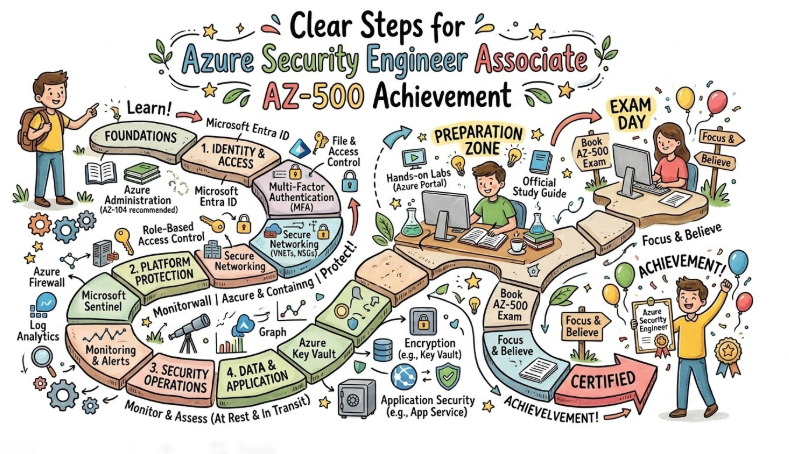
- The management of identity and access through Microsoft Entra ID is mastered.
- Security for the entire cloud platform, including networks and host systems, is implemented.
- Security operations are conducted using advanced monitoring and threat-tracking tools.
- Data and application security are ensured through robust encryption and access policies.
Real-world projects you should be able to do
- A secure network architecture for a large-scale financial application is designed and deployed.
- Automated compliance checks are configured to ensure that all Azure resources meet company standards.
- A centralized security incident response system is built using Microsoft Sentinel and Azure Logic Apps.
- Secure storage solutions for sensitive customer data are implemented using Azure Key Vault and Disk Encryption.
Preparation plan
7–14 Days Plan (The Knowledge Sprint)
- A high-level review of all exam domains is performed.
- Official Microsoft practice questions are used to identify knowledge gaps.
- Focus is placed on understanding the most common security services and their pricing models.
30 Days Plan (The Professional Pace)
- Week 1: Identity and Access Management concepts are studied in depth.
- Week 2: Protection for cloud platforms and networking is mastered through practical labs.
- Week 3: Security operations and threat protection tools are explored.
- Week 4: Data and application security modules are finalized, followed by comprehensive mock exams.
60 Days Plan (The Expert Mastery)
- Month 1: A strong theoretical foundation is built by studying every exam objective and service documentation.
- Month 2: Daily hands-on labs are performed to ensure that every configuration task is understood. The final two weeks are dedicated to taking multiple practice tests and reviewing errors.
Common mistakes to avoid
- The importance of hands-on practice in the Azure portal is often forgotten.
- The latest updates to Azure security services are sometimes ignored by learners.
- Too much time is spent on theory without understanding how to troubleshoot real-world security issues.
Best next certification after this
- Same track: Microsoft Certified: Cybersecurity Architect Expert (SC-100).
- Cross-track: Azure DevOps Engineer Expert (AZ-400).
- Leadership / management: Microsoft Certified: Azure Solutions Architect Expert (AZ-305).
Choose Your Learning Path
1. DevOps Path
This path is chosen by those who want to automate security within the software development lifecycle. The focus is placed on ensuring that every code deployment is secure by default.
2. DevSecOps Path
This is intended for security-focused engineers who wish to apply security principles at scale. Advanced threat modeling and automated response strategies are developed.
3. Site Reliability Engineering (SRE) Path
For those who view security as a part of system reliability. This path ensures that security controls do not interfere with system performance or uptime.
4. AIOps / MLOps Path
Security in the age of artificial intelligence is the main theme. The protection of machine learning models and the data they process is the primary goal.
5. DataOps Path
This path is best for professionals who manage large data sets. The focus is placed on maintaining data privacy and meeting strict regulatory requirements.
6. FinOps Path
The financial implications of security are managed here. This path is intended for those who must balance high-level security with cloud budget optimization.
Role → Recommended Certifications Mapping
| Professional Role | Entry Level Cert | Core Certification | Advanced Certification |
| DevOps Engineer | AZ-104 | AZ-500 | AZ-400 |
| SRE | AZ-104 | AZ-500 | AZ-700 |
| Platform Engineer | AZ-900 | AZ-500 | AZ-305 |
| Cloud Engineer | AZ-104 | AZ-500 | SC-300 |
| Security Engineer | SC-900 | AZ-500 | SC-100 |
| Data Engineer | DP-900 | AZ-500 | DP-203 |
| FinOps Practitioner | AZ-900 | AZ-500 | AZ-104 |
| Engineering Manager | AZ-900 | AZ-500 | AZ-305 |
Next Certifications to Take
A strategy for continuous professional growth is essential for staying ahead in the market.
- For the Automation Focused:
- Same-track: Kubernetes Security Specialist (CKS).
- Cross-track: AZ-500.
- Leadership: Certified Information Systems Security Professional (CISSP).
- For the Security Focused:
- Same-track: SC-400 (Information Protection).
- Cross-track: AZ-305.
- Leadership: CISM (Certified Information Security Manager).
- For the Data Focused:
- Same-track: DP-203 (Data Engineering).
- Cross-track: AZ-500.
- Leadership: CDMP (Certified Data Management Professional).
Training & Certification Support Institutions
- DevOpsSchool: High-quality training programs are offered with a focus on real-world practical skills. Learners are prepared for the demands of the global IT industry.
- Cotocus: Professional training in specialized cloud technologies is delivered. Corporate teams are upskilled through tailored learning paths.
- ScmGalaxy: A wide range of community-driven resources and technical guides is provided. A deep focus on configuration management and automation is maintained.
- BestDevOps: The best standards in technical education are upheld. Mentorship is offered to help students achieve their career goals in cloud and DevOps.
- devsecopsschool.com: Training is exclusively focused on the integration of security and DevOps. Practical methods for shifting security “left” are taught.
- sreschool.com: The principles of site reliability and system stability are explored. Engineers are trained to manage and secure large-scale environments.
- aiopsschool.com: The intersection of AI and cloud operations is mastered. Knowledge on how to automate security with intelligent systems is provided.
- dataopsschool.com: Secure data lifecycle management is the primary focus. Skills in data engineering and protection are developed through hands-on training.
- finopsschool.com: Cloud financial management and optimization are taught. Strategies for balancing security costs with cloud budgets are shared.
FAQs Section
- Is the investment in the AZ-500 certification recovered quickly?
A significant increase in market value is typically observed, leading to a rapid return on investment. - How does this certification reduce operational risk costs?
Skilled engineers can prevent costly security breaches by implementing the right controls early. - Is the demand for Azure security experts stable in the job market?
A constant and growing demand for security professionals is seen as cloud migration increases. - Are salaries for certified security engineers higher than for general cloud engineers?
A premium is often paid for specialized security expertise in the cloud. - How is job market liquidity improved by this credential?
Being certified by Microsoft makes a professional more attractive to a wider range of global employers. - Does this certification help in achieving senior-level promotions?
Clear evidence of technical leadership is provided by passing such an advanced exam. - Is the cost of the exam worth the long-term career stability?
Long-term career security is established by mastering a field that is critical to every modern business. - How is technical debt reduced through better security?
Security issues are caught early, preventing expensive rework and system downtime. - Can this certification be used to negotiate better contract rates?
Higher rates are often commanded by independent consultants who hold recognized certifications. - Is the Azure platform a safe bet for a long-term career?
Microsoft Azure is recognized as a leader in the cloud space, ensuring the relevance of this skill set for years. - How do certifications impact organizational trust?
Clients are more likely to trust a firm where the engineers hold verified security credentials. - Is it possible to switch from a non-security role to a security role using this exam?
A clear path for career transition is provided by mastering the AZ-500 domains.
AZ-500 Specific FAQs
- How is the cost of cloud security managed within the AZ-500 framework?
Optimization of security service costs is a key part of the learning objectives. - Are compliance standards like GDPR or HIPAA covered?
Tools for automated compliance monitoring and auditing are extensively explored. - Does the exam cover the financial risks of identity theft?
Methods for securing identities and preventing unauthorized access are a major focus. - Is the ROI of using Microsoft Defender for Cloud discussed?
The value of proactive threat detection versus reactive incident response is evaluated. - How is data loss prevention (DLP) addressed from a business perspective?
Strategies for protecting the company’s most valuable data assets are taught. - Are the costs of network security tools part of the syllabus?
The trade-offs between different security architectures and their costs are understood. - Is risk assessment a part of the AZ-500 journey?
The ability to identify and mitigate risks across the entire cloud platform is developed. - How are the financial benefits of automated security responses explained?
Human error and response time are reduced, leading to lower overall operational costs.
Testimonials
A significant improvement in the ability to manage cloud risks was achieved. The practical approach taken during the sessions was extremely valuable.
— Aarav
A clear understanding of how security impacts the bottom line was gained. The certification has opened many new doors in my career.
— Ishani
The mentorship provided was instrumental in passing the exam on the first attempt. Technical concepts were explained in a very human and simple way.
— Kabir
Confidence in securing large-scale Azure environments was built through this course. It is highly recommended for anyone in the cloud space.
— Megha
A strategic perspective on cloud security was developed. The importance of proactive defense is now fully integrated into my daily work.
— Reyansh
Conclusion
The Azure Security Engineer Associate (AZ-500) is recognized as an essential asset for any cloud professional. It provides the skills needed to protect the financial and technical integrity of a modern enterprise. Long-term career stability and increased earning potential are achieved by those who dedicate themselves to mastering these security domains. A proactive and strategic approach to learning is encouraged, as the value of cloud security will only continue to grow in the coming years.