Introduction
In the modern world of software development, speed and reliability are no longer optional. For software engineers and engineering managers, the ability to deliver high-quality code at a rapid pace is a requirement. Azure DevOps is recognized as a leading set of tools that allows teams to collaborate, plan, and automate their work. However, the path to mastery is often found to be confusing due to the vast number of features available.
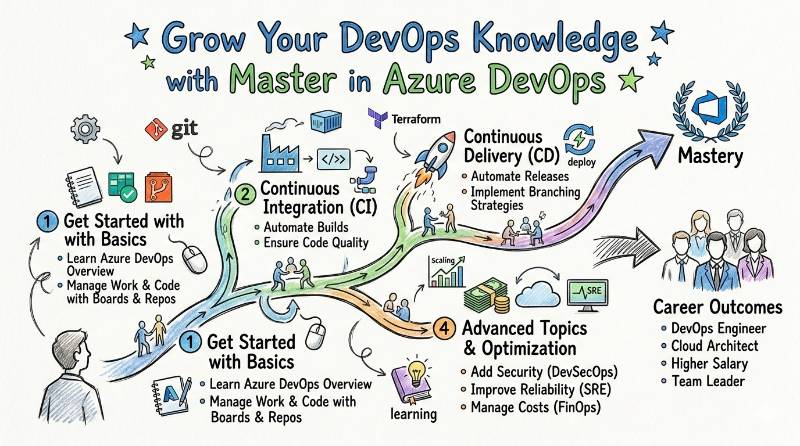
A structured learning path is provided by the Master in Azure DevOps program to solve this problem. This guide is written to help you navigate this journey. It is designed to ensure that the transition from a traditional developer or administrator to a cloud-fluent professional is handled smoothly. By the end of this article, a clear understanding of why this certification is valued globally will be gained.
What is Master in Azure DevOps?
The Master in Azure DevOps is a professional program where the entire lifecycle of software creation is taught. It is not limited to a single tool; instead, it is focused on how people, processes, and technology are brought together. This program is structured to provide deep knowledge of version control, automated testing, and cloud deployment. Every aspect of the software delivery pipeline is explored in detail, ensuring that the learner is prepared for complex, real-world scenarios.
Why it matters in today’s ecosystem
In today’s market, automation is the backbone of successful companies. Manual processes are being replaced by automated workflows to reduce human error and increase efficiency. By mastering Azure DevOps, an engineer is empowered to manage these automated systems. It is observed that organizations using these tools can release features much faster than their competitors. This ecosystem is built on the idea of continuous improvement, which is a vital skill in the current job market.
Why certifications are important for engineers and managers
Certifications are often used by recruiters as a filter to identify high-quality talent. For an engineer, it is a way for their skills to be validated by an external, trusted authority. For managers, certifications provide a roadmap for team development. When a team is trained under a standardized program like this, a common language is established. This leads to better communication, fewer misunderstandings, and a much higher success rate for technical projects.
Certification Overview Table
| Track | Level | Who it’s for | Prerequisites | Skills Covered | Recommended Order |
| Master in Azure DevOps | Expert | Engineers & Managers | Basic IT Knowledge | CI/CD, Boards, Repos, Security | 1st |
Provider: DevOpsSchool
Why Choose DevOpsSchool?
DevOpsSchool is frequently selected by professionals because the training is rooted in practical application rather than just theory.
- Expert Instructors: All sessions are conducted by veterans who have managed large-scale cloud environments for years.
- Hands-on Labs: A heavy emphasis is placed on “learning by doing,” where students are required to build actual pipelines.
- Updated Curriculum: The course material is reviewed and updated constantly to ensure it matches the latest Azure updates.
- Community Access: Long-term support is offered through a vast network of alumni and technical experts.
- Career Guidance: Assistance is provided to help learners translate their certification into better job opportunities.
Certification Deep-Dive
Master in Azure DevOps
What is this certification?
This is a comprehensive expert-level program where the complete suite of Azure DevOps services is covered. It is designed to transform a technical professional into a specialist who can handle the entire “Build-Test-Deploy” cycle.
Who should take this certification?
- Developers who wish to understand how their code is deployed and monitored in the cloud.
- System Administrators who want to move away from manual server management toward “Infrastructure as Code.”
- Project Managers who need to track team progress and quality metrics using modern tools.
Skills you will gain
- Azure Repos Mastery: The ability to manage complex codebases using Git branching strategies is developed.
- CI/CD Pipeline Construction: Automated workflows are created to ensure that every code change is tested and deployed without manual intervention.
- Azure Boards Management: Agile methodologies are implemented to track work, bugs, and sprints efficiently.
- Security Integration: Security checks are embedded directly into the development process to prevent vulnerabilities.
- Artifact Management: Private packages are shared and managed securely across the entire organization.
- Continuous Monitoring: Tools like Azure Monitor are used to track the health and performance of live applications.
Real-world projects you should be able to do
- Multi-Tier App Deployment: A full pipeline is built for an application consisting of a frontend, backend, and database.
- Zero-Downtime Releases: Strategies like Blue-Green or Canary deployments are implemented to ensure users never experience an outage.
- Cloud Infrastructure Automation: Tools like Terraform are integrated to set up servers and networks automatically.
- Compliance Auditing: Automated reports are generated to ensure that all deployments meet company security standards.
Preparation plan
- 7–14 days plan: The basics of Cloud computing and Git are mastered. Small repositories are created, and simple commits are practiced.
- 30 days plan: The focus is shifted to Azure Pipelines. Simple “Hello World” builds are created, and the logic of YAML-based pipelines is understood.
- 60 days plan: Advanced integrations are practiced. This includes connecting third-party security tools and managing complex release gates.
Common mistakes to avoid
- Ignoring the YAML Logic: Many beginners rely only on the visual editor and fail to learn the underlying code that powers the pipelines.
- Overlooking Documentation: It is often seen that students skip reading official documentation, which leads to a shallow understanding of the tools.
- Lack of Practice: Theory is quickly forgotten if it is not applied to a real project immediately.
Best next certification after this
- Same track: Azure Solutions Architect Expert.
- Cross-track: Google Cloud Professional DevOps Engineer.
- Leadership / management: Certified Kubernetes Administrator (CKA).
Choose Your Learning Path
- DevOps Path: This path is ideal for those who want to be the “engine” of a development team. It is focused on speed, efficiency, and removing bottlenecks in the software delivery process.
- DevSecOps Path: This is designed for security-minded professionals. The goal here is to ensure that speed does not come at the cost of safety. Every automated step is checked for security risks.
- Site Reliability Engineering (SRE) Path: This path is chosen by those who love solving puzzles related to system stability. It is focused on making sure that even if a system fails, it recovers quickly and automatically.
- AIOps / MLOps Path: This is the path of the future. It is focused on using Artificial Intelligence to manage operations and ensuring that Machine Learning models are deployed reliably.
- DataOps Path: This is perfect for data engineers. It focuses on how data flows through a company and ensures that data quality is maintained at every step of the pipeline.
- FinOps Path: This is a business-focused technical path. It is designed to help companies understand their cloud bills and find ways to save money without affecting performance.
Role → Recommended Certifications Mapping
- DevOps Engineer: Master in Azure DevOps is paired with Docker and Kubernetes for container management.
- Site Reliability Engineer (SRE): Master in Azure DevOps is combined with advanced monitoring tools like Prometheus.
- Platform Engineer: The focus is placed on Master in Azure DevOps along with Infrastructure as Code tools like Terraform.
- Cloud Engineer: This role is supported by Master in Azure DevOps and the Azure Administrator certification.
- Security Engineer: A combination of Master in Azure DevOps and Azure Security Engineer is recommended.
- Data Engineer: Master in Azure DevOps is utilized alongside Azure Data Factory for big data projects.
- FinOps Practitioner: Master in Azure DevOps is studied with a focus on Cloud Cost Management and optimization tools.
- Engineering Manager: Master in Azure DevOps is taken to understand the technical constraints, paired with Agile Leadership training.
Next Certifications to Take
- Same-Track Recommendation: Specialized certifications in Azure Network Engineering or Azure Database Administration should be explored to deepen technical expertise.
- Cross-Track Recommendation: A certification in AWS or Google Cloud is suggested to become a “Multi-Cloud” expert, which is highly valued by large enterprises.
- Leadership Recommendation: Certifications such as PMP (Project Management Professional) or specialized ITIL courses are recommended for those moving into senior management roles.
Training & Certification Support Institutions
- DevOpsSchool: This is a premier institution where a deep focus on technical excellence is maintained. A wide variety of courses are offered to help engineers stay updated with modern trends.
- Cotocus: Professional training and consulting are provided here, with a focus on helping organizations adopt cloud technologies effectively.
- ScmGalaxy: This is a community-driven platform where a wealth of knowledge regarding software configuration management is shared through blogs and tutorials.
- BestDevOps: Quick and effective training modules are delivered here, making it a popular choice for busy professionals who need to upskill fast.
- devsecopsschool.com: A specialized platform where the integration of security into the development cycle is treated as a core discipline.
- sreschool.com: Dedicated training for Site Reliability Engineering is provided, focusing on high availability and system resilience.
- aiopsschool.com: This institution prepares engineers for the age of AI, focusing on how machine learning can be used to improve IT operations.
- dataopsschool.com: The focus here is placed on the automation of data pipelines, ensuring that data is delivered accurately and on time.
- finopsschool.com: Specialized training in cloud financial management is offered to help professionals manage and reduce cloud spending.
FAQs Section
1. Is the Master in Azure DevOps certification difficult for beginners?
The program is structured to start with the basics, so while it is comprehensive, it is not considered impossible for a dedicated beginner.
2. How much time should be dedicated daily to finish in 2 months?
At least one to two hours of focused study and lab work is recommended for consistent progress.
3. What are the technical prerequisites?
A basic understanding of how the internet works and a willingness to learn command-line tools is all that is required.
4. Can I take this certification if I don’t know how to code?
Yes, while coding helps, Azure DevOps is largely about process and configuration, which can be learned without being a programmer.
5. How is this certification viewed by international companies?
It is highly respected globally as Azure is a major player in the cloud market for Fortune 500 companies.
6. What is the average salary growth expected after certification?
While it varies, a significant increase in salary is often reported by professionals who move into specialized DevOps roles.
7. Is there a focus on Linux or Windows?
Both environments are covered, as Azure DevOps is designed to be platform-independent.
8. Can I use these skills on other cloud platforms like AWS?
Yes, the core concepts of CI/CD and automation are universal and can be applied across all major cloud providers.
9. Are the labs performed on a real Azure account?
Yes, students are guided on how to use their own Azure accounts to perform real-world tasks.
10. Is any hardware required for the course?
A standard laptop with a stable internet connection is sufficient to access all the tools and labs.
11. Is job placement support provided?
Many of the mentioned institutions provide guidance on resumes and interview preparation to help students find roles.
12. Can this certification be used for freelance work?
Absolutely, many small companies look for certified experts to set up their initial cloud infrastructure.
Master in Azure DevOps Specific FAQs
13. What is the “Master” level in this certification?
It signifies that the learner has gone beyond basic tools and understands how to design complete, end-to-end systems.
14. Are there group discounts for corporate teams?
Most training institutions offer specialized pricing for companies looking to train their entire engineering department.
15. Is the exam conducted online or at a center?
Exams are typically available in both formats, allowing for maximum flexibility for the student.
16. Does the course cover mobile app deployment?
Yes, the principles of automating mobile builds are included in the advanced sections of the program.
17. What happens if the Azure portal changes?
The instructors provide updates and the curriculum is adjusted to reflect the latest UI and feature changes.
18. Is there a limit to how many times the labs can be practiced?
In most cases, students are encouraged to repeat the labs until they are completely confident in their skills.
19. How does this help in an Engineering Manager role?
It allows a manager to set realistic deadlines and understand the technical challenges their team faces every day.
20. Is this program suitable for fresh graduates?
Yes, it provides a practical edge that is often missing from traditional university degrees, making graduates more “job-ready.”
Testimonials
Karan:
The way complex topics were broken down into simple steps was very helpful. I was able to set up my first automated pipeline in just a few days. My confidence at work has grown tremendously.
Megha:
I had been struggling to understand the difference between CI and CD for a long time. This program made everything clear. The real-world projects were the highlight for me.
Vikram:
As a senior engineer, I was worried about staying relevant. This certification helped me transition into a modern DevOps role without any stress. The mentor support was excellent.
Sanjay:
The focus on security was exactly what I was looking for. I am now leading the DevSecOps initiative in my current company thanks to the skills I gained here.
Neha:
This course provided the perfect balance between theory and practice. I highly recommend it to anyone who wants to build a serious career in the cloud.
Conclusion
The Master in Azure DevOps certification is more than just a credential; it is a gateway to a more stable and rewarding career. As companies continue to move their operations to the cloud, the demand for professionals who can manage these systems will only increase. By following the structured path outlined in this guide, a solid foundation is built. It is encouraged that a long-term view of learning is taken, focusing on the quality of skills gained. The benefits of this certification are realized through better job roles, higher salaries, and the ability to solve complex technical problems with ease.