Introduction
Most people look at their bank account balance, see a positive number, and assume everything is fine. They might check if they have enough money to buy lunch or pay rent, but they rarely look closer.
Then, small surprises happen. A subscription you canceled three months ago is still charging your card. A restaurant overcharged you by ten dollars. Or worse, a stranger is making small, unauthorized purchases using your debit card number.
Modern banking apps make spending money very easy, but they also make it easy to miss financial mistakes. Reviewing your bank statement manually forces you to slow down and look at where your money actually went. You do not need a degree in finance or complex software to do it. You just need a pen, your statement, and a little bit of focus.
What Is a Bank Statement?
A bank statement is an official summary of all financial activity in your bank account over a specific period, usually one month. Think of it as a monthly report card for your money.
It lists every deposit (money coming in) and every withdrawal (money going out) between a starting date and an ending date.
Why Reviewing It Matters
Your bank is a massive business handling millions of transactions. Mistakes happen. Software glitches occur, merchants make billing errors, and criminals steal payment card information. If you do not check your statement, you carry the financial cost of these errors.
When you review your statement yourself, you take back control. You ensure that every dollar you earned was spent or saved the way you intended.
How the Manual Review Process Works
Reviewing a statement manually is a straightforward process. You compare what the bank says happened against what you know actually happened.
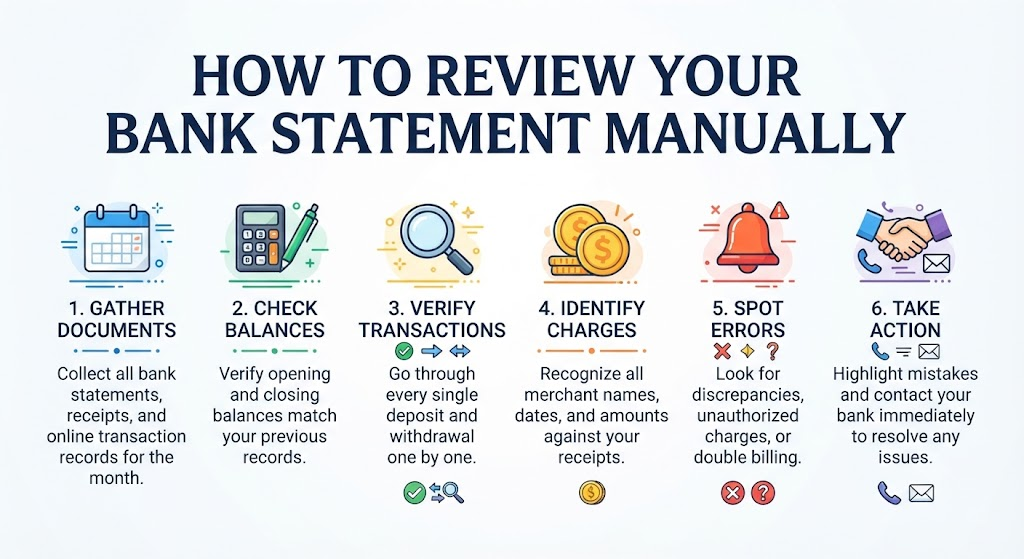
Step 1: Gather Your Records
Download or print your bank statement for the previous month. At the same time, gather your receipts, online purchase confirmations, and notes of cash withdrawals. If you use a budgeting app, open its transaction history as a secondary reference.
Step 2: Check Your Starting and Ending Balances
Look at the top of your statement.
- Starting Balance: How much money you had in the account on the first day of the statement cycle.
- Ending Balance: How much money you had on the final day.
Make sure the starting balance matches the ending balance of your previous month’s statement. If these numbers do not line up, your bank may have carried over an unresolved error.
Step 3: Line-by-Line Verification
Go through every single transaction on the list. Put a small checkmark next to each item that matches your records.
As you check them off, ask yourself three simple questions:
- Do I recognize this merchant or company name?
- Is the dollar amount correct?
- Did I actually authorize this transaction during this billing cycle?
Important Concepts to Know
When reading your statement, you will see a few financial terms that might look confusing. Understanding them makes the review much faster.
- Pending Transaction: A purchase you made that the merchant has not fully processed yet. It reduces your available balance, but it might not show up on your official monthly statement until it clears.
- ACH Transfer: Stands for Automated Clearing House. This is an electronic money movement between bank accounts, such as your direct deposit from your job or an online payment to your utility company.
- Overdraft Fee: A penalty charge the bank takes from your account when you spend more money than you actually have.
- Maintenance Fee: A monthly fee some banks charge just for keeping your account open, often waived if you maintain a minimum daily balance.
Common Mistakes to Look For
When you review your statement, keep an eye out for these frequent errors:
- Double Billing: A merchant accidentally swipes your card twice for the same purchase. You pay for the item two times.
- Incorrect Amounts: A restaurant worker types the wrong tip or total into the card reader, charging you more than your receipt shows.
- Forgotten Subscriptions: Free trials that automatically turn into monthly charges without clear warning.
- Unnoticed Bank Fees: Small, recurring account charges that eat away at your balance over time.
Risks and Limitations of Manual Reviews
Manual reviews are powerful, but they have natural limits.
- Human Error: It is easy to miss a tiny unauthorized charge if you skim the page too fast.
- Time Commitment: Reading through fifty lines of transactions takes patience.
- Delayed Discovery: Since statements only come out once a month, fraudulent charges from week one might sit undetected for thirty days.
To reduce these risks, pair your monthly manual review with real-time text or email alerts from your banking app for any transaction over a certain dollar amount.
A Simple Checklist for Your Review
Before you close your bank statement file each month, run through this quick checklist:
- Did I verify that my starting balance matches last month’s ending balance?
- Did I check every single deposit against my paycheck or expected income?
- Did I look up any unfamiliar merchant names to see what company they represent?
- Did I identify and question any unexpected bank fees?
- Did I flag any recurring subscriptions I no longer use?
- Did I report any unauthorized charges to my bank immediately?
Key Terms
- ATM Withdrawal: Taking physical cash out of an automated teller machine using your debit card.
- Cleared Check: A paper check that you wrote, which the recipient has successfully cashed or deposited, withdrawing funds from your account.
- Debit: Any money leaving your account, including purchases, bill payments, and cash withdrawals.
- Deposit: Any money added to your account, such as cash, checks, or electronic transfers.
- Merchant: A business or person selling goods or services who charges your card or account.
- Reconciliation: The process of matching your personal records against your bank statement to ensure they agree.
- Statement Period: The specific date range covered by your bank statement, usually lasting roughly 30 days.
FAQs
How often should I review my bank statement?
You should do a deep manual review once a month when your official statement arrives. However, checking your online transaction history once a week helps you catch problems much faster.
What should I do if I find an error on my statement?
Contact your bank’s customer service department immediately. Tell them you found an unauthorized or incorrect charge. Banks have specific dispute windows, so reporting problems quickly increases your chances of getting your money back.
Are small unrecognized charges a big deal?
Yes. Criminals often test stolen debit card numbers by making a tiny purchase of one or two dollars. If that goes unnoticed, they follow up with much larger charges. Always investigate unfamiliar charges, no matter how small.
Do online banking apps replace the need to review statements?
Not entirely. Apps show you what happened, but it is easy to scroll past mistakes on a phone screen. A structured monthly review forces you to look at the big picture of your spending habits and account security.
Why does a merchant’s name on my statement look different from their store name?
Many businesses use a parent company name or a payment processor name for their billing transactions. If a name looks completely unfamiliar, type it into a search engine along with the dollar amount to see what business pops up.
How long should I keep my old bank statements?
For personal use, keeping digital or paper statements for one year is usually enough for budgeting and tax purposes. If a statement contains records related to business taxes or major asset deductions, keep those for at least three to seven years.
Conclusion
Reviewing your bank statement manually is a simple habit that pays off. It takes very little time, but it guards your money against errors, hidden fees, and theft. By making this a regular part of your monthly routine, you stay fully aware of where your money goes and keep your financial life secure.