Introduction
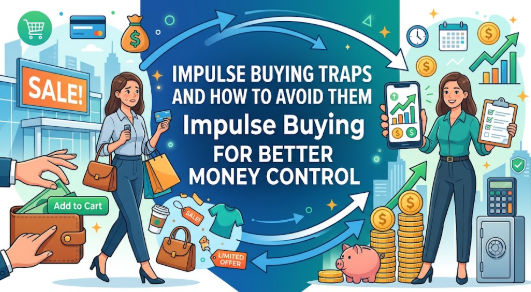
Small daily purchases may look harmless, but they can quietly damage monthly savings when they happen repeatedly without planning. A discounted product, late-night online order, food delivery, gadget upgrade, or social-media recommendation can make spending feel reasonable in the moment even when the purchase was never part of the budget. Understanding impulse buying traps and how to avoid them is therefore an important part of personal finance. Beginners often focus on earning more money while overlooking the effect of uncontrolled spending habits. This guide explains why impulse purchases happen, how emotions and marketing influence decisions, and how practical budgeting, waiting periods, spending limits, and better financial habits can help people make more deliberate choices.
Understanding Impulse Buying Traps and How to Avoid Them in Simple Words
Impulse buying means purchasing something without having planned the purchase properly beforehand. The decision usually happens quickly and is influenced more by emotion, convenience, excitement, urgency, or external pressure than by a careful assessment of need.
For example, imagine that you open a shopping application to buy a household item costing ₹500. You notice a promotional banner saying that a pair of headphones is available at a reduced price for a limited period. You had no plan to purchase headphones, but the discount makes the offer feel difficult to ignore. You add them to the cart and spend another ₹2,000.
The problem is not necessarily the headphones. The problem is that the purchase happened without considering your budget, priorities, existing products, upcoming bills, or savings goals.
Impulse buying traps are situations that encourage this type of unplanned spending. Common examples include:
- Limited-time discounts
- Flash sales
- Free-shipping thresholds
- Buy-one-get-one offers
- Social-media advertisements
- Influencer recommendations
- Emotional shopping
- Easy digital payments
- Saved card information
- One-click checkout
- Fear of missing out
- Lifestyle comparison
- Reward-point promotions
- Shopping during boredom or stress
People search for ways to control impulse spending because repeated small purchases can become significant over an entire month.
Impulse buying also connects directly with budgeting, saving, debt management, emergency funds, investing, and financial planning. Money spent unnecessarily cannot simultaneously be used for other priorities.
A common misunderstanding is that controlling impulse spending means avoiding all enjoyment. It does not. Responsible personal budgeting should allow some discretionary spending.
The better goal is intentional spending: choosing when, why, and how much you spend rather than allowing marketing or temporary emotions to make the decision.
Practical takeaway: Before buying something unexpectedly, create a small gap between wanting the product and paying for it. Even a short waiting period can improve decision quality.
Why Impulse Buying Control Is Important
Impulse spending affects more than the balance in a shopping account. It influences the entire financial system of an individual or household.
Savings
Every unplanned purchase competes with savings.
Someone trying to save ₹10,000 per month may struggle not because the savings goal is unrealistic, but because several ₹300, ₹500, or ₹1,000 purchases repeatedly consume the available surplus.
Borrowing
Impulse buying becomes more dangerous when purchases are funded through credit cards, consumer loans, buy-now-pay-later arrangements, or other borrowing.
A spontaneous purchase can become more expensive when repayment charges or interest are involved.
Investing
Money invested for long-term goals usually requires consistency. Frequent unnecessary spending may reduce the amount available for systematic investing.
Debt Management
People with existing debt need to manage cash flow carefully. Repeated discretionary purchases can delay debt repayment and increase financial pressure.
Emergency Preparedness
An emergency fund protects against unexpected expenses such as urgent travel, repairs, job uncertainty, or medical needs. Constant impulse spending can prevent this safety reserve from growing.
Emotional Decision-Making
Impulse purchases often provide temporary satisfaction. However, excitement can disappear quickly, leaving regret when the buyer realizes the product was unnecessary.
Long-Term Financial Discipline
Financial stability is generally built through repeated behaviors rather than isolated decisions.
If someone regularly practices deliberate spending, budgeting becomes easier. If spontaneous purchasing becomes normal, financial planning becomes harder.
Practical Scenario
Consider a salaried employee who earns enough to save each month but regularly orders food, buys discounted clothes, subscribes to unused services, and purchases small gadgets.
Individually, none of these expenses appears serious.
Together, they may consume the entire amount that could have gone toward an emergency fund.
The better approach is not complete spending restriction. It is allocating a realistic discretionary budget and stopping when that amount has been used.
The Real Problem Readers Face With Impulse Spending
Impulse buying is rarely caused by one single weakness. It usually results from several factors working together.
Lack of Awareness
Many people simply do not know how much they spend on unplanned purchases.
A ₹250 purchase feels minor. Fifteen similar purchases during the month equal ₹3,750.
Without expense tracking, the pattern remains invisible.
Too Much Confusing Advice
Financial advice online often swings between extremes.
Some people promote strict no-spending lifestyles, while others normalize buying almost anything as a form of self-care.
Neither approach works equally well for everyone.
Personal finance requires balance.
Emotional Decision-Making
Shopping can become a response to:
- Stress
- Boredom
- Loneliness
- Celebration
- Frustration
- Anxiety
- Social pressure
The purchase may solve an emotional need temporarily without solving the actual problem.
Poor Planning
When people shop without lists, budgets, priorities, or spending limits, extra purchases become much easier.
Weak Comparison
The excitement of an offer can cause buyers to skip basic questions:
- Do I need this?
- Do I already own something similar?
- Is this actually a good price?
- Can I afford it without using savings or credit?
- Would I buy it without the discount?
Unrealistic Expectations
Marketing often connects products with status, happiness, productivity, beauty, confidence, or convenience.
Products can certainly be useful, but they rarely transform life as dramatically as advertising suggests.
Ignoring Financial Risk
A small purchase may not seem risky, but repeated uncontrolled spending can create:
- Credit card balances
- Missed savings targets
- Insufficient emergency reserves
- Difficulty paying bills
- Financial stress
Social-Media Influence
Modern purchasing decisions are strongly influenced by repeated exposure.
Seeing the same product through advertisements, influencers, reviews, videos, and recommendations can create familiarity that feels like genuine need.
Unclear Next Steps
Many people recognize that they overspend but do not know what to change.
The solution is not simply saying, “Stop shopping.”
It requires identifying triggers, creating spending boundaries, adding purchase delays, improving budgeting, and reviewing behavior regularly.
How to Avoid Impulse Buying Step by Step
Step 1: Identify Your Personal Spending Triggers
The first step is understanding what normally causes your unplanned purchases. Some people shop when bored. Others spend after payday, during sales, after seeing influencers, or when feeling stressed. Review your last ten unnecessary purchases and ask what happened immediately before each one. For example, you may notice that most purchases occurred while scrolling social media at night. The common mistake is treating every purchase as an isolated event. The better approach is identifying repeated patterns because controlling the trigger is often easier than resisting every individual product.
Step 2: Separate Needs From Wants
Before making an unplanned purchase, classify the item as a genuine need, useful want, or temporary desire. A need supports basic living or an important responsibility. A want may improve comfort or enjoyment but can usually wait. A temporary desire often disappears quickly. For example, replacing broken work shoes may be necessary, while buying a third similar pair because of a discount is probably discretionary. The mistake is labeling every useful product as necessary. The better approach is asking what would realistically happen if you did not buy it this week.
Step 3: Use a Waiting Period
Create a waiting rule for non-essential purchases. Small purchases might require 24 hours, while expensive discretionary items may deserve several days or longer. During the waiting period, do not keep reopening the product page. For example, if you suddenly want a smartwatch, save the item to a list rather than purchasing immediately. The common mistake is believing that delaying means losing every good opportunity. The better approach is remembering that avoiding one unnecessary purchase can be financially more valuable than capturing every discount.
Step 4: Create a Discretionary Spending Limit
A budget should include money for enjoyment, dining, hobbies, entertainment, and personal purchases. Without such a category, people may feel restricted and eventually overspend. Decide how much discretionary spending your income and financial obligations comfortably allow. For example, someone might allocate a fixed monthly amount for non-essential purchases. Once the amount is used, additional purchases wait until the next budget period. The mistake is relying on mental calculations. The better approach is maintaining a visible spending limit.
Step 5: Make Purchasing Slightly Less Convenient
Digital commerce is designed to reduce friction. Saved cards, one-click checkout, payment wallets, notifications, and personalized recommendations make purchasing extremely easy. Add healthy friction by removing saved cards, turning off promotional notifications, unsubscribing from unnecessary marketing messages, or avoiding shopping applications during vulnerable periods. The mistake is believing discipline alone should solve everything. The better approach is designing an environment where you have enough time to reconsider purchases.
Step 6: Check the Opportunity Cost
Opportunity cost means understanding what you give up when choosing one use of money over another. Before spending ₹5,000 on an unnecessary product, ask what else that money could support. It might contribute to an emergency fund, insurance premium, education goal, debt repayment, investment, vacation fund, or planned larger purchase. The mistake is seeing only the product price. The better approach is comparing the purchase with your financial priorities.
Step 7: Review Purchases and Improve Monthly
At the end of each month, review your discretionary expenses without blaming yourself. Look for patterns. Which purchases were useful? Which were regretted? Which triggers appeared repeatedly? For example, you might discover that weekend browsing generates most unnecessary spending. The common mistake is reviewing only total expenses. The better approach is reviewing behavior as well as numbers. Financial habits improve when people learn from previous decisions.
Key Factors That Influence Impulse Buying
Income
Higher income does not automatically eliminate impulse spending.
People often increase discretionary spending as income rises. This is sometimes connected with lifestyle inflation.
The important question is not only how much you earn but how intentionally you allocate it.
Expenses
People who do not understand their fixed and variable expenses may believe they have more disposable money than they actually do.
Rent, insurance, school expenses, subscriptions, loan payments, utilities, groceries, and savings commitments should be considered before discretionary spending.
Needs Versus Wants
Distinguishing between necessities and optional purchases is a fundamental money-management skill.
A product can be useful without being necessary.
Savings Goals
Clear goals make spending decisions easier.
Someone saving for higher education, home ownership, travel, emergency reserves, or retirement has a meaningful reason to reconsider unnecessary purchases.
Emergency Fund
An emergency fund should generally remain separate from routine discretionary spending.
Using emergency savings to purchase lifestyle products weakens the protection that the fund is intended to provide.
Debt Control
Impulse spending becomes especially important when credit card balances or other high-cost debts already exist.
Using additional credit for non-essential purchases can increase financial pressure.
Lifestyle Inflation
When income grows, spending often grows with it.
Upgrading restaurants, clothing, electronics, vehicles, subscriptions, and entertainment may feel natural.
Some lifestyle improvement is reasonable, but automatic upgrading can prevent financial progress despite higher earnings.
Monthly Review
Regular financial reviews increase awareness.
A monthly review shows where money actually went instead of where you assumed it went.
Detailed Breakdown of Impulse Buying Traps and How to Avoid Them
The Discount Trap
Discounts create the impression that buying saves money.
But spending ₹3,000 on something unnecessary because its previous listed price was ₹5,000 does not create ₹2,000 of savings. It creates a ₹3,000 expense.
A useful question is:
Would I still buy this if there were no discount banner?
If the answer is no, the promotion may be driving the decision more strongly than genuine need.
The Limited-Time Offer Trap
Countdown timers and limited-time promotions create urgency.
Urgency reduces the amount of time people spend evaluating whether the purchase fits their budget.
The better approach is maintaining your waiting-period rule regardless of promotional pressure.
Missing a discretionary offer is usually less damaging than making a purchase you later regret.
The Free-Shipping Trap
Suppose your cart contains ₹800 of products, but free shipping starts at ₹1,200.
Adding a ₹400 item you do not need to avoid a ₹70 delivery charge increases total spending rather than reducing it.
Always compare the additional purchase amount with the actual fee being avoided.
Buy-One-Get-One Promotions
Buying more can be financially reasonable for products you already use regularly.
However, the same offer can encourage unnecessary consumption when applied to clothing, cosmetics, snacks, accessories, or other non-essential items.
Ask whether you genuinely need both units.
Social-Media Advertising
Social platforms can expose users to highly targeted products based on browsing behavior, interests, demographics, and previous engagement.
Repeated exposure can create a feeling that a product is popular, necessary, or personally relevant.
Avoid making purchases directly from advertisements.
Write the product down and evaluate it later independently.
Influencer Recommendations
A recommendation may be useful, but viewers should remember that promotional relationships, affiliate arrangements, free products, or individual preferences can influence online recommendations.
Evaluate products based on your own requirements.
Emotional Spending
Emotional spending occurs when purchasing becomes a way to change how you feel.
The person may be trying to reduce stress, reward themselves, overcome boredom, or create excitement.
A better habit is recognizing the emotion before opening shopping applications.
Payday Spending
Some people spend much more immediately after receiving salary because the account balance temporarily feels abundant.
A useful strategy is allocating savings, bills, debt payments, and essential expenses before discretionary spending begins.
One-Click Checkout
Payment convenience reduces time for reconsideration.
Removing saved payment information creates a small pause that can help prevent unnecessary purchases.
Credit Card Rewards
Reward points, cashback, and benefits can be useful when the underlying spending was already planned.
They become harmful when people spend extra simply to earn rewards.
Spending ₹1,000 unnecessarily to earn a small reward is still unnecessary spending.
Buy Now, Pay Later
Delayed payment can psychologically separate the pleasure of receiving the product from the cost of paying for it.
The important question is not whether you can postpone payment.
Ask whether the purchase fits your budget at all.
Subscription Traps
Free trials, introductory rates, and recurring subscriptions can create small but persistent spending leaks.
Review subscriptions regularly and cancel services that no longer provide meaningful value.
Lifestyle Comparison
Seeing friends, colleagues, influencers, or online personalities purchasing expensive products can create pressure to maintain a similar lifestyle.
Financial situations differ considerably.
Someone else’s visible spending tells you very little about their income, debt, savings, family obligations, or financial stability.
The Upgrade Trap
Companies frequently introduce improved versions of phones, watches, laptops, appliances, software, clothing, and other products.
An upgrade may be justified when your existing product no longer meets your needs.
It becomes an impulse trap when novelty alone drives repeated replacement.
Small-Purchase Blindness
People often examine large purchases carefully while ignoring small ones.
Coffee, snacks, food delivery, app purchases, accessories, delivery fees, and entertainment may appear insignificant individually.
Tracking them collectively reveals their actual effect.
Common Mistakes Beginners Make With Impulse Buying
Shopping Without a Budget
Without a predefined spending limit, almost every purchase can be mentally justified.
Create a discretionary allowance instead.
Treating Discounts as Savings
A discount saves money only when you were already going to buy the item at an acceptable price.
Otherwise, it creates an additional expense.
Following Random Recommendations
A product that works for an influencer, friend, or reviewer may not solve your needs.
Evaluate purchases independently.
Ignoring Financial Priorities
Impulse buyers sometimes focus on the affordability of today’s purchase without considering upcoming bills or financial goals.
Review your monthly plan first.
Using Emergency Money
Emergency funds are intended for genuine financial shocks, not temporary shopping desires.
Keep emergency money in a separate account when practical.
Borrowing for Discretionary Purchases
Using credit for products you cannot currently afford can convert short-term excitement into long-term repayment pressure.
Ignoring Terms and Conditions
Installment plans, cashback schemes, loyalty programs, subscriptions, and financing may have conditions that buyers overlook.
Read the relevant terms before committing.
Making Emotional Decisions
Stress, excitement, boredom, celebration, and social pressure can weaken financial judgment.
Delay purchases when emotions are unusually strong.
Depending Only on Social Media
Social media is useful for discovering products but should not be the only source of evaluation.
Compare features, price, actual need, durability, and alternatives independently.
Sharing Sensitive Information
Unfamiliar sellers, suspicious promotions, fake shopping websites, and fraudulent payment requests can expose personal or financial data.
Protect payment credentials, passwords, one-time codes, and identity information.
Don’t Do This Checklist
- Do not buy only because a countdown timer is running.
- Do not use emergency savings for unnecessary purchases.
- Do not borrow simply to maintain someone else’s lifestyle.
- Do not assume every discount is good value.
- Do not shop emotionally when stressed or frustrated.
- Do not keep buying to earn reward points.
- Do not ignore recurring subscription charges.
- Do not save payment information everywhere unnecessarily.
- Do not purchase expensive products without comparison.
- Do not trust unrealistic promotional claims.
- Do not confuse affordability with necessity.
- Do not allow social pressure to determine your spending.
Practical Real-Life Examples of Impulse Buying
Example 1: The Salaried Employee
Situation: A salaried professional regularly orders food and buys small products after work.
Challenge: None of the expenses appears large, but together they reduce monthly savings.
Better action: A fixed weekly discretionary allowance is created.
Learning: Small spending leaks become easier to control when they have a clear limit.
Example 2: The Student and Flash Sale
Situation: A student sees discounted headphones during an online sale despite already owning a functioning pair.
Mistake: The purchase feels justified because the discount seems unusually large.
Better action: The student follows a 72-hour waiting rule and eventually decides the upgrade is unnecessary.
Learning: A lower price does not automatically create a need.
Example 3: The Credit Card Reward Hunter
Situation: A cardholder increases monthly spending to reach a promotional reward threshold.
Mistake: Extra purchases are made solely to qualify for points.
Better action: Rewards are treated only as a benefit on purchases that were already planned.
Learning: Reward optimization should never override responsible budgeting.
Example 4: The Social-Media Shopper
Situation: Someone repeatedly buys beauty and lifestyle products recommended by creators.
Challenge: Several products remain unused.
Better action: All recommended products are added to a 30-day wish list instead of being purchased immediately.
Learning: Time separates genuine usefulness from temporary online influence.
Example 5: The Small Business Owner
Situation: A business owner frequently purchases office gadgets and subscriptions because they appear productivity-related.
Mistake: Business usefulness is assumed without reviewing actual usage.
Better action: New subscriptions require a defined business purpose and monthly review.
Learning: Business spending can also become impulsive when every product is labelled an investment.
Table 1: Common Impulse Buying Traps and Better Responses
| Impulse Buying Trap | Why It Works | Better Response |
|---|---|---|
| Flash sale | Creates urgency | Apply a waiting period |
| Large discount | Makes spending feel like saving | Ask whether you would buy at normal price |
| Free shipping threshold | Encourages larger carts | Compare extra spending with delivery cost |
| Influencer recommendation | Builds social trust | Evaluate personal need independently |
| One-click checkout | Removes thinking time | Remove saved payment details |
| Buy now, pay later | Delays perception of cost | Evaluate total affordability first |
| Reward points | Encourages spending for benefits | Earn rewards only on planned purchases |
| Emotional shopping | Provides temporary satisfaction | Identify the emotion before spending |
Table 2: Impulsive Spending Versus Mindful Spending
| Impulsive Approach | Mindful Approach |
|---|---|
| Buy immediately | Wait before buying |
| Focus on discount | Focus on actual need |
| Shop without a list | Use a planned shopping list |
| Spend first, save later | Allocate savings before discretionary spending |
| Follow social trends | Follow personal financial priorities |
| Use available credit | Check budget affordability |
| Ignore small purchases | Track recurring spending |
| Upgrade frequently | Replace products when genuinely needed |
Tools, Methods, and Frameworks Readers Can Use
Budget Tracker
A budget tracker records income and expenses.
Beginners can divide spending into categories such as housing, food, transportation, savings, debt, entertainment, shopping, and subscriptions.
The main benefit is visibility.
You cannot effectively control spending that you do not recognize.
Expense Sheet
An expense sheet focuses on actual transactions rather than planned amounts.
Recording discretionary purchases for one month can reveal patterns that memory misses.
Wish-List Method
Instead of purchasing immediately, place non-essential products on a wish list.
Add:
- Product name
- Price
- Date discovered
- Reason for wanting it
- Planned review date
Many items become less attractive after several days.
24-Hour Rule
Use a minimum 24-hour waiting period for unplanned purchases.
The method is especially helpful for online shopping because it interrupts instant checkout.
72-Hour Rule
For moderately expensive discretionary purchases, wait three days.
This provides time to compare alternatives and reconsider need.
30-Day Rule
For major lifestyle purchases, a longer cooling-off period may be appropriate.
The goal is not delaying necessary purchases but improving decisions around expensive wants.
Monthly Money Review
Set aside time once per month to review:
- Savings
- Bills
- Debt
- Discretionary spending
- Subscriptions
- Financial goals
- Regretted purchases
The review turns financial management into a learning process.
Goal Planner
Written financial goals make opportunity cost easier to understand.
Instead of thinking, “I should not spend ₹4,000,” you can think, “This ₹4,000 could move me closer to my emergency-fund target.”
Spending Trigger Journal
Whenever you make an unnecessary purchase, record the emotion or situation involved.
Patterns may include:
- Stress
- Payday excitement
- Weekend boredom
- Social-media browsing
- Sales notifications
- Comparison with friends
Once patterns become visible, they become easier to manage.
Risk Checklist
Before an expensive purchase, ask:
- Can I afford this without debt?
- Do I already own something similar?
- Will I use it regularly?
- Does it interfere with essential expenses?
- Have I compared alternatives?
- Am I buying because of pressure?
- Would I still want it next week?
Expert Tips to Make Better Spending Decisions
1. Pay Yourself First
Allocate money toward savings and important financial goals before discretionary spending begins. This matters because waiting until month-end to save often leaves little money available. Automating or scheduling savings can reduce the temptation to spend money that already has a purpose.
2. Give Fun Spending a Budget
A sustainable personal-finance plan does not have to eliminate entertainment and enjoyment. Allocate an affordable amount for hobbies, restaurants, shopping, and leisure. This reduces guilt while creating a clear spending boundary.
3. Avoid Shopping as Entertainment
Browsing shopping websites without a purchase goal exposes you to thousands of opportunities to spend. If you are bored, use activities that do not automatically place you in a commercial environment.
4. Turn Off Promotional Notifications
Sales alerts create artificial urgency. Disable unnecessary shopping-app and promotional notifications. You can search for products when you genuinely need something instead of allowing products to continuously search for your attention.
5. Keep a Running Wish List
Record interesting products rather than purchasing them immediately. Review the list periodically. Items you still want after several weeks can be evaluated against your budget.
6. Calculate Cost Per Use
For products you genuinely want, estimate how frequently you will use them. A relatively expensive item used hundreds of times may provide better value than a cheap product used once.
Cost per use is not perfect, but it encourages practical thinking.
7. Avoid Shopping When Emotionally Vulnerable
Strong emotions can distort judgment. If you feel stressed, angry, lonely, or unusually excited, delay discretionary financial decisions.
8. Review Your Digital Subscriptions
Software, entertainment, storage, fitness, learning platforms, and premium applications can create recurring spending. Review them regularly and remove services that no longer justify their cost.
9. Compare With Your Goals, Not Other People
Someone else’s lifestyle should not determine your spending.
Compare a purchase with your own goals, income, responsibilities, and priorities.
10. Use Cash-Flow Awareness
Before spending, consider upcoming expenses rather than looking only at your current account balance.
A large bank balance immediately after payday does not mean all of that money is available for discretionary purchases.
11. Question Urgency
When a seller says an offer will disappear soon, ask whether your underlying need will also disappear soon.
Usually, it will not.
12. Keep Emergency Money Separate
Keeping emergency savings separate from daily spending accounts creates a practical barrier against using it casually.
13. Review Regretted Purchases
Do not simply feel guilty about past mistakes.
Study them.
Ask what triggered the purchase and what rule could prevent repetition.
14. Protect Personal and Financial Data
Impulse decisions can also increase fraud risk because buyers may rush through unfamiliar websites or payment requests. Verify sellers and protect passwords, card details, and authentication codes.
15. Use Professional Advice When Financial Pressure Is Serious
If uncontrolled spending has created significant debt, repayment difficulties, or broader financial stress, consider speaking with a qualified financial professional or appropriate debt adviser.
Self-help strategies are useful, but complicated financial situations may require personalized guidance.
Case Studies: How Better Understanding Changes Decisions
Case Study 1: Salary Disappearing Before Month-End
Profile: Priya is a salaried professional with stable monthly income.
Situation: She regularly reaches the final week of the month with much less money than expected.
Problem: Priya assumes her main expenses are rent and groceries, but she has never reviewed smaller discretionary transactions.
Wrong approach: She repeatedly promises herself that she will “spend less next month” without changing any system.
Better approach: Priya reviews three months of transactions and identifies repeated food deliveries, fashion purchases, small online orders, and subscriptions. She creates a discretionary spending category, disables shopping notifications, and begins using a 48-hour rule.
Result or learning: Her spending becomes more predictable. She still enjoys discretionary purchases but chooses them deliberately.
Key takeaway: Awareness combined with simple boundaries is more effective than vague intentions.
Case Study 2: The Technology Upgrade Cycle
Profile: Arjun enjoys technology and frequently follows product launches online.
Situation: He replaces phones, headphones, smartwatches, and accessories more frequently than necessary.
Problem: Most upgrades are triggered by reviews and launch excitement rather than technical need.
Wrong approach: Arjun justifies each purchase by focusing on improvements between models.
Better approach: He creates an upgrade checklist. Replacement is considered only when the existing product has a meaningful limitation affecting daily use.
He also follows a 30-day waiting rule for expensive technology.
Result or learning: Some upgrades still happen, but they are connected to actual requirements.
Key takeaway: A product can be better than what you own without being necessary to buy.
Case Study 3: Rewards Creating More Spending
Profile: Sameer uses several credit cards and enjoys maximizing reward points.
Situation: He regularly participates in spending-based promotions.
Problem: He sometimes buys products he would otherwise avoid simply to reach promotional thresholds.
Wrong approach: Sameer calculates the reward value but ignores the unnecessary spending required to earn it.
Better approach: He creates a simple rule: rewards are considered only after deciding that the underlying purchase is necessary and affordable.
Result or learning: Reward optimization becomes secondary to spending control.
Key takeaway: A financial benefit attached to unnecessary spending does not automatically make the transaction financially beneficial.
Risk Awareness: What Readers Must Check First
Debt Risk
Impulse purchases funded with credit can create repayment obligations long after the excitement of the purchase disappears.
Risk reduction: Avoid borrowing for routine discretionary spending whenever possible and understand repayment terms before using credit.
Interest Cost Risk
Credit-card balances and some financing products may involve significant interest or charges when balances are not repaid according to the applicable terms.
Risk reduction: Understand total repayment obligations rather than focusing only on the monthly payment.
Emergency-Fund Risk
Repeated unnecessary spending can prevent emergency savings from growing or may cause people to withdraw money already saved.
Risk reduction: Keep emergency funds separate from everyday spending.
Fraud Risk
Urgent discounts and unfamiliar sellers can sometimes be used to pressure consumers into unsafe transactions.
Risk reduction: Verify sellers and avoid rushing financial payments.
Data Privacy Risk
Online shopping requires sharing personal information.
Risk reduction: Use trusted platforms, strong passwords, secure payment practices, and never share sensitive authentication information casually.
Emotional Risk
Shopping can become connected with emotional relief.
When purchasing becomes a repeated response to emotional difficulty, financial problems may increase.
Risk reduction: Identify emotional triggers and use non-shopping responses where possible.
Lifestyle Inflation Risk
Increasing income may create pressure to upgrade spending automatically.
Risk reduction: Increase savings and long-term financial contributions alongside lifestyle spending.
Misinformation Risk
Influencers, promotional content, online communities, and product advertising may encourage unnecessary financial decisions.
Risk reduction: Separate information from persuasion and evaluate purchases independently.
Opportunity-Cost Risk
Every rupee has alternative uses.
Money repeatedly spent on temporary wants may delay important goals.
Risk reduction: Compare large discretionary purchases with savings goals before buying.
Readers should always verify financial product terms independently and consult a qualified financial, tax, investment, or legal professional where individual circumstances require expert advice.
Checklist Before Making an Unplanned Purchase
Before paying for a non-essential item, check:
- Do I clearly understand why I want this?
- Did I plan to buy it before seeing the promotion?
- Is it a genuine need or discretionary want?
- Do I already own something that performs the same function?
- Have I waited before making the decision?
- Does the purchase fit my discretionary budget?
- Are my essential expenses already covered?
- Have I made the planned savings contribution?
- Is my emergency fund protected?
- Am I using debt for the purchase?
- Have I reviewed applicable interest, fees, or repayment conditions?
- Am I buying because of a discount rather than need?
- Am I reacting to fear of missing out?
- Am I trying to impress or copy someone?
- Am I shopping because I am stressed or bored?
- Have I compared alternatives?
- Have I checked the total price?
- Is the seller trustworthy?
- Is my personal information protected?
- Could this money support a more important goal?
- Would I still want this product next week?
- Would I buy it if there were no sale?
- Have I written the purchase into my financial plan?
Use this checklist as a decision filter rather than a strict prohibition against spending. If the purchase remains affordable, useful, and desirable after careful evaluation, buying it can be perfectly reasonable. The purpose is to replace automatic spending with intentional spending.
Strategic Insights for Better Decision-Making
Understand Your Spending Triggers
Most impulse buying follows predictable patterns.
You might spend more:
- After salary arrives
- Late at night
- During sales
- After stressful workdays
- While watching social media
- During celebrations
- When comparing yourself with others
A trigger does not automatically cause spending, but recognizing it allows you to prepare a response.
Control Lifestyle Inflation
Lifestyle inflation happens when spending automatically increases with income.
Suppose your salary rises by ₹10,000 per month.
If the entire increase goes toward restaurants, subscriptions, shopping, and upgrades, your financial position may not improve much.
A more balanced approach could allocate part toward lifestyle improvements and part toward savings or other goals.
Automate Important Priorities
Automation reduces reliance on willpower.
You may automate:
- Savings transfers
- Investment contributions
- Bill payments
- Debt repayments
When important commitments happen early, the remaining discretionary amount becomes clearer.
Use Goal-Based Budgeting
Money feels easier to protect when it has a defined purpose.
Instead of keeping an undefined savings balance, separate goals mentally or financially:
- Emergency fund
- Travel
- Education
- Vehicle
- Home purchase
- Retirement
- Business reserve
The stronger the purpose, the easier it becomes to reject low-value impulse purchases.
Practice Habit-Based Money Management
Personal finance improves when good behaviors become routine.
Examples include:
- Reviewing expenses every Sunday
- Checking subscriptions monthly
- Waiting before discretionary purchases
- Creating shopping lists
- Comparing expensive products
- Saving immediately after payday
Habits reduce the number of decisions requiring active willpower.
Make Impulsive Spending Visible
People often remember major expenses but forget small transactions.
Create a separate category called “Unplanned Purchases.”
Seeing the monthly total can significantly improve awareness.
Separate Affordability From Value
Being able to afford something does not automatically mean it is worth purchasing.
Ask two questions:
- Can I afford this?
- Does this purchase provide enough value to justify the money?
Both answers matter.
Focus on Total Financial Direction
You do not need perfect spending behavior.
Buying an unnecessary coffee, meal, book, game, or accessory occasionally will not automatically destroy a financial plan.
The bigger question is whether your overall financial direction supports your goals.
Sustainable financial discipline allows flexibility without losing control.
Key Terms Explained for Beginners
- Impulse Buying: Purchasing something without sufficient prior planning, usually because of emotion, urgency, convenience, or marketing influence.
- Discretionary Spending: Money spent on non-essential items such as entertainment, dining, hobbies, fashion, and optional upgrades.
- Needs: Essential expenses required for basic living, responsibilities, health, work, or important commitments.
- Wants: Products or experiences that improve enjoyment or comfort but are not essential.
- Budget: A plan showing how income will be allocated among expenses, savings, debt, and other goals.
- Emergency Fund: Money reserved for genuine unexpected financial needs rather than routine discretionary spending.
- Lifestyle Inflation: The tendency for spending to increase as income increases.
- Emotional Spending: Purchasing products or services mainly to influence mood or cope with emotions.
- Opportunity Cost: The value of the alternative use of money that is given up when you choose to spend it elsewhere.
- Cash Flow: The movement of money entering and leaving your personal finances over a period.
- Financial Goal: A specific money-related objective such as building emergency savings, repaying debt, funding education, or planning retirement.
- Cooling-Off Period: A self-imposed waiting period between wanting a product and buying it.
- Fear of Missing Out: Anxiety that an opportunity, experience, trend, or offer will disappear unless immediate action is taken.
- Recurring Expense: A payment that repeats regularly, such as a subscription, membership, or service charge.
- Mindful Spending: Making purchasing decisions deliberately based on need, value, affordability, priorities, and financial goals.
Who Should Read This Blog
Beginners
Anyone starting to learn personal finance can use these principles to understand the connection between daily spending and long-term financial stability.
Students
Students managing limited allowances or early income can benefit from learning spending discipline before larger financial responsibilities begin.
Salaried Employees
Regular income can make frequent discretionary purchases feel affordable. Spending systems help employees protect savings goals.
Small Business Owners
Personal and business impulse spending can both affect cash flow. Owners benefit from separating necessary business investment from attractive but unnecessary purchases.
New Investors
Investment consistency can be reduced when discretionary spending repeatedly consumes available surplus money.
Traders
Although trading decisions involve a separate set of financial risks, emotional discipline and money-management awareness are valuable for anyone making financial decisions.
Loan Seekers
People considering borrowing should control unnecessary spending and understand repayment capacity before adding new obligations.
Crypto Learners
Crypto involves significant volatility and other risks. Strong personal financial discipline can help prevent the use of emergency money or essential funds for speculative decisions.
Casino Content Readers
Anyone consuming gambling-related financial content should remember that gambling involves the possibility of financial loss and should never be treated as guaranteed income or a reliable money-making strategy.
Finance Bloggers
Content creators discussing money can use impulse spending as an important financial-awareness topic because behavioral habits strongly affect budgeting outcomes.
People Improving Money Awareness
Anyone who repeatedly wonders where their salary went by month-end may benefit from tracking unplanned purchases.
People Trying to Avoid Financial Mistakes
The principles in this guide can help readers reduce avoidable spending decisions while maintaining reasonable flexibility.
Frequently Asked Questions
1. What are impulse buying traps?
Impulse buying traps are situations that encourage people to purchase products without sufficient planning. Discounts, urgency, social influence, emotional triggers, easy payments, and personalized advertising are common examples.
2. Why are impulse buying traps and how to avoid them important?
Understanding impulse buying traps and how to avoid them helps people protect savings, control discretionary expenses, reduce unnecessary borrowing, and make purchasing decisions based on actual priorities rather than temporary emotion.
3. How can beginners stop impulse buying?
Start by tracking spending, identifying personal triggers, creating a discretionary budget, using a waiting period, and removing unnecessary shopping notifications. The goal is gradual improvement rather than perfect spending behavior.
4. Is all impulse buying financially harmful?
Not necessarily. An occasional affordable unplanned purchase may have little effect on a strong financial plan. Problems usually arise when spontaneous spending becomes frequent, expensive, debt-funded, or disruptive to important goals.
5. What is the best waiting period before buying?
There is no universal waiting period. A 24-hour rule can work for smaller purchases, while expensive discretionary items may deserve several days or weeks of consideration.
6. Can credit cards increase impulse spending?
They can make purchasing easier because payment feels less immediate. Credit cards can still be useful financial tools when used carefully, but spending should remain connected to budget affordability and repayment capacity.
7. Do discounts cause unnecessary spending?
Discounts do not automatically cause poor decisions, but they can encourage buyers to focus on the amount saved rather than the amount spent. Ask whether you would buy the product without the discount.
8. How does impulse buying affect personal budgeting?
Unplanned purchases make expenses less predictable. Repeated discretionary spending can reduce savings, interfere with bill planning, and make it difficult to understand where money is going.
9. Can social media increase impulse buying?
Yes. Repeated advertisements, influencer recommendations, product demonstrations, trends, and lifestyle content can create desire for products that were not previously considered necessary.
10. What is one simple way to control impulse buying?
Create a rule that every non-essential product must remain on a wish list before purchase. This creates distance between the initial emotional reaction and the financial decision.
11. Should I seek professional advice for overspending?
If spending has resulted in significant debt, serious repayment difficulties, or complex financial problems, qualified professional guidance may be useful. General budgeting tips cannot replace personalized financial advice.
12. What is the best next step after learning about impulse buying traps and how to avoid them?
Review your recent transactions and identify three unplanned purchases. Determine what triggered each one, create one prevention rule, and monitor whether that rule improves your decisions during the next month.
Conclusion
Understanding impulse buying traps and how to avoid them can help you build stronger money habits and protect your financial goals. The key is not to stop enjoying your money, but to spend with purpose. Track your expenses, identify emotional triggers, use a waiting period before non-essential purchases, and keep savings and emergency funds separate from casual spending. Avoid buying only because of discounts, social pressure, or limited-time offers. Review your spending regularly and learn from purchases you later regret. Over time, these small habits can improve budgeting, reduce unnecessary expenses, and support better financial discipline. Focus on making thoughtful decisions that match your needs, priorities, and long-term financial plans.