Introduction
Modern apps and websites need to run all day, every day. When a website goes down, users get frustrated, and businesses lose money. Managing these massive systems is a difficult job. In the past, companies separated software developers who write code from system administrators who keep servers running. Often, developers wanted to launch new features quickly, while system administrators wanted stability. This gap caused friction and frequent production outages.
Site Reliability Engineering was created to bridge this gap. Instead of relying purely on manual server management, SRE uses software engineering to solve operational problems.
This guide explores everything you need to know about SRE training, essential tools, certifications, and how to build a successful career as an SRE engineer.
What Is Site Reliability Engineering?
Site Reliability Engineering is a discipline that brings software development principles into infrastructure and operations.
Imagine you run a popular online store. During a massive holiday sale, millions of visitors arrive at the exact same time. If your servers crash, you lose millions of dollars in minutes. An SRE team writes code and builds automation frameworks to make sure the store stays online, handles the traffic spike, and recovers quickly if a server fails.
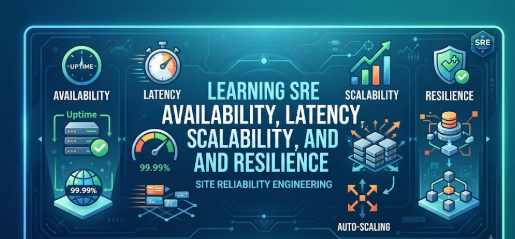
Instead of fixing problems manually when they break, SREs write programs to fix them automatically. They focus heavily on availability, latency, performance, efficiency, change management, emergency response, and capacity planning.
How SRE Works in Practice
SRE teams do not just sit and wait for servers to fail. Their daily work blends software development with system administration.
Half of an SRE’s time usually goes toward software engineering tasks, such as building automation tools, writing deployment pipelines, and designing monitoring systems. The other half involves operational work, such as responding to alerts, debugging tricky production bugs, and participating in post-incident reviews.
By automating repetitive tasks, SREs prevent burnout. If a routine task has to be done twice, an SRE will usually write a script or program to automate it the third time.
Why SRE Matters for Modern Businesses
Traditional IT operations often struggle to keep up with fast-paced software updates. When developers push new code daily, manual testing and deployment lead to human error and system instability.
SRE matters because it introduces a mathematical and systematic approach to uptime. Key reasons companies invest in SRE include:
- Higher System Uptime: Proactive monitoring and automation reduce unexpected outages.
- Faster Recovery: When things break, structured incident management helps teams restore service quickly.
- Controlled Risk: Error budgets allow teams to balance speed of delivery with system stability.
- Efficient Scaling: Automated infrastructure management lets systems grow smoothly as user demand increases.
Core Concepts of Site Reliability Engineering
To understand SRE, you must master several foundational concepts. These terms form the vocabulary of every reliability engineer.
Service-Level Indicators (SLIs)
An SLI is a careful quantitative measure of how well your service is performing. For example, an SLI might measure the percentage of web page requests that load successfully in under half a second.
Service-Level Objectives (SLOs)
An SLO is the target reliability goal for your service, agreed upon by the team and the business. If your SLI measures page load speed, your SLO might state that 99 percent of requests must load in under 500 milliseconds over a 30-day window.
Service-Level Agreements (SLAs)
An SLA is an explicit or implicit contract with your users or customers that includes consequences if the service fails to meet the SLO. While SLOs are internal goals to keep teams focused, SLAs often involve financial penalties or refunds if breached.
Error Budgets
An error budget is the allowable amount of unreliability a service can have before users notice and complain. It is calculated directly from your SLO. For example, a 99.9 percent availability target gives you an error budget of 0.1 percent downtime. If you have remaining error budget, developers can release new features quickly. If the budget is exhausted, feature releases pause until reliability is restored.
Essential SRE Tools and Technologies
SREs rely on a robust ecosystem of tools to monitor, manage, and automate infrastructure.
- Observability Tools: Platforms like Prometheus, Grafana, and Datadog help engineers monitor system health, track metrics, visualize logs, and trace requests across distributed networks.
- Infrastructure as Code (IaC): Tools like Terraform and Ansible let engineers manage and provision servers using code files instead of manual clicks.
- Containerization and Orchestration: Docker and Kubernetes help package applications and manage them efficiently across large clusters of servers.
- Incident Management Tools: PagerDuty and Opsgenie manage on-call schedules, alert engineers when systems fail, and track incident lifecycles.
SRE Best Practices for High Availability
Adopting SRE requires cultural and technical shifts. Successful teams follow proven best practices:
- Embrace Risk: Zero downtime is impossible and expensive. Instead of aiming for 100 percent uptime, set realistic targets based on business needs.
- Abolish Blame: When an outage happens, focus on fixing the broken process or system flaw, not punishing the human who made a mistake.
- Automate Operational Work: Eliminate toil—repetitive, manual work that brings no enduring value—by writing automation scripts.
- Practice Disaster Recovery: Test system resilience regularly by intentionally breaking things in controlled environments using chaos engineering.
- Write Detailed Post-Mortems: Document every major incident thoroughly. Explain what happened, why it happened, and what steps will prevent it from happening again.
SRE Training and Certification Programs
As demand for reliable cloud infrastructure grows, structured learning paths have become essential for IT professionals.
Comprehensive SRE training helps engineers transition from traditional system administration or software development into reliability engineering. These programs cover Linux internals, networking, cloud platforms, automation scripting, and observability.
Structured SRE certification exams validate your practical knowledge and show employers that you understand how to design, operate, and troubleshoot production systems. An in-depth SRE course walks learners step-by-step from foundational concepts to advanced production practices.
SRE Training in India and Global Markets
The demand for skilled Site Reliability Engineers has surged globally, with major tech hubs looking for structured talent.
Professionals seeking SRE training in India can find specialized bootcamps, online certifications, and corporate training programs designed to build practical operational skills. These courses focus heavily on hands-on labs involving Kubernetes, cloud platforms, CI/CD pipelines, and incident response workflows.
Common Mistakes Beginners Make
When starting out in Site Reliability Engineering, professionals often fall into common traps:
- Treating SRE as Just a New Name for SysAdmin: SRE requires software development skills. Simply monitoring servers manually is not SRE.
- Setting Unrealistic SLOs: Aiming for five nines (99.999 percent uptime) right away leads to constant stress and burned-out teams. Start with realistic targets.
- Ignoring the Human Element: Technology is only half the battle. If your incident response culture is toxic, talented engineers will leave.
- Over-Automating Too Early: Trying to automate everything before understanding the manual process often creates fragile automation scripts.
Decision Framework: Is SRE Right for Your Organization?
Before transforming your operations team into an SRE practice, evaluate your organization using this simple framework:
- Step 1: Assess System Complexity: Is your software distributed, microservices-based, and running in the cloud? If yes, SRE principles will help manage that complexity.
- Step 2: Measure Operational Pain: Are your engineers spending most of their time fighting fires rather than building new features? If yes, SRE automation and toil reduction will provide immediate relief.
- Step 3: Check Leadership Support: Does management understand that reliability requires slowing down feature releases when error budgets are exhausted? Cultural buy-in is mandatory.
- Step 4: Choose the Right Training: Invest in structured SRE courses and practical certifications to upskill your existing development and operations teams.
Checklist for Aspiring SRE Engineers
If you want to build a successful career as an SRE engineer, use this checklist to guide your learning journey:
- Master Linux operating system internals and command-line troubleshooting.
- Learn at least one programming language like Python, Go, or Bash for automation.
- Understand core networking concepts (TCP/IP, DNS, HTTP, load balancing).
- Gain hands-on experience with containerization using Docker and Kubernetes.
- Learn Infrastructure as Code tools like Terraform.
- Study monitoring, logging, and observability fundamentals using Prometheus and Grafana.
- Familiarize yourself with CI/CD pipelines and deployment strategies.
- Practice incident management, on-call rotations, and root-cause analysis.
Key Terms
- Toil: Repetitive, manual operational work that scales linearly with service growth and offers no enduring value.
- Chaos Engineering: The discipline of experimenting on a system in production to build confidence in the system’s capability to withstand turbulent conditions.
- Post-Mortem: A written record of an incident, its impact, the root cause, mitigation steps, and action items to prevent recurrence.
- Latency: The time it takes for a system to process a request and return a response.
- Pipeline: A set of automated steps that builds, tests, and deploys software code to production environments.
Frequently Asked Questions
What is the difference between DevOps and SRE?
DevOps is a cultural philosophy focused on breaking down silos between development and operations to deliver software faster. SRE is a specific implementation of that philosophy that treats operations as a software problem, focusing heavily on uptime, error budgets, and automation.
Do I need to know how to code to become an SRE?
Yes. Unlike traditional system administrators, SREs spend a significant portion of their time writing code to automate infrastructure, build monitoring tools, and fix production issues.
How do error budgets help engineering teams?
Error budgets bridge the gap between developers and operations. If a team has remaining error budget, developers can release new features quickly. If reliability drops and the budget runs out, the team pauses new features to focus entirely on fixing bugs and improving stability.
What background is best for an SRE career?
Professionals with backgrounds in software development, system administration, cloud engineering, or DevOps find the transition into SRE very natural.
How long does it take to complete an SRE course?
Timelines vary depending on the depth of the program. Foundational courses can take a few weeks, while comprehensive certification paths covering cloud platforms, Kubernetes, and observability often take several months of dedicated study and hands-on lab work.
Conclusion
Site Reliability Engineering transforms how organizations manage software in production. By combining software engineering with operational discipline, teams can build systems that scale smoothly, recover quickly from failures, and deliver great user experiences.
Whether you are an engineer starting your journey or an organization looking to improve system stability, investing in proper SRE training, mastering essential tools, and following proven best practices will help you build resilient and dependable modern technology platforms.