Introduction
In the modern world of technology, the speed at which software is delivered has become a primary measure of business success. To keep up with this demand, the industry has shifted away from traditional, siloed departments toward a unified approach. A key part of this shift is the Master in DevOps Engineering (MDE). This comprehensive guide is designed to explore every aspect of this certification and how it serves as a critical foundation for any professional aiming for a long-term career in the cloud and automation space.
What is Master in DevOps Engineering (MDE)?
The Master in DevOps Engineering (MDE) is an advanced professional program created to validate an engineer’s ability to manage the entire software delivery lifecycle. It is much more than a simple course on tools; it is a deep dive into the culture and methodologies that allow development and operations teams to work as one. The MDE framework is used to certify that a professional can handle everything from the first line of code to the final deployment in a live production environment. It covers the essential pillars of automation, communication, and measurement that define modern engineering excellence.
Why it matters in today’s software, cloud, and automation ecosystem
In today’s fast-paced market, efficiency is no longer an advantage—it is a requirement. Companies that fail to automate their processes often struggle with slow release cycles and frequent system failures. The MDE standards are used to bridge these gaps by introducing reliable automation at every stage. In a cloud-native world, where infrastructure is managed through code and systems must scale instantly, having a standardized approach like MDE is essential. It ensures that software is not only delivered quickly but is also stable, secure, and cost-effective.
Why certifications are important for engineers and managers
Certifications are used as a global benchmark for technical competency. For an engineer, being a certified Master in DevOps Engineering is a clear signal to employers that their skills have been tested and verified against industry standards. It provides a level of professional credibility that is hard to gain through experience alone. For managers, these certifications are used as a strategic tool for team building. By ensuring that team members are certified, a manager can be confident that everyone is following the same best practices, which reduces errors and improves overall team performance.
Certification Overview Table
| Track | Level | Who it’s for | Prerequisites | Skills Covered | Recommended Order |
| DevOps | Master | Engineers & Managers | Basic Linux & Coding | CI/CD, IaC, Monitoring | Foundation → MDE |
Provider: devopsschool
Why choose DevOpsSchool?
DevOpsSchool is frequently chosen by professionals because of its heavy emphasis on hands-on, real-world application. The training is not limited to theoretical slides; instead, it is delivered through practical labs and live projects. Technical guidance is provided by mentors who have spent over two decades solving complex infrastructure problems for global companies. Additionally, the curriculum is updated constantly to ensure it remains relevant to the latest industry trends. Comprehensive support, including lifetime access to course materials and a strong community network, is offered to every participant to ensure their long-term success.
Certification Deep-Dive
Master in DevOps Engineering (MDE)
What is this certification?
This is a high-level professional program that focuses on the end-to-end integration of the software supply chain. It is designed to take a professional from basic automation tasks to the design of complex, self-healing systems. The focus is placed on creating a seamless flow from the developer’s laptop to the customer’s screen.
Who should take this certification?
This path is highly recommended for software developers, system administrators, and site reliability engineers who wish to move into senior or lead roles. It is also extremely valuable for project managers and technical leads who need to understand the technical workflows of their teams to make better strategic decisions.
Skills you will gain
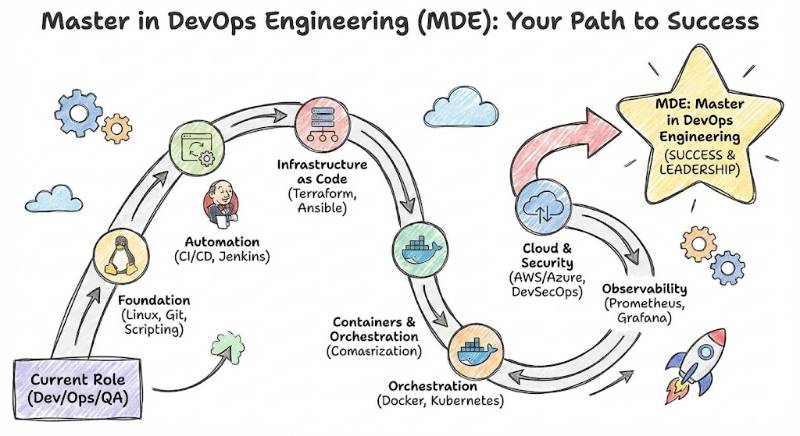
- Mastery of continuous integration and continuous deployment (CI/CD) pipelines.
- Deep knowledge of Infrastructure as Code (IaC) using tools like Terraform and Ansible.
- Professional management of containerized applications using Docker and Kubernetes.
- Implementation of advanced monitoring, logging, and observability frameworks.
- Integration of automated security protocols at every stage of the pipeline.
Real-world projects you should be able to do after this certification
- A fully automated, multi-stage deployment pipeline is built for a microservices-based application.
- A complete cloud infrastructure is provisioned across multiple regions using automated scripts.
- A sophisticated monitoring and alerting dashboard is created to track system health in real-time.
- A disaster recovery plan is automated to ensure zero downtime during system failures.
Preparation plan
- 7–14 days plan: The focus is placed on the basics of version control with Git and the Linux command line. Small automation scripts are written to handle repetitive daily tasks.
- 30 days plan: Hands-on labs are completed for build tools and containerization. A basic CI/CD pipeline is established for a sample project.
- 60 days plan: Complex orchestration and infrastructure management are explored. A capstone project is completed that integrates all the tools learned throughout the course.
Common mistakes to avoid
- Focus is placed only on learning specific tools instead of understanding the broader DevOps philosophy.
- Practical, hands-on practice is neglected in favor of just watching video tutorials.
- Security is ignored until the very end of the project instead of being built into the process from the start.
Best next certification after this
- Same track: Advanced Kubernetes Professional.
- Cross-track: Certified DevSecOps Professional.
- Leadership / management: Engineering Management and Leadership Certification.
Choose Your Learning Path
To help professionals align their education with their career goals, six specialized learning paths are provided:
- DevOps Path: This is the ideal choice for those who want to focus on the speed and agility of software delivery. It is designed for engineers who want to automate every part of the development lifecycle.
- DevSecOps Path: This path is chosen by security-minded professionals. It focuses on the “shift-left” approach, where security checks are integrated into the pipeline as early as possible.
- Site Reliability Engineering (SRE) Path: This is designed for those who care about system stability and uptime. It focuses on the intersection of operations and software engineering to create reliable systems at scale.
- AIOps / MLOps Path: This is a forward-looking path for those working with AI and machine learning. Automation is applied to the training, deployment, and monitoring of data models.
- DataOps Path: This is best for data engineers and architects. The focus is placed on the automated and secure flow of data from various sources to the final analysis platform.
- FinOps Path: This path is chosen by those who manage cloud finances. It provides the tools and strategies needed to optimize cloud spending and ensure that every dollar spent on the cloud is justified.
Role → Recommended Certifications Mapping
The following mapping is provided to help you choose the right certifications based on your current or future job role:
- DevOps Engineer: Master in DevOps Engineering (MDE) and Kubernetes Administration.
- Site Reliability Engineer (SRE): SRE Master Certification and Observability Specialist.
- Platform Engineer: Infrastructure as Code Master and MDE.
- Cloud Engineer: Multi-Cloud Architect and Cloud Automation Expert.
- Security Engineer: DevSecOps Professional and Cloud Security Master.
- Data Engineer: DataOps Master and Big Data Automation.
- FinOps Practitioner: FinOps Certified Professional and Cloud Cost Management.
- Engineering Manager: DevOps for Managers and Agile Leadership Certification.
Next Certifications to Take
Once the MDE certification is achieved, the following steps are recommended to continue your professional growth:
- One same-track certification: An Advanced Automation Architect course is recommended to further refine your technical skills in complex environments.
- One cross-track certification: A DevSecOps professional course is suggested to expand your expertise into the critical area of cybersecurity.
- One leadership-focused certification: A program in Strategic Engineering Management is recommended for those looking to move into executive or senior management positions.
Training & Certification Support Institutions
Several institutions are recognized for their excellence in providing training and support for these certifications:
- DevOpsSchool: This is a leading institution that provides comprehensive training programs across all DevOps disciplines. It is known for its practical approach and expert faculty.
- Cotocus: Specialized consulting and training services are provided here, with a focus on modern enterprise tools and cloud migration strategies.
- ScmGalaxy: This platform is used as a vast resource for version control, build automation, and configuration management. It is a hub for community learning.
- BestDevOps: Curated courses that are easy to understand for both beginners and experienced professionals are offered here.
- devsecopsschool.com: This institution focuses entirely on the integration of security into the DevOps process. It is the top resource for DevSecOps training.
- sreschool.com: Training that focuses on system reliability, performance, and scalability is provided here for engineers managing large-scale systems.
- aiopsschool.com: This platform explores the intersection of artificial intelligence and operations, providing training on how to use AI to automate IT tasks.
- dataopsschool.com: Specialized education for managing the data lifecycle with agility and security is found here.
- finopsschool.com: This institution provides the training needed to master the financial management of cloud resources, helping companies reduce waste.
FAQs Section
General Career FAQs
- Is the MDE program very difficult?
While the program is intensive, it is designed to be accessible to anyone with a basic technical background. - How much time should I dedicate daily?
Dedicating 1 to 2 hours a day is usually sufficient to complete the course in 3 months. - Are there coding prerequisites?
A basic understanding of scripting or any programming language is highly recommended. - In what order should I take the certifications?
It is best to start with the MDE Foundation before moving to the Master level. - What is the job market like for MDE graduates?
Demand is extremely high, with many roles offering competitive salaries and remote work options. - Can this certification help me work abroad? Yes, the MDE is recognized by tech companies in India, the US, Europe, and globally.
- Is the training conducted live?
Both live instructor-led sessions and self-paced options are typically available. - Will I get a certificate of completion?
Yes, a formal, verifiable certificate is issued upon the successful completion of the exam. - Is help provided for job interviews?
Many training partners offer dedicated sessions for resume building and interview practice. - Can I access the course material later?
Yes, lifetime access to the updated course content is usually provided. - Is there an exam fee?
The exam fee is often included in the total cost of the training program. - How do I renew my certification?
Renewal is usually required every three years through a short refresher course or exam.
MDE Focused FAQs
- Is MDE limited to AWS?
No, the program is cloud-agnostic and covers automation across AWS, Azure, and GCP. - How many tools will I learn?
You will be introduced to a wide range of tools, including Git, Jenkins, Docker, Kubernetes, and Terraform. - Is there a community for MDE students?
Yes, a private group is provided for networking and technical support among students and alumni. - What is the passing grade for the exam?
A score of 70% or higher is generally required to pass the final assessment. - Are there any hands-on projects?
Yes, completing a real-world capstone project is a mandatory part of the certification. - Can I take the course while working full-time?
Yes, the schedule is flexible to accommodate the needs of working professionals. - What makes MDE better than a general cloud cert?
MDE focuses on the process and automation, whereas cloud certs focus only on a specific provider’s tools. - Is the curriculum updated for 2026?
Yes, the latest tools and industry practices are always integrated into the training.
Testimonials
“My technical skills were greatly expanded by this program. The focus on real-world projects made a huge difference in my daily work.” — Amit
“A very clear and practical path for career growth was provided. I was able to transition into a senior role much faster than I expected.” — Sneha
“The automation techniques I learned here are now used by my entire team. It has completely changed how we handle our deployments.” — Rahul
“I finally understand how to integrate security into our pipelines. This course provided the practical knowledge that was missing from my previous training.” — Anjali
“This certification gave me the confidence to lead our company’s migration to the cloud. The mentorship was outstanding.” — Karthik
Conclusion
The Master in DevOps Engineering (MDE) certification is a powerful tool for any professional looking to excel in the modern tech industry. Long-term career benefits are gained through the mastery of automation, security, and system reliability. By following a structured learning path and utilizing the support of expert institutions, a successful and stable career is built. Strategic planning and a commitment to continuous learning are encouraged for everyone aiming to stay at the top of their field.