Introduction
Monthly subscriptions have become a normal part of modern life, from entertainment apps and cloud storage to mobile plans, learning platforms, software tools, and food delivery memberships. At first, these payments may look small and affordable, but when they continue automatically every month, they can quietly reduce your savings and disturb your budget. Many beginners do not notice how much they are spending because subscriptions are spread across cards, wallets, bank accounts, and app stores. The real challenge is not using subscriptions, but using them without regular review. This guide explains the Best Ways to Reduce Monthly Subscription Costs in a simple and practical way, so you can identify unused services, avoid duplicate payments, downgrade unnecessary plans, and build better control over your monthly money.
Understanding Monthly Subscription Costs in Simple Words
Monthly subscription costs are recurring payments you make regularly for services, apps, memberships, tools, content, storage, software, entertainment, or convenience-based products. Instead of paying once, you agree to pay every month, quarter, or year until you cancel or change the plan.
The topic works in a simple way. You subscribe to a service, give payment details, and the company charges you automatically based on the billing cycle. This can be helpful because you do not need to manually pay every time. However, the same convenience can become a problem when you forget what you are paying for.
People search for the Best Ways to Reduce Monthly Subscription Costs because they often feel that money disappears from their account without clear spending. Many discover that multiple small payments together become a large monthly burden.
In real life, subscription costs appear in areas such as:
- Entertainment apps
- Cloud storage
- Mobile and internet plans
- Gym or fitness apps
- Business software
- Online learning platforms
- News and magazine memberships
- Food delivery memberships
- Accounting, billing, or productivity tools
This connects directly with personal finance and budgeting because subscriptions are part of fixed or semi-fixed monthly expenses. If not reviewed, they can affect savings, loan repayment capacity, investment planning, and emergency fund building.
For example, a person may pay for three video streaming platforms but actively use only one. The simple takeaway is not to cancel everything, but to match every payment with actual usage and value.
A common misunderstanding is that “small payments do not matter.” In reality, small recurring payments matter because they repeat every month. The practical takeaway is simple: review subscriptions like you review rent, EMI, groceries, and savings.
Why Reducing Monthly Subscription Costs Is Important
It helps you spend on real value:
The purpose is not to cancel everything, but to keep only those subscriptions that are useful, affordable, and regularly used.
It helps you save more money:
Small monthly payments may look minor, but together they can reduce your savings. Cutting unused subscriptions helps you keep more money for important goals.
It improves monthly budgeting:
When you know exactly where your money is going, it becomes easier to plan your expenses, savings, and emergency needs.
It reduces unnecessary spending:
Many people pay for apps, tools, or memberships they rarely use. Reviewing subscriptions helps remove wasteful payments.
It protects your emergency fund:
Money saved from unused subscriptions can be used to build or protect an emergency fund for medical needs, job loss, repairs, or urgent expenses.
It reduces financial stress:
Fewer automatic deductions mean fewer surprises in your bank account. This helps you feel more in control of your money.
It helps avoid duplicate payments:
Sometimes people pay for multiple apps that offer the same service. Reducing subscriptions helps you keep only the most useful one.
It supports debt repayment:
If you have loans or credit card bills, reducing unnecessary subscriptions can free up money for repayment.
It improves spending discipline:
Regularly checking subscriptions builds a habit of thinking before paying, instead of spending automatically.
It prevents free trial charges:
Many subscriptions start as free trials and later become paid plans. Reviewing them helps avoid unwanted deductions.
The Real Problem Readers Face With Monthly Subscriptions
- Lack of awareness:
Many people do not know how many subscriptions they are paying for every month. Payments happen automatically, so they often go unnoticed. - Too many small payments:
One subscription may look affordable, but several small payments together can become a big monthly expense. - Forgotten free trials:
Many users start free trials and forget to cancel them before the paid billing begins. This creates unwanted charges. - Duplicate services:
People often pay for multiple apps that offer similar services, such as streaming, cloud storage, music, or productivity tools. - Unused subscriptions:
Some subscriptions continue even when the user rarely opens the app or uses the service. - Poor monthly budgeting:
Without a clear budget, people fail to track recurring payments and understand how much money is going out regularly. - Emotional sign-ups:
Users subscribe during discounts, offers, influencer promotions, or temporary excitement without checking long-term need. - Ignoring renewal dates:
Annual or monthly renewals can happen silently. Many users notice them only after money is deducted. - Not reading terms and conditions:
Some users do not check cancellation rules, refund policies, or price changes, which can create confusion later. - Weak comparison before buying:
People often choose premium plans without comparing basic plans, family plans, or cheaper alternatives. - Using multiple payment methods:
Subscriptions linked to different cards, wallets, and bank accounts become harder to track. - No regular review habit:
The biggest problem is not reviewing subscriptions every month. Without review, unnecessary payments keep continuing automatically.
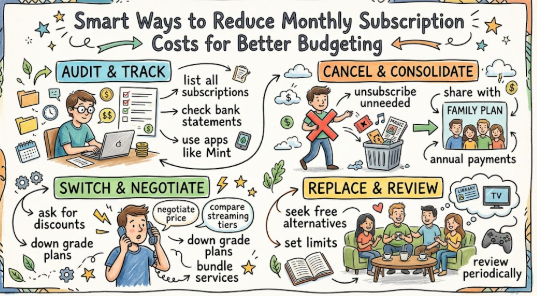
How to Reduce Monthly Subscription Costs Step by Step
Step 1: List Every Active Subscription
What it means:
Write down every recurring payment you make, including apps, memberships, software, entertainment, mobile add-ons, and business tools.
Why it matters:
You cannot reduce what you cannot see. Many people underestimate subscriptions because payments are spread across bank accounts, cards, wallets, and app stores.
How to apply it:
Check bank statements, credit card bills, UPI autopay, app store subscriptions, emails, and payment reminders.
Practical example:
You may find a cloud storage plan, two streaming apps, one music app, and one unused learning platform.
Common mistake:
Checking only one bank account.
Better approach:
Review all payment sources together.
Step 2: Separate Essential and Non-Essential Subscriptions
What it means:
Divide subscriptions into must-have, useful, optional, and unused categories.
Why it matters:
This prevents emotional cancellation of services that are actually important for work, education, or family use.
How to apply it:
Ask: “Does this subscription save time, support income, improve learning, or provide regular value?”
Practical example:
Accounting software used for business may be essential, while an unused entertainment app may be optional.
Common mistake:
Cancelling randomly without checking purpose.
Better approach:
Judge each payment by value and usage.
Step 3: Track Usage Before Cancelling
What it means:
Review how often you actually use each service.
Why it matters:
A low-cost subscription used daily may be more valuable than an expensive subscription used once a month.
How to apply it:
Check app usage, login history, watch history, project usage, or family usage.
Practical example:
A music app used daily during work may be worth keeping, while a premium course platform unused for months may not be.
Common mistake:
Judging only by price.
Better approach:
Judge by cost plus usage plus value.
Step 4: Downgrade Before Cancelling
What it means:
Move from premium to basic plans where possible.
Why it matters:
Sometimes you do not need to cancel the service; you only need a lower plan.
How to apply it:
Check whether you can reduce screens, storage, features, users, or add-ons.
Practical example:
A freelancer using premium software only for basic tasks may shift to a lower plan.
Common mistake:
Keeping premium features “just in case.”
Better approach:
Pay only for features you regularly use.
Step 5: Remove Duplicate Services
What it means:
Cancel subscriptions that perform the same function.
Why it matters:
Duplicate services create hidden waste.
How to apply it:
Compare streaming apps, cloud storage services, productivity tools, learning platforms, and business software.
Practical example:
If two apps offer similar note-taking features, keep the one you actually use.
Common mistake:
Keeping multiple apps because each has one attractive feature.
Better approach:
Choose the service that solves most of your need.
Step 6: Set Renewal Reminders
What it means:
Create calendar alerts before renewals, especially for free trials and annual plans.
Why it matters:
Many people pay because they forgot to cancel before renewal.
How to apply it:
Set reminders three to seven days before billing.
Practical example:
Before an annual software plan renews, you can decide whether to continue, downgrade, or cancel.
Common mistake:
Trusting memory.
Better approach:
Use reminders and written tracking.
Step 7: Review Family and Business Sharing Options Carefully
What it means:
Some services allow family plans or team plans that can reduce cost per user.
Why it matters:
Legal sharing can reduce duplicate payments.
How to apply it:
Read plan terms and check whether family or team usage is allowed.
Practical example:
A family music plan may be better than four separate individual plans if the provider allows it.
Common mistake:
Sharing accounts against terms.
Better approach:
Use only allowed sharing options.
Step 8: Repeat the Review Monthly
What it means:
Subscription management should be a regular habit.
Why it matters:
New subscriptions can appear every month, especially after trials, offers, or work needs.
How to apply it:
Choose one date every month for a subscription review.
Practical example:
Review subscriptions during salary week or monthly budget planning.
Common mistake:
Doing one review and never checking again.
Better approach:
Make it part of your monthly money routine.
Key Factors That Influence Subscription Costs
Income
Income decides how much flexibility you have. A subscription that feels small for one person may be heavy for another. Beginners should compare recurring payments with monthly income, not just individual price.
Expenses
Subscriptions should be reviewed along with rent, groceries, transport, EMIs, insurance, and savings. If basic expenses are already high, unnecessary subscriptions can create pressure.
Needs vs Wants
A need supports work, education, safety, health, or essential communication. A want provides comfort, entertainment, or convenience. Both can be valid, but they should not be confused.
Savings
If subscriptions reduce your ability to save regularly, they need review. A good budget protects savings before lifestyle upgrades.
Emergency Fund
Emergency money should not be disturbed because of recurring lifestyle costs. If subscriptions stop you from building an emergency fund, the better approach is to reduce low-value plans.
Debt Control
People with credit card dues, personal loans, or EMI pressure should review subscriptions more strictly. Reducing recurring costs can support repayment discipline.
Lifestyle Inflation
As income increases, people often add more subscriptions without noticing. Lifestyle inflation can reduce the benefit of higher income.
Monthly Review
Subscription costs change over time. Offers expire, plans increase, and usage changes. A monthly review keeps spending aligned with real needs.
Detailed Breakdown of Best Ways to Reduce Monthly Subscription Costs
Track Income Before Reviewing Subscriptions
The first step in reducing subscription costs is understanding your income clearly. Beginners often focus only on expenses but ignore income stability. A salaried employee may have predictable income, while a freelancer or small business owner may have irregular cash flow.
If income is stable, a fixed subscription budget can work well. If income is irregular, subscriptions should be more flexible and fewer in number.
Common mistake: Keeping too many fixed monthly plans with unstable income.
Better approach: Keep essential tools and pause optional subscriptions during low-income months.
Create Clear Expense Categories
Subscriptions should be divided into categories such as entertainment, learning, work tools, storage, health, finance, and lifestyle. This makes it easier to identify overspending.
For example, one streaming app may be reasonable, but four entertainment subscriptions may not match your budget. Similarly, one business tool may be necessary, but multiple overlapping tools can increase costs.
Common mistake: Treating subscriptions as small random payments.
Better approach: Put them into proper budget categories.
Understand Needs vs Wants
Not every subscription is wasteful. A tool used for business, accounting, design, writing, communication, or productivity may support income. However, a subscription bought out of boredom or social pressure may be less important.
A beginner should ask:
- Do I use this regularly?
- Does it support my work or learning?
- Can I replace it with a lower-cost option?
- Will cancelling it affect my daily life?
Common mistake: Cancelling useful subscriptions and keeping emotional ones.
Better approach: Decide based on value, not mood.
Build an Emergency Fund First
Before adding premium plans, paid communities, and lifestyle memberships, focus on building emergency savings. Emergency funds protect you during job loss, health issues, urgent travel, family needs, or business slowdown.
Subscriptions should not weaken emergency preparedness. If your emergency fund is not ready, avoid unnecessary paid plans.
Common mistake: Spending first and saving whatever remains.
Better approach: Save first, then spend on selected subscriptions.
Control Debt Before Lifestyle Upgrades
If you have credit card debt or high-interest loans, subscription review becomes even more important. Recurring expenses can reduce repayment capacity and extend financial stress.
Reducing unused subscriptions may not solve all debt problems, but it can support a better repayment plan.
Common mistake: Paying for unused apps while delaying debt repayment.
Better approach: Reduce waste and redirect money toward important financial priorities.
Review Small Spending Leaks
Subscription leaks often happen through free trials, auto-renewals, app upgrades, extra storage, premium features, and forgotten memberships. These leaks do not feel large immediately, but they repeat.
A good method is to check every recurring payment and ask: “Would I subscribe again today if I had to manually approve this payment?”
Common mistake: Continuing payments because cancellation feels inconvenient.
Better approach: Cancel or downgrade anything you would not choose again.
Improve Saving Habits Through Automation
Once you reduce subscription waste, do not let the saved money disappear into other spending. Create a habit of moving that money into savings, emergency funds, debt repayment, or goal-based accounts.
This turns cost reduction into real financial improvement.
Common mistake: Cancelling subscriptions but spending the saved money casually.
Better approach: Give saved money a purpose.
Review Progress Regularly
Subscription management is not a one-day activity. Your needs change. A learning app may be useful for three months and unnecessary later. A business tool may be needed during a project and removable afterward.
A monthly review helps you stay updated.
Common mistake: Assuming old decisions are still correct.
Better approach: Review subscriptions based on current usage.
Common Mistakes Beginners Make With Monthly Subscription Costs
Following Random Advice
This happens when people copy someone else’s app list or financial routine. It is risky because your income, needs, family size, job, and goals are different. Instead, build your own subscription system.
Ignoring Risk
Many people save card details without checking cancellation rules or renewal dates. This can lead to surprise deductions. Always review billing terms.
Not Comparing Options
Some users keep expensive plans because they never compare basic, family, student, or annual options. Compare carefully before renewing.
Trusting Fake Savings Claims
Some platforms may use attractive language to make upgrades look necessary. Do not upgrade unless the feature solves a real problem.
Ignoring Hidden Charges
Taxes, add-ons, extra storage, extra users, and premium features can increase costs. Read the billing page carefully.
Making Emotional Decisions
People subscribe during excitement, stress, boredom, or social pressure. Pause before buying.
Using Emergency Money for Optional Services
Emergency money should be protected. Avoid spending it on lifestyle subscriptions.
Not Reading Terms and Conditions
Cancellation rules, renewal dates, and refund policies matter. Not reading them can create avoidable problems.
Sharing Sensitive Information Carelessly
Avoid entering card details on unknown or suspicious platforms. Protect financial data.
Depending Only on Social Media Advice
Social media recommendations may not match your needs. Use your own budget and usage review.
Don’t Do This Checklist
- Do not keep subscriptions you cannot remember using.
- Do not ignore free trial expiry dates.
- Do not pay for duplicate services.
- Do not upgrade only because of discounts.
- Do not share account details carelessly.
- Do not use credit cards for subscriptions you cannot control.
- Do not forget annual renewals.
- Do not cancel essential work tools without alternatives.
- Do not rely only on social media recommendations.
- Do not treat small payments as meaningless.
Practical Real-Life Examples of Monthly Subscription Cost Reduction
Example 1: Salaried Person Managing Month-End Pressure
Situation: A salaried employee feels short of money before salary day.
Mistake or challenge: Several entertainment and app subscriptions are active but rarely used.
Better action: The person reviews all payments, cancels unused plans, and keeps only one useful streaming service.
Learning: Small recurring payments can affect monthly comfort when they are not reviewed.
Example 2: Student Paying for Too Many Learning Apps
Situation: A student subscribes to multiple online course platforms.
Mistake or challenge: The student watches only a few lessons but keeps paying monthly.
Better action: One course is completed first before paying for another.
Learning: Learning subscriptions are useful only when matched with discipline and completion.
Example 3: Freelancer Using Duplicate Tools
Situation: A freelancer pays for design, storage, writing, and project tools.
Mistake or challenge: Some tools overlap and offer similar features.
Better action: The freelancer keeps the most useful tools and downgrades others.
Learning: Business subscriptions should support income, not create unnecessary fixed costs.
Example 4: Family With Multiple Individual Plans
Situation: A family has separate music and entertainment subscriptions for each member.
Mistake or challenge: Costs are higher because nobody checked family plans.
Better action: They review allowed family plans and reduce duplicate payments legally.
Learning: Shared plans can help when used according to provider terms.
Example 5: Small Business Owner Forgetting Trial Renewals
Situation: A small business owner tests several software tools during a project.
Mistake or challenge: Free trials convert into paid plans after the project ends.
Better action: Renewal reminders are added before every trial expiry.
Learning: Trial tracking is important for business budgeting.
Two Useful Tables for Better Understanding
Table 1: Subscription Type vs Review Approach
| Subscription Type | What to Check | Better Decision Approach |
|---|---|---|
| Entertainment apps | Usage, duplicate content, family need | Keep one or two high-use services |
| Learning platforms | Course completion, career relevance | Pay only when actively learning |
| Business software | Income support, project need, team usage | Keep tools that support work output |
| Cloud storage | Storage used, duplicate backups | Downgrade or clean files before upgrading |
| Fitness apps or gym plans | Attendance and consistency | Pause or switch if not used regularly |
| News or content memberships | Reading frequency and value | Keep only regularly used sources |
| Mobile add-ons | Data usage and plan overlap | Remove add-ons not needed |
| Food delivery memberships | Order frequency and actual savings | Cancel if usage is low |
Table 2: Beginner Mistake vs Correct Approach
| Beginner Mistake | Why It Hurts Budget | Correct Approach |
|---|---|---|
| Forgetting free trials | Leads to unwanted charges | Set renewal reminders |
| Keeping duplicate apps | Increases recurring waste | Choose the most useful option |
| Paying for premium features | Cost rises without real need | Downgrade to basic plan |
| Not checking bank statements | Hidden payments continue | Review monthly statements |
| Buying annual plans blindly | Money gets locked upfront | Test usage before long commitment |
| Ignoring cancellation terms | Difficult exits or surprise renewals | Read billing terms first |
| Using many cards for payments | Tracking becomes confusing | Maintain one subscription tracker |
| Not reviewing family usage | Separate payments increase cost | Use allowed shared plans |
Tools, Methods, and Frameworks Readers Can Use
Budget Tracker
A budget tracker is a simple sheet, notebook, or app where you record income and expenses. It helps beginners see how much money goes toward subscriptions every month. Use it by listing all recurring payments under one category. It helps avoid the mistake of treating subscriptions as invisible spending.
Expense Sheet
An expense sheet gives more detail than a basic budget. You can add service name, amount, billing date, card used, purpose, and cancellation link. This helps avoid forgotten renewals.
Monthly Money Review System
This is a fixed monthly habit where you review income, spending, subscriptions, savings, and upcoming bills. Beginners can use it on salary day or the first weekend of every month. It helps avoid emotional and unplanned spending.
Goal Planner
A goal planner connects money with future needs such as emergency funds, travel, education, debt repayment, or investment planning. When you see your goals clearly, unnecessary subscriptions become easier to reduce.
Subscription Audit Checklist
This is a checklist that asks whether each subscription is used, needed, affordable, replaceable, or cancellable. It helps beginners make structured decisions instead of emotional ones.
Card Statement Review
Bank and card statements show actual deductions. Reviewing them helps find subscriptions you forgot. This method is especially useful when payments are spread across different platforms.
Renewal Calendar
A renewal calendar reminds you before billing dates. This is useful for annual plans, free trials, and business tools. It helps avoid surprise charges.
Needs vs Wants Framework
This framework separates essential subscriptions from lifestyle subscriptions. It helps beginners avoid cancelling useful tools while removing low-value payments.
Expert Tips to Make Better Subscription Decisions
1. Review Subscriptions Every Month
This matters because subscriptions change as your lifestyle, work, and interests change. Apply it by choosing one fixed review date monthly and checking all recurring payments.
2. Cancel What You Do Not Use
Unused subscriptions are direct money leaks. Apply this by checking last usage and cancelling services you have not used meaningfully.
3. Downgrade Premium Plans
Premium features are useful only when actively needed. Apply this by comparing your actual usage with the lower plan features.
4. Avoid Free Trial Traps
Free trials are helpful but easy to forget. Apply this by setting a reminder before the trial ends.
5. Keep Emergency Money Separate
Emergency funds should not be used for optional subscriptions. Apply this by saving first and spending after essentials are covered.
6. Compare Before Renewing
Renewal should be a decision, not an automatic habit. Apply this by checking alternatives before annual or monthly renewal.
7. Use One Payment Method for Tracking
Multiple cards and wallets make tracking difficult. Apply this by using one preferred payment method for subscriptions where possible.
8. Read Cancellation Rules
Some services have specific cancellation steps. Apply this by checking billing terms before subscribing.
9. Avoid Duplicate Services
Duplicate apps increase costs without increasing value. Apply this by choosing one service for one main purpose.
10. Protect Personal Data
Subscription platforms may store payment details. Apply this by using trusted platforms and avoiding suspicious sites.
11. Do Not Subscribe Under Pressure
Limited-time offers can create emotional buying. Apply this by waiting before subscribing.
12. Track Business Subscriptions Separately
Business tools should be reviewed based on income support. Apply this by separating personal and business payments.
13. Involve Family Members
Family subscriptions affect household budgets. Apply this by discussing what is actually used.
14. Use Saved Money Purposefully
Cancelling subscriptions helps only if the money is redirected. Apply this by moving saved money into savings, debt repayment, or goals.
15. Take Professional Advice When Needed
For business, tax, or accounting-related subscriptions, professional advice may be useful. Apply this before claiming expenses or making compliance decisions.
Case Studies: How Better Understanding Changes Decisions
Case Study 1: Salaried Employee With Too Many Small Payments
Profile: A salaried employee living in a city.
Situation: The person feels monthly savings are not improving.
Problem: Multiple small subscriptions are active across entertainment, cloud storage, and food delivery.
Wrong approach: Ignoring small deductions because each one seems affordable.
Better approach: Listing all subscriptions, cancelling unused ones, and setting a monthly review reminder.
Result or learning: The person gains better control over cash flow and becomes more aware of recurring expenses.
Key takeaway: Small payments become important when they repeat every month.
Case Study 2: Freelancer Paying for Unused Software
Profile: A freelance designer and content creator.
Situation: Several paid tools were taken during different client projects.
Problem: Some projects ended, but the tools continued billing.
Wrong approach: Keeping every tool because it might be useful someday.
Better approach: Keeping only active project tools and downgrading premium plans.
Result or learning: The freelancer reduces fixed business costs and improves income control.
Key takeaway: Business subscriptions should be linked to active work value.
Case Study 3: Family Reviewing Entertainment Spending
Profile: A family with multiple members using different apps.
Situation: Everyone has separate subscriptions for music, video, and cloud storage.
Problem: The household pays for duplicate services without checking shared options.
Wrong approach: Allowing everyone to subscribe separately without review.
Better approach: Checking legal family plans, removing duplicates, and keeping only regularly used services.
Result or learning: The family creates a cleaner entertainment budget.
Key takeaway: Family spending needs shared review and clear rules.
Risk Awareness: What Readers Must Check First
Data Privacy Risk
This means your payment and personal details may be stored by platforms. It matters because unsafe platforms can expose sensitive information. Reduce the risk by using trusted services and avoiding unknown websites.
Auto-Renewal Risk
Auto-renewal means your plan renews automatically. It matters because you may pay even when you no longer use the service. Reduce the risk by setting renewal reminders.
Budget Risk
This means subscriptions can reduce money available for essentials. It matters because small payments can disturb monthly planning. Reduce the risk by setting a subscription budget limit.
Credit Card Risk
Credit cards make subscriptions easy, but they can hide spending. It matters because unpaid card bills may create financial pressure. Reduce the risk by reviewing statements every month.
Fraud Risk
Some fake platforms may offer attractive plans to collect payment details. It matters because personal and financial data can be misused. Reduce the risk by verifying platforms before paying.
Emotional Spending Risk
This happens when you subscribe due to boredom, stress, or social influence. It matters because emotional payments often become wasteful. Reduce the risk by waiting before subscribing.
Business Cash Flow Risk
Small business owners may keep tools after projects end. It matters because fixed costs reduce profit. Reduce the risk by reviewing software monthly.
Tax and Compliance Risk
Some people may assume every subscription is tax-deductible for business. It matters because wrong claims can create compliance issues. Reduce the risk by consulting a qualified tax professional.
Readers should verify details, read terms carefully, and seek qualified advice when financial, tax, legal, or business decisions are involved.
Checklist Before Taking Action
- Have I listed all active subscriptions?
- Do I know the billing date for each one?
- Do I use this service regularly?
- Is this subscription essential, useful, optional, or unused?
- Can I downgrade instead of cancelling?
- Do I have duplicate services?
- Have I checked cancellation terms?
- Have I reviewed free trial expiry dates?
- Is this payment affecting my savings?
- Is this payment affecting debt repayment?
- Is my emergency fund protected?
- Are my payment details safe?
- Have I compared alternatives?
- Have I discussed family subscriptions where needed?
- Have I separated business and personal tools?
- Have I avoided emotional decisions?
- Have I considered professional advice where tax or business treatment is involved?
Use this checklist before subscribing, renewing, upgrading, or cancelling. It helps you make calm and practical decisions instead of reacting emotionally.
Strategic Insights for Better Decision-Making
Lifestyle Inflation
Lifestyle inflation happens when income rises and spending rises with it. Subscriptions are a common part of this pattern. A beginner-friendly example is adding more premium apps after a salary increase without increasing savings.
Spending Triggers
Spending triggers are situations that push you to subscribe, such as boredom, offers, influencer recommendations, or fear of missing out. Identify your triggers before buying.
Saving Automation
Once you reduce subscription waste, automate savings. This makes sure the saved money supports real goals instead of disappearing into other expenses.
Emergency Fund Planning
A strong emergency fund gives financial security. Subscription spending should not delay basic emergency savings.
Goal-Based Budgeting
Connect subscriptions with goals. If a learning subscription supports a career goal and you actively use it, it may be valuable. If it only creates guilt and no progress, review it.
Habit-Based Money Management
Money management improves through habits, not one-time motivation. A monthly subscription review is a simple habit that protects long-term financial discipline.
Subscription Rotation
Instead of keeping many entertainment services at once, some people rotate them. For example, use one streaming app for a month, cancel it, and switch only when needed.
Value-Based Spending
The best subscription is not always the cheapest. It is the one that gives real value based on usage, purpose, affordability, and goals.
Key Terms Explained for Beginners
- Subscription: A recurring payment for access to a service, product, app, or membership.
- Auto-Renewal: A billing system where your plan renews automatically unless you cancel before the renewal date.
- Free Trial: A temporary free access period that may become paid after the trial ends.
- Budget: A plan that shows how your income will be used for expenses, savings, debt, and goals.
- Recurring Expense: Any expense that repeats regularly, such as rent, EMI, insurance, or subscriptions.
- Needs: Expenses that support essential life, work, education, health, or financial stability.
- Wants: Expenses that provide comfort, entertainment, convenience, or lifestyle value.
- Downgrade: Moving from a higher-cost plan to a lower-cost plan with fewer features.
- Duplicate Subscription: Two or more services that solve the same need.
- Emergency Fund: Money kept aside for unexpected situations like medical needs, job loss, or urgent repairs.
- Lifestyle Inflation: Spending more as income increases without improving savings or financial security.
- Cash Flow: The movement of money in and out of your account every month.
- Cancellation Policy: The rules that explain how and when you can stop a subscription.
- Billing Cycle: The period after which you are charged, such as monthly, quarterly, or annually.
- Value-Based Spending: Spending based on real usefulness instead of impulse, pressure, or habit.
Who Should Read This Blog
Beginners
Beginners can use this blog to understand how recurring payments work and how to control them without confusion.
Students
Students often subscribe to learning, entertainment, and productivity apps. This guide helps them avoid unnecessary spending.
Salaried Employees
Salaried people can use this blog to improve monthly savings and reduce salary-end pressure.
Small Business Owners
Business owners can review software, tools, and memberships that affect monthly cash flow.
New Investors
New investors can free up money for disciplined financial goals by reducing wasteful recurring payments.
Traders
Traders can avoid paying for too many tools, signals, or platforms without understanding real value and risk.
Loan Seekers
Loan seekers can review monthly commitments before taking new repayment responsibilities.
Crypto Learners
Crypto learners can avoid unnecessary paid groups, premium tools, or risky platforms that promise unrealistic benefits.
Casino Content Creators
Casino content creators can understand responsible subscription spending for tools, research, and content platforms.
Finance Bloggers
Finance bloggers can use this topic to educate readers about hidden money leaks and budgeting discipline.
People Improving Money Awareness
Anyone who wants better control over monthly expenses can benefit from this guide.
Frequently Asked Questions
1. What are the Best Ways to Reduce Monthly Subscription Costs?
The Best Ways to Reduce Monthly Subscription Costs include listing all active subscriptions, cancelling unused plans, downgrading premium services, removing duplicate apps, and setting renewal reminders. The goal is to pay only for services that provide real value.
2. Why are monthly subscriptions difficult to control?
They are difficult to control because most payments happen automatically. People often forget free trials, annual renewals, and small recurring deductions. A written tracker makes them easier to manage.
3. Is cancelling every subscription a good idea?
No, cancelling everything is not always practical. Some subscriptions support work, learning, health, or family needs. The better approach is to review usage and value before deciding.
4. How often should I review my subscriptions?
A monthly review is ideal for most people. It helps you catch new subscriptions, unused trials, duplicate services, and price changes before they affect your budget.
5. Can reducing subscriptions improve savings?
Yes, reducing unused or low-value subscriptions can support better savings habits. However, the saved money should be directed toward a clear purpose such as emergency funds, debt repayment, or goals.
6. What is the biggest mistake beginners make?
The biggest mistake is ignoring small recurring payments. A single payment may look harmless, but multiple automatic charges can create real monthly pressure.
7. How can salaried people use the Best Ways to Reduce Monthly Subscription Costs?
Salaried people can review subscriptions after salary day, cancel unused services, and set a monthly subscription limit. This helps reduce month-end stress and improve budgeting discipline.
8. Should I choose annual plans to save money?
Annual plans may be useful only if you are sure you will use the service regularly. Beginners should avoid annual payments for services they have not tested properly.
9. How do I avoid free trial charges?
Set a reminder before the trial ends. Also read the cancellation rules before starting the trial. This simple habit can prevent unwanted deductions.
10. Are subscription trackers useful?
Yes, subscription trackers are useful because they show all recurring payments in one place. Even a simple spreadsheet can help beginners manage renewals and cancellations.
11. Can subscription costs affect loan planning?
Yes, recurring expenses reduce available monthly income. Before taking a loan, it is wise to review subscriptions and understand repayment capacity clearly.
12. What is the best next step after reading this blog?
The best next step is to list all active subscriptions today. Then mark each one as essential, useful, optional, or unused and take action based on real usage.
Conclusion
Reducing monthly subscription costs is one of the simplest ways to improve your financial discipline without making major lifestyle changes. The goal is not to cancel every service, but to understand which subscriptions truly add value and which ones silently waste money. By listing all active payments, checking usage, setting renewal reminders, comparing plans, and cancelling or downgrading low-value services, you can create a cleaner and more controlled budget. These small actions can support savings, emergency funds, debt repayment, and better long-term planning. Always review subscriptions regularly because your needs, income, and priorities can change over time. A smart money habit begins with awareness, and managing subscriptions carefully helps you spend with purpose instead of paying automatically without thinking.