Introduction
You work hard all week. You earn a steady salary, pay your taxes on time, and maybe even put a small amount into savings each month. Yet, at the end of the year, your bank account does not reflect the effort you put in. Where does the money go?
Often, the problem is not your income. The problem is silent financial drainage.
Many working professionals focus so much on earning more that they ignore where their money slowly slips away. These small, unnoticed costs add up over time. This article will help you find these hidden costs using a practical money leak checklist. You will learn how to identify, evaluate, and plug financial drains without lowering your quality of life.
What Is a Money Leak?
Professional term: Unoptimized recurrent discretionary leakage.
Simple meaning: Money that leaves your bank account automatically or through small habits without you noticing or benefiting much from it.
Why it matters: Small leaks grow into large losses over months and years, slowing down your financial goals.
Example: Paying ten dollars every month for a video streaming app that you have not watched in six months.
A money leak is different from a fixed expense like rent or a utility bill. Fixed expenses are necessary and predictable. Money leaks are often invisible, sneaky, and tied to convenience or poor tracking.
How Money Leaks Happen
Money leaks usually happen because of how modern banking and commerce work. Companies make it very easy to spend money and very hard to stop spending it.
The Automation Trap
When services charge your credit card automatically every month, you stop thinking about them. You do not review the bill because the amount is small. Over time, you accumulate five or six subscriptions that you rarely use.
Convenience Premium
Working long hours leaves you tired. To save time, you might pay extra for food delivery, rideshares, or pre-cut groceries. While convenience has value, paying for it out of habit rather than necessity drains your savings quickly.
Why Money Leaks Matter
When you lose fifty dollars a month to a hidden leak, it might not feel like a big deal. However, money has earning power through compounding.
Professional term: Opportunity cost.
Simple meaning: The value of what you give up by spending money today instead of investing it for tomorrow.
Why it matters: A small monthly leak is actually a large future loss.
Example: Fifty dollars saved each month and invested in a broad market index fund with a seven percent average annual return grows to over eight thousand dollars in ten years. That same fifty dollars spent on unused apps is simply gone.
Money Leak Checklist for Working Professionals
Use this checklist to examine your financial life. Go through each category and check for hidden drains.
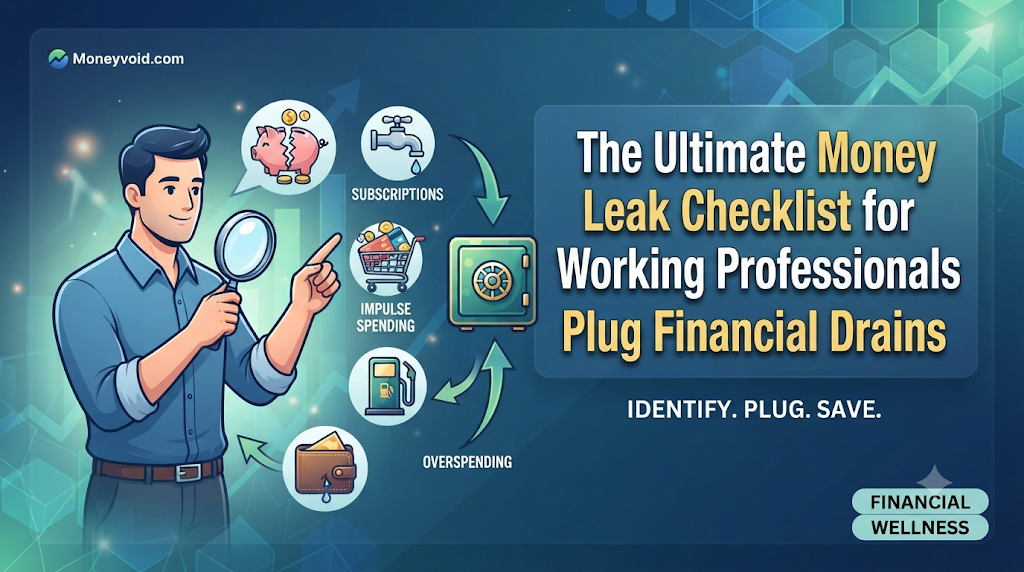
1. Digital Subscriptions and Memberships
- Streaming services: Are you paying for video, music, or podcast apps you rarely open?
- Software and apps: Do you have productivity, fitness, or editing apps charging your card monthly?
- News and media: Are you paying for digital newspaper subscriptions that you can access for free through your local library?
- Cloud storage: Are you paying for multiple cloud storage accounts instead of organizing one?
2. Banking and Financial Fees
- Account maintenance fees: Are you paying monthly fees because your balance drops below a certain limit?
- ATM fees: Are you frequently withdrawing cash from out-of-network ATMs?
- Credit card interest: Are you carrying a balance and paying high interest rates?
- Investment management fees: Are your retirement accounts charging high expense ratios without giving better returns?
3. Food and Dining Habits
- Workday lunches: Do you buy lunch every day out of habit rather than pleasure?
- Delivery app markups: Are you paying delivery fees, service fees, and tips that double the price of a meal?
- Grocery waste: Do you buy fresh produce that spoils before you can cook it?
- Daily coffee runs: Are you buying expensive coffee every morning when you could make it at home?
4. Transportation and Commuting
- Rideshare reliance: Do you take rideshares when public transit or walking is a viable option?
- Car insurance rates: Have you compared insurance providers in the last two years to find a better rate?
- Unused parking permits: Are you paying for a parking spot you rarely use?
Detailed Explanation: The Audit Process
Finding leaks requires a simple audit. You do not need a complex accounting degree to do this. Follow these steps:
- Pull your bank and credit card statements: Gather the statements from the last three months.
- Highlight recurring charges: Look for every item that repeats on a monthly or yearly basis.
- Classify each item: Label each recurring charge as Essential (rent, insurance), Valuable (gym you actually use, hobby supplies), or Leak (unused app, forgotten fee).
- Cut or reduce: Immediately cancel the items labeled as leaks. Contact service providers to negotiate lower rates for essential bills like internet or insurance.
Practical Examples
Example 1: The Busy Professional
Rohan works long hours in tech. He does not have time to cook, so he orders food delivery five nights a week. Between service charges and tips, he spends an extra two hundred dollars a month more than necessary. By meal-prepping twice a week and cutting delivery to once a week, Rohan plugs a significant leak and saves over two thousand dollars a year.
Example 2: The Forgotten Subscriptions
Priya signed up for a free trial of a language learning app a year ago. She forgot to cancel it. The app charged her fifteen dollars every month. Over twelve months, she lost one hundred and eighty dollars for an app she opened twice. A quick thirty-minute review of her credit card statement stopped the drain.
Common Mistakes
Mistake 1: Cutting Things That Bring True Joy
- Why people do it: They try to live on a strict budget and cut out all fun.
- Why it causes problems: Extreme restriction leads to burnout and binge-spending later.
- What to do instead: Focus on cutting things you do not value or use. Keep the expenses that genuinely improve your daily life.
Mistake 2: Doing a One-Time Audit and Stopping
- Why people do it: They check their statements once, fix a few things, and never look again.
- Why it causes problems: New subscriptions and price increases creep back in over time.
- What to do instead: Set a calendar reminder to review your recurring expenses every three months.
Risks and Limitations
Plugging money leaks is a great habit, but it has limits.
- The income ceiling: Cutting expenses helps, but you can only cut so much. Eventually, increasing your earning power through career growth or skill development matters more than saving a few dollars on coffee.
- Time versus money balance: Sometimes spending money saves you valuable time that you can use to rest or work on higher-value projects. Do not sacrifice your health or peace of mind just to save a tiny amount of money.
Comparison: Conscious Spending vs. Unconscious Leaks
| Feature | Unconscious Money Leaks | Conscious Spending |
| Awareness | You do not know where the money goes. | You choose exactly where every dollar goes. |
| Value | Low or zero value; forgotten services. | High value; brings joy or moves you toward goals. |
| Control | Automated drains control your bank account. | You control your money through active choices. |
| Long-term Impact | Slower wealth building and financial stress. | Faster goal achievement and financial peace. |
Checklist: Your 4-Step Leak-Proof Plan
- [ ] Download the last three months of bank and credit card statements.
- [ ] Identify every recurring monthly or annual charge.
- [ ] Cancel all subscriptions, memberships, and apps unused in the last 30 days.
- [ ] Set a calendar reminder to repeat this audit every 90 days.
Key Terms
- Compounding: The process where your money earns returns, which then earn their own returns over time.
- Discretionary Spending: Money spent on non-essential items, wants, and lifestyle choices.
- Expense Ratio: The annual fee that mutual funds or exchange-traded funds charge investors.
- Fixed Expenses: Regular bills that stay the same every month, such as rent or loan payments.
- Recurring Charge: An automated payment that repeats on a regular schedule, like a monthly subscription.
FAQs
How often should I check for money leaks?
You should review your bank statements and credit card bills every three months. This helps you catch new subscription price increases or forgotten trials early.
Are all monthly subscriptions considered money leaks?
No. Subscriptions that you use regularly and that bring you genuine value or improve your life are not leaks. Only unused or forgotten services are leaks.
How do I stop impulse online shopping?
Use a cooling-off period. When you want to buy something non-essential, add it to your online cart and wait forty-eight hours before completing the purchase. Often, the urge to buy will pass.
What is the easiest way to track my spending?
You can use budgeting apps, download your bank’s transaction CSV files into a spreadsheet, or simply review your mobile banking app transaction history weekly.
Can small expenses really ruin my financial future?
Small expenses alone do not ruin finances, but they represent habits of unconscious spending. Building awareness around small expenses helps you manage larger financial decisions better.
What should I do with the money I save from plugging leaks?
Direct the saved money immediately toward an emergency fund, high-interest debt paydown, or automated investments so it does not accidentally get spent elsewhere.
Is it worth calling customer service to cancel subscriptions?
Yes. Some services make cancellation difficult or offer you a lower promotional rate to keep you as a customer, which can save you money if you actually want the service.
How do bank fees become money leaks?
Bank fees like monthly maintenance charges or overdraft fees drain cash directly from your account without giving you any product or service in return. Switch to accounts with no minimum balance fees.
Conclusion
Money leaks are silent thieves. They do not take large amounts all at once; they drain your wealth a few dollars at a time through forgotten subscriptions, careless habits, and hidden fees.
By taking charge of your finances with a regular audit, you can plug these drains and redirect your hard-earned money toward things that truly matter to you. Start with your bank statements today, cancel what you do not use, and keep your financial future secure.