Introduction
Moving across the world is a beautiful, exhilarating, and sometimes completely overwhelming decision. If you have been dreaming of a life surrounded by the majestic Alps, safe neighborhoods, historic architecture, and an exceptional work-life balance, Austria is likely at the top of your list.
But turning that dream into reality requires navigating the immigration system. When you look at official immigration websites, you are often met with dense legal text, complex charts, and confusing jargon.
Let’s break down this point system together, not like a machine analyzing data, but like two friends mapping out a major life milestone over a cup of coffee.
What is the Austria PR Points Calculator and Why Does It Matter?
At its core, the Austria PR points calculator is a digital diagnostic tool designed to evaluate whether you meet the country’s selection criteria for skilled migration. Austria does not select its future residents based on luck; it uses a transparent, objective assessment model known as the Red-White-Red (Rot-Weiß-Rot) Card system.
This calculator matters because it gives you immediate clarity. Instead of guessing where you stand, spending thousands on premature consultation fees, or assembling documents blindly, the calculator shows you exactly how the Austrian government views your profile. It transforms a vague desire to move into a clear, measurable strategy.
How It Works
The system acts like a scorecard. Austria has specific economic and labor needs, and it awards points for individual attributes that help a person integrate into their economy. You input your personal data—such as your age, your university degree, the number of years you have spent working, and your language capabilities. The calculator processes these factors against the official immigration frameworks and gives you a total score out of a possible 90 or 100 points, depending on your specific application stream.
Understanding the Core Eligibility Pillars
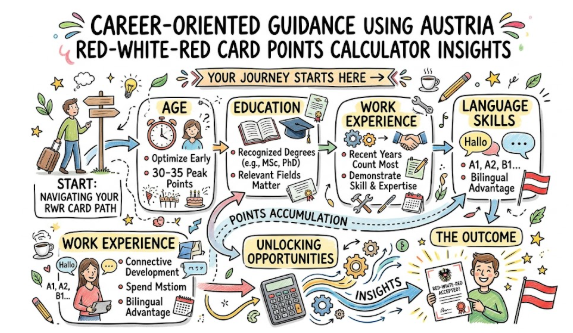
To successfully qualify for an Austrian Red-White-Red Card, you don’t need to be perfect in every single category. The system is flexible; strengths in one area can easily compensate for minor shortcomings in another. Here is how the core pillars of the eligibility criteria break down:
- Minimum Points Required: For skilled workers in shortage occupations or key workers, the magical number is 55 points out of 90. If you are applying under the “Very Highly Qualified Professionals” category, the entry barrier is slightly higher, requiring a minimum of 70 points out of 100.
- Language Skills: Communication is the bedrock of successful integration. The system offers points for both German and English. While knowing basic German (A1 or A2) gives you an excellent foundational score, proving your proficiency in English (if it’s the primary language of your prospective employer) can add vital points to your tally.
- Work Experience: Every year you have spent working in your field counts. The system looks closely at professional experience that directly matches your educational qualifications. You earn points for every six months of active work, with substantial bonus points if that experience was gained inside Austria.
- Age Factor: Youth is highly valued in the points grid because it represents longevity in the Austrian workforce. Applicants under 30 years old receive the maximum point allocation. The points gradually step down as you enter your 30s and 40s, reflecting the changing timeline for tax and pension contributions.
- Education Benefits: Higher education pays off significantly here. Holding a completed university degree, a master’s program, or a specialized vocational training certificate in a high-demand industry provides a massive boost to your score, forming the bedrock of most successful applications.
How to Increase Your Austria PR Points
If you run your initial calculation and find yourself sitting a few points short of the threshold, do not panic. Your profile is not set in stone, and there are several highly practical strategies you can use to intentionally elevate your score:
- Level Up Your German: If you currently have no German skills, clearing an A1 or A2 exam through an accredited body like the Goethe-Institut or ÖSD can instantly give you 5 to 10 additional points. It is often the fastest way to bridge a small point gap.
- Document Every Month of Experience: Because Austria calculates experience in half-year increments, ensuring you get comprehensive, highly detailed reference letters from previous employers can help you claim every single fraction of a point you deserve.
- Target Shortage Occupations: If your profession falls under Austria’s annually updated shortage list (such as specific engineering disciplines, IT specializations, or healthcare roles), you unlock access to a stream with a highly achievable 55-point passing mark.
- Leverage Company Language: If you secure a job offer from an international firm located in Vienna or Graz where the official corporate operating language is English, you can claim an additional 5 points for corporate language proficiency.
Step-by-Step Guide to Calculate Your Austria PR Points
If you are a beginner looking at this process for the very first time, here is the simplest way to manually map out your score before moving into formal application stages:
- Identify Your Pathway: Determine which stream matches your profile. Are you a skilled worker with a job offer in a shortage field, or are you a highly qualified executive aiming for a job-seeker visa?
- Audit Your Education: Look at your highest qualification. Determine if your degree matches your current job profile, as mismatched qualifications will not grant you full points.
- Tally Your Professional Experience: Write down your exact employment timeline. Count the total number of years and half-years you have worked post-graduation, keeping a separate tally for any time spent working within the EU.
- Assess Your Language Competency: Gather your valid language test scores (like IELTS for English or ÖSD for German). Ensure these certificates are less than five years old.
- Factor in Your Age: Note down your exact age at the current moment, as the points applied are locked in based on the day your application is officially received by the authorities.
- Sum It All Up: Add the figures from steps 2 through 5 together to find your definitive baseline score, then compare it against your specific pathway’s target requirement.
Common Mistakes People Make
- Using Mismatched Qualifications: A common pitfall is claiming maximum points for a university degree that has absolutely nothing to do with the job offer you have received. If you have a degree in philosophy but are working as a software engineer, Austria will not grant you educational points for that specific IT job.
- Submitting Expired Language Certificates: Language test results do not last forever in the eyes of immigration officers. If your IELTS or Goethe certificate is older than five years at the time of submission, it will be completely rejected.
- Vague Reference Letters: Simply submitting a contract or a basic letter stating you worked at a company is a major mistake. Your work experience letters must explicitly detail your day-to-day tasks, technologies used, and exact start and end dates to be counted.
Important Documents Needed
To back up the claims you make on the points calculator, you will need a highly organized portfolio containing:
- A valid passport and clear biometric documentation.
- University diplomas, graduation certificates, and full academic transcripts.
- Official employment reference letters printed on company letterhead.
- Valid language proficiency test certificates (IELTS, TOEFL, Goethe, or ÖSD).
- A concrete, legally binding job offer from an employer registered in Austria, outlining your specific salary and role responsibilities.
Table 1: Austria PR Routes Comparison
| Migration Stream | Target Applicant Profile | Minimum Points Required | Job Offer Requirement |
| Very Highly Qualified | Senior executives, researchers, and innovators | 70 out of 100 | Not required initially (Job-Seeker Visa granted) |
| Shortage Occupations | Specialized trades, tech workers, and engineers | 55 out of 90 | Mandatory from an Austrian employer |
| Key Workers | High-earning professionals outside shortage lists | 55 out of 90 | Mandatory (Must meet minimum wage criteria) |
Table 2: Points Distribution Breakdown
| Assessment Category | Maximum Point Potential | Key Metric for Points Allocation |
| Educational Credentials | Up to 30 Points | Higher point values assigned for tertiary university degrees |
| Professional Experience | Up to 20 Points | Awarded per 6-month block; doubled if experience is local |
| Language Capabilities | Up to 25 Points | Stackable scores for German (A1–B1) and English levels |
| Age Criteria | Up to 20 Points | Highest point brackets awarded to candidates under 30 |
Real Stories: Journeys to Austria
Elena’s Story
When I first calculated my points, I hit exactly 52 points for a shortage occupation—three points short of what I needed to move. I remember sitting at my kitchen table feeling utterly defeated, thinking my dream of living in Vienna was over before it even started. But instead of giving up, I looked closely at where I was losing ground. I realized I had zero points for language. I spent four months studying intensely for the basic German A1 exam. The day I got my certificate, I added those 5 points to my score, pushed my total to 57, and filed my application. Walking through the streets of Vienna today, I am so glad I didn’t let that initial calculation stop me.
Rahul’s Story
As a software developer, I thought my master’s degree and deep technical background would make my application a breeze. But when I used the calculator, I realized my older language certificates were expired, and some of my early work experience letters lacked detailed job descriptions. The system gave me a surprisingly low baseline score. It was a massive wake-up call. I went back to my previous companies, politely requested updated, highly detailed reference letters showing my exact technical duties, and retook my English test. Correcting those small documentary oversights brought my verified score well over the required threshold, and my visa was approved a few months later.
Why Take the Austrian Path?
If you are still wondering whether the effort required to navigate this system is truly worth it, consider what awaits you on the other side of the process:
- Unparalleled Quality of Life: Austria consistently ranks at the absolute top of global indexes for safety, healthcare accessibility, public transit infrastructure, and clean environmental standards.
- Unrestricted Family Access: Once your Red-White-Red Card is approved, your immediate family members can join you in Austria, gaining full, unrestricted access to live, study, and work anywhere in the country.
- A Gateway to Europe: Holding an Austrian residence permit allows you to travel freely throughout the entire Schengen Area without the hassle of visa applications.
- Predictable Legal Pathways: The points system completely removes guesswork. If you possess the qualifications, document them accurately, and meet the math, the path to a long-term residency permit is exceptionally clear.
Frequently Asked Questions
Can I apply for the Red-White-Red Card without a concrete job offer?
If you qualify under the “Very Highly Qualified Persons” category and score at least 70 points, you can apply for a 6-month Job Seeker Visa. This allows you to enter Austria legally to find a position. For most other streams, a valid job offer is required to apply.
How long do my German or English language certificates remain valid?
For Austrian immigration purposes, your language certificates must not be older than five years at the exact moment you submit your application to the embassy or immigration authority.
If I score higher than the maximum points in a single category, does it help?
No, each individual category has a strict point ceiling. For instance, if you have fifteen years of experience, you will still only receive the maximum cap of 20 points for experience. Excess points cannot be carried over to other categories.
Are English skills enough, or do I absolutely have to speak German?
You can absolutely qualify using English skills alone, especially if your employer operates primarily in English. However, learning basic German provides invaluable bonus points that can tip the scales in your favor if your score is borderline.
Does an internship count toward my total work experience points?
Generally, standard university internships or unpaid training periods are not counted by Austrian authorities. They look for formal, post-qualification, paid professional employment accompanied by tax or salary proof.
What happens if I turn a year older while my application is being processed?
Your age score is locked in on the exact date your application is officially stamped and received by the Austrian authority. Any birthday that occurs during subsequent processing times will not negatively impact your score.
Can I combine points from two different degrees?
Points are not cumulative for multiple degrees. The system will only evaluate and award points for your single highest level of qualification that is directly relevant to the career path you are pursuing in Austria.
How long does it take for authorities to process the visa once points are verified?
While timelines can vary depending on the specific location and volume of applications, most professionals receive a definitive decision within eight to twelve weeks after submitting a complete document file.
Can I switch employers once I am in Austria on a Red-White-Red Card?
Your initial Red-White-Red Card is tied directly to the specific employer who sponsored you. However, after 21 months of employment, you can upgrade to a Red-White-Red Card Plus, which grants you complete freedom to work for any employer across Austria.
Is there an official age limit beyond which I cannot apply?
There is no hard age limit or ban, but the points awarded for age drop significantly as you get older. If you are over 50, you receive 0 points for the age factor, meaning you must score exceptionally high in education, experience, and language to qualify.
Conclusion
Navigating an immigration journey is all about taking control of the variables you can influence. Instead of worrying about changing policies or wondering if you have what it takes, take a structured approach to your future.
Spend a few quiet minutes reviewing your career timeline, gathering your milestones, and checking your actual PR points online. It is the simplest, most grounded way to transform your European aspirations into a realistic, step-by-step action plan.