Introduction
Cloud computing has changed how infrastructure is bought and managed. In traditional setups, hardware was a fixed expense. Today, cloud resources are active, variable, and can be scaled with a single line of code. This flexibility allows software engineers and DevOps teams to build fast, but it also creates a major challenge: unmanaged and runaway cloud costs.
When engineers spinning up infrastructure do not see the financial impact of their choices, cloud budgets are often blown past. This gap between engineering actions and business spend is why financial operations, or FinOps, has become a critical discipline.
A Certified FinOps Professional is an expert who bridges this exact gap. This role ensures that cloud spending is optimized without slowing down product delivery. For professionals in India and across global markets, mastering this domain is no longer just a luxury. It is a necessary career path for anyone managing production cloud infrastructure.
What is Certified FinOps Professional
The Certified FinOps Professional designation is a practical certification for individuals who want to validate their knowledge of cloud cost optimization, financial accountability, and business-focused cloud engineering. This program is designed to move professionals beyond basic cost awareness into active strategy execution.
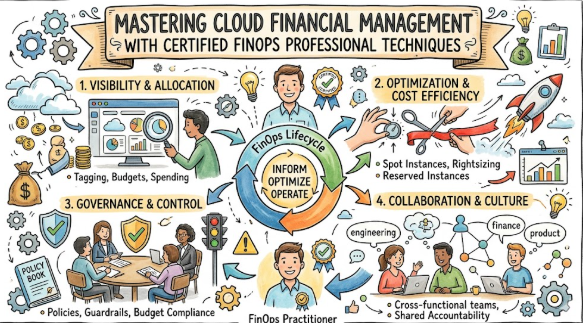
Unlike general technical certs, this course focuses heavily on the framework of cloud financial management. It ensures that infrastructure changes are made with deep visibility into their economic impact. The course covers the three key operational phases:
- Inform: Providing visibility, allocation, and tracking for every dollar spent.
- Optimize: Identifying waste, rightsizing resources, and leveraging commitment discounts.
- Operate: Building a culture where engineering, finance, and product teams work together daily.
Why It Matters Today
Cloud environments grow rapidly. Without continuous monitoring, unused development servers, oversized databases, and unattached storage volumes can quietly drain company capital. Organizations cannot afford to view cloud bills as an afterthought.
Companies worldwide are actively looking for professionals who understand how to balance performance, reliability, speed, and budget. Having an engineer who knows how to control infrastructure costs without degrading application uptime is incredibly valuable. This practice is essential for maintaining healthy profit margins, making it a highly valued skillset in modern tech hubs.
Why Certified FinOps Professional Certifications Are Important
Getting certified is a clear proof of professional maturity. It shows employers that you do not just write code or build pipelines, but you also understand how your technical decisions affect the company’s bottom line.
- Standardized Vocabulary: It provides a common language so engineering teams can communicate clearly with financial analysts and business managers.
- Transcend Toolsets: Instead of teaching a single proprietary platform, it establishes architectural and operational principles that apply to any public cloud provider.
- Career Growth: It shifts your profile from a pure cost-center operator to a strategic contributor who actively helps the business save money and scale efficiently.
Why Choose Finopsschool?
Choosing the right platform for financial operations training is crucial because this discipline requires real practical context, not just theoretical book reading.
Here is why Finopsschool stands out as the ideal choice for professionals:
- Industry-Driven Curriculum: The entire course structure is built by keeping real-world corporate environments in mind. It balances technical infrastructure adjustments with corporate financial realities.
- Expert Faculty Network: The training programs are guided by mentors who bring deep industry experience, helping students understand actual production cost scenarios.
- Hands-on Focus: Rather than just preparing you to pass a multiple-choice exam, the platform uses practical exercises and live examples to ensure you can apply cost-management strategies on day one.
- Global Recognition: The certification programs are respected across international borders, making it an excellent addition to your resume whether you are applying for jobs in India or globally.
Certification Deep-Dive
What Is This Certification?
The Certified FinOps Professional program validates a candidate’s ability to implement cost visibility, forecasting, governance, and automated cost remediation across complex, multi-account cloud environments.
Who Should Take This Certification?
This program is ideal for Software Engineers, DevOps Engineers, Cloud Engineers, SREs, Platform Teams, and Engineering Managers who are responsible for running and scaling production cloud infrastructure.
Certification Overview Table
| Track | Level | Who it’s for | Prerequisites | Skills Covered | Recommended Order |
| FinOps Foundation | Foundation | Beginners, cloud learners, finance teams | Basic cloud awareness | Billing basics, tagging, budget visibility | First |
| Certified FinOps Professional | Professional | Cloud engineers, DevOps teams, SREs | Cloud usage and billing knowledge | Cost visibility, optimization, forecasting | Second |
| Certified FinOps Practitioner | Professional | Cloud cost analysts, FinOps contributors | Foundation FinOps concepts | Showback, chargeback, reporting workflows | After Foundation |
| Certified FinOps Manager | Leadership | Team leads, governance owners | Practical FinOps understanding | Team accountability, policy, stakeholders | After Professional |
| Certified FinOps Architect | Advanced | Cloud architects, consultants | Strong FinOps and cloud experience | Cost-aware design, automated governance | Advanced Stage |
Skills You Will Gain
- Advanced unit economics and multi-account cost allocation methodologies.
- Designing and deploying automated cost-remediation scripts and policies.
- Analyzing, negotiating, and managing complex cloud commitment discounts like Savings Plans and Reserved Instances.
- Building custom engineering dashboards that connect technical KPIs with financial spending metrics.
- Formulating long-term cloud financial forecasting models based on application growth patterns.
Real-World Projects You Should Be Able to Do After This Certification
- Automated Waste Cleanup Pipeline: Build a script-based automation that detects unattached storage volumes and orphaned resources, sending alerts or cleaning them up safely.
- Multi-Tenant Cost Allocation System: Set up a detailed tagging strategy and allocation model to split shared container cluster costs accurately among different engineering teams.
- Anomalous Spend Detection Engine: Configure a monitoring and alerting system that flags sudden, unexpected spikes in cloud resource consumption within an hour of occurrence.
- Commitment Coverage Optimization Planner: Audit historical usage logs across multiple cloud accounts to design an optimal mix of spot instances, savings plans, and on-demand assets.
Preparation Plan
7–14 Days Plan
This fast track is for experienced engineers who already manage cloud bills daily. Spend the first 4 days reviewing advanced cloud optimization techniques and specific billing data structures. Spend the next 5 days practicing with automated governance patterns. Dedicate the final days to taking practice evaluations on the core framework concepts.
30 Days Plan
This balanced approach is perfect for active DevOps or software engineers. Spend week 1 on cloud cost visibility, tagging policies, and basic allocation concepts. Spend week 2 focusing on optimization mechanics like rightsizing and commitment strategies. Dedicate week 3 to hands-on practice with API-based cost management tools. Spend week 4 on mock assessments and reviewing weak areas.
60 Days Plan
This comprehensive track is best for professionals new to financial tracking or managing large team budgets. Spend the first 20 days mastering cloud billing formats and foundational financial terms. Spend the next 20 days deeply exploring technical remediation, automated cleanups, and architectural cost patterns. Spend the remaining 20 days on organizational policy creation, change management frameworks, and taking comprehensive evaluation exams.
Common Mistakes to Avoid
- Treating FinOps as a Pure Finance Task: Forgetting that engineering teams must own their architecture decisions; cost management cannot be done solely by finance analysts.
- Over-Purchasing Long-Term Commitments: Locking the organization into massive 3-year commitment plans before properly optimizing or rightsizing the actual workloads.
- Ignoring Shared Resource Costs: Failing to create a clear allocation strategy for shared infrastructure like Kubernetes clusters or central data warehouses, leaving large portions of the bill unassigned.
- Relying Entirely on Manual Reviews: Trying to manage costs using spreadsheets and manual cleanups instead of building automated policies and guardrails.
Best Next Certification After This
Same Track
Certified FinOps Practitioner: This allows you to dive deeper into custom showback, chargeback, and complex reporting workflows across multiple cross-functional teams.
Cross-Track
Certified Site Reliability Engineer – Foundation: This helps you master the operational reliability, monitoring, and incident management skills needed to balance application performance with financial cost targets.
Leadership / Management
Certified FinOps Manager: This track prepares you to lead enterprise governance initiatives, define financial policies, and align multiple business stakeholders with cloud engineering goals.
Choose Your Learning Path
DevOps Path
This path is tailored for engineers focused on continuous integration and delivery. It centers on building financial guardrails directly into deployment pipelines. You will learn how to inject cost-checking tools into code reviews, preventing expensive or misconfigured infrastructure from being deployed to production in the first place.
DevSecOps Path
This track is designed for security and compliance-focused professionals. It covers the overlap between security policies and financial governance. You will study how to enforce resource policies that simultaneously block security vulnerabilities and eliminate unnecessary spending on unapproved, high-cost cloud instances.
Site Reliability Engineering (SRE) Path
This direction is built for professionals who maintain platform stability and availability. It highlights the balance between performance metrics and budget constraints. You will learn how to configure autoscaling thresholds intelligently, ensuring applications stay resilient during traffic spikes without maintaining costly, idle backup resources.
AIOps / MLOps Path
This path serves engineers managing artificial intelligence and machine learning pipelines. Training complex models can easily cause cloud bills to spike. This path focuses on tracking the cost of training runs, optimizing expensive GPU allocations, and managing data pipeline spending effectively.
DataOps Path
This track is for data platform engineers and database administrators handling large-scale storage. It targets data retention optimization, storage tiers, and big data query management. You will master the process of shifting old data to archive tiers and optimizing query structures to prevent massive analytical bills.
FinOps Path
This dedicated path is for professionals who want to specialize entirely in cloud financial operations as their primary career focus. It focuses heavily on building communication frameworks, designing enterprise chargeback models, and establishing long-term corporate cloud budgets across multiple global departments.
Role to Recommended Certifications Mapping
| Role | Recommended Certifications | Key Focus Area |
| DevOps Engineer | Certified FinOps Professional, DevOps Continuous Delivery | Pipeline guardrails, infrastructure as code costs |
| Site Reliability Engineer (SRE) | Certified FinOps Professional, Certified SRE Professional | High availability cost balance, scaling metrics |
| Platform Engineer | Certified FinOps Professional, Certified Cloud Architect | Shared cluster allocation, base platform optimization |
| Cloud Engineer | Certified FinOps Professional, Cloud Administration | Resource rightsizing, tagging compliance, visibility |
| Security Engineer | Certified FinOps Professional, DevSecOps Expert | Policy enforcement, secure and cost-optimized design |
| Data Engineer | Certified FinOps Professional, Data Lifecycle Specialist | Data storage tiering, big data query optimization |
| FinOps Practitioner | Certified FinOps Professional, Certified FinOps Practitioner | Chargeback models, multi-department cost reporting |
| Engineering Manager | Certified FinOps Professional, Certified FinOps Manager | Budget forecasting, team accountability frameworks |
Next Certifications to Take
After completing your initial professional training, advancing your career requires a targeted approach to your next educational steps.
One Same-Track Certification
The Certified FinOps Practitioner program provides an ideal next step within the same track. This course explains how to build advanced reporting structures, manage detailed showback and chargeback systems, and run day-to-day cost optimization clinics within engineering teams.
One Cross-Track Certification
The Certified Site Reliability Engineer course serves as an excellent cross-track option. It bridges the gap between systems operational performance and cost management, teaching professionals how to maintain high availability and error budgets while controlling financial spending.
One Leadership-Focused Certification
The Certified FinOps Manager credential is the perfect choice for professionals moving into leadership positions. This certification covers enterprise change management, cloud financial policy definition, and the strategies needed to align executive leadership, finance, and engineering teams.
Training & Certification Support Institutions
DevOpsSchool
This platform offers comprehensive training and certification support for DevOps and cloud technologies. It provides deep hands-on labs, live training options, and extensive study materials designed to help working engineers bridge technical architecture with real-world infrastructure delivery practices.
Cotocus
This institution focuses heavily on custom enterprise cloud training and platform engineering enablement. It helps teams master complex infrastructure setups, automation tools, and cost management methodologies through practical, scenario-based learning modules designed for fast-paced modern environments.
ScmGalaxy
A well-known community and educational platform centered around source code management, continuous integration, and build automation. It provides professionals with deeply detailed guides, community forums, and training support to master delivery pipelines and modern operational frameworks.
BestDevOps
This site focuses entirely on providing curated resources, exam preparation materials, and focused bootcamps for modern infrastructure certifications. It helps candidates understand complex technical concepts quickly through simplified learning paths, targeted practice labs, and practical code examples.
devsecopsschool.com
An educational portal dedicated entirely to the intersection of cloud security, automation, and delivery. It assists engineers in learning how to integrate automated security scanning, compliance policies, and cost-governance guardrails naturally into their existing software delivery pipelines.
sreschool.com
This institution provides targeted training focused purely on site reliability engineering principles. It helps engineers master application uptime, monitoring configurations, incident responses, and the art of managing infrastructure budgets alongside strict performance SLAs.
aiopsschool.com
This learning portal is dedicated to teaching artificial intelligence and machine learning operational practices. It helps engineers understand how to automate IT operations using smart analytics and manage the high infrastructure costs linked with modern AI workloads.
dataopsschool.com
A specialized platform focusing on data pipeline engineering, data quality, and storage architecture. It offers structured courses that teach data professionals how to build reliable data infrastructure while maintaining strict cost-efficiency across large data Warehouses.
finopsschool.com
The primary dedicated portal for cloud financial operations education and certification. It provides structured learning paths, official courses, and expert mentorship to help engineers, managers, and finance professionals master cloud cost management and drive cultural accountability.
Frequently Asked Questions (FAQs)
Q1: What is the general difficulty level of the Certified FinOps Professional exam?
The exam features a moderate to high difficulty level because it requires candidates to understand both engineering infrastructure and basic financial accounting logic. It tests practical application scenarios rather than simple term memorization.
Q2: How much time is typically required to prepare for this certification?
For an active cloud or DevOps engineer, around 30 days of consistent study for an hour a day is usually sufficient. Professionals new to cloud billing or financial management may require up to 60 days to fully master the concepts.
Q3: Are there any strict prerequisites before taking the exam?
There are no official hard prerequisites required to sit for the exam. However, having a foundational understanding of public cloud infrastructure, basic billing concepts, and simple spreadsheet navigation is highly recommended.
Q4: What is the recommended certification sequence for a beginner?
It is best to start with the FinOps Foundation course to learn the core terminology and lifecycle phases. After that, you should move to the Certified FinOps Professional exam to master advanced optimization strategies and engineering governance.
Q5: What career value does this certification bring to an engineer in India?
It provides massive career value as Indian enterprises scale their cloud infrastructure rapidly. It helps engineers stand out for senior roles like Cloud Architect, Principal DevOps Engineer, or FinOps Lead, which often command higher salaries.
Q6: Which job roles directly benefit from holding this credential?
DevOps Engineers, Cloud Architects, System Administrators, Site Reliability Engineers, Procurement Officers, Financial Analysts, and Engineering Managers all benefit significantly from the structured cost management skills taught in this program.
Q7: Does this program focus on AWS, Azure, or Google Cloud?
The certification is completely cloud-agnostic. It teaches foundational operational frameworks, lifecycle methodologies, and cost allocation principles that apply equally across all public, private, and hybrid cloud environments.
Q8: How long does the official certification remain valid?
The certification remains valid for a period of three years. To maintain the credential after this period, professionals must complete the renewal process or pass the updated version of the professional assessment.
Q9: Can an engineering manager use this course to improve team delivery?
Yes. The course provides managers with clear frameworks to establish cloud cost ownership within their development teams. This prevents budgets from being blown while allowing developers to maintain their deployment speed.
Q10: What is the main difference between the Foundation and Professional levels?
The Foundation level focuses on basic terms, the three lifecycle phases, and understanding a cloud bill. The Professional level requires hands-on execution skills, automated remediation setup, forecasting, and driving organizational culture changes.
Q11: Are there any programming skills required for this course?
While advanced coding is not mandatory to pass the certification, having basic scripting skills in languages like Python or Bash helps enormously when implementing the automated cost remediation and cleanup exercises.
Q12: How does this certification help with corporate cloud governance?
It teaches you how to design and enforce tagging compliance policies, budget tracking alerts, and resource guardrails. This ensures your company’s cloud infrastructure automatically complies with internal financial budgets and goals.
Certified FinOps Professional FAQs
Q1: What specific cost visibility skills are learned under the Certified FinOps Professional program?
You will learn how to build deep, multi-account cost allocation systems, map untagged resources to specific business units, and create customized dashboards that show real-world unit economics for engineering applications.
Q2: How does the professional program cover cloud commitment management?
It trains you to deeply analyze historical cloud consumption metrics. This allows you to accurately calculate, purchase, and modify complex Savings Plans and Reserved Instances to maximize monthly infrastructure savings.
Q3: What is automated cost remediation in the context of this training?
It refers to building automated policies and background tasks that scan your cloud environment. These scripts automatically identify, alert, or shut down idle dev systems, unattached storage drives, and oversized testing environments.
Q4: How does the course teach professionals to handle cloud cost forecasting?
The program teaches you how to combine historical billing trends with future product growth estimates. This allows you to build accurate, data-backed financial forecasts that prevent unexpected budget overruns.
Q5: What does unit economics mean inside this professional curriculum?
Unit economics involves mapping cloud costs directly to business growth metrics, such as calculating the exact cloud infrastructure cost required to process a single customer transaction or support one active user.
Q6: How does earning this certification improve confidence in engineering choices?
It gives engineers the framework to justify their architecture decisions using both performance data and cost metrics, allowing them to confidently present infrastructure scaling plans to executive leadership.
Q7: Does the training help bridge communication gaps between technical and finance teams?
Yes. It provides a shared set of definitions and operational metrics. This allows software engineers to explain architectural needs clearly to financial analysts, and helps finance teams communicate budget limits to developers.
Q8: How are tracking showback and chargeback systems handled in this program?
The course details how to configure clear tracking mechanisms that either show teams their monthly cloud spend to drive awareness (showback) or directly bill those costs back to their specific department budgets (chargeback).
Testimonials
Amit
The practical cost allocation techniques I learned completely changed how we handle our deployments. We managed to identify and clean up over thirty percent waste in our staging environments within the first month. It gave me massive clarity on balancing pipeline speed with our infrastructure budget.
— DevOps Engineer
Deepak
Balancing high availability with cost was always a struggle for our team. This certification gave me the exact data frameworks needed to set smart autoscaling boundaries. Our production systems remain highly resilient, and our monthly cloud spend has dropped significantly.
— SRE
Priya
I used to look at our massive multi-account cloud bill with confusion every month. After completing this program, I was able to build an automated dashboard connecting engineering metrics with financial spend. My confidence in managing our scale has grown tremendously.
— Cloud Engineer
Vikram
Enforcing infrastructure compliance was tough when teams viewed budget tracking as a blocker. The governance policies taught here helped me set up automated guardrails that protect our environment without slowing down developers. It brought real operational clarity to our team.
— Security Engineer
Ananya
Managing large development budgets requires clear forecasting methods. This course provided the exact framework needed to align our engineering roadmaps with corporate financial goals. It has helped us plan our project scaling phases with total accuracy and predictability.
— Engineering Manager
Conclusion
Mastering cloud cost management has become a crucial requirement for modern engineering teams. The Certified FinOps Professional certification program provides the perfect path to bridge technical execution with business value. By validating your ability to build cost visibility, design automated guardrails, and foster team accountability, you position yourself as a mature contributor capable of leading high-impact cloud initiatives.
Investing time in this structured educational program yields massive long-term career growth. It ensures you remain highly relevant as organizations worldwide continue to audit and optimize their cloud environments. Strategic career planning combined with focused financial operations training allows you to deliver massive financial value while building scalable, high-performance cloud architectures.