Introduction
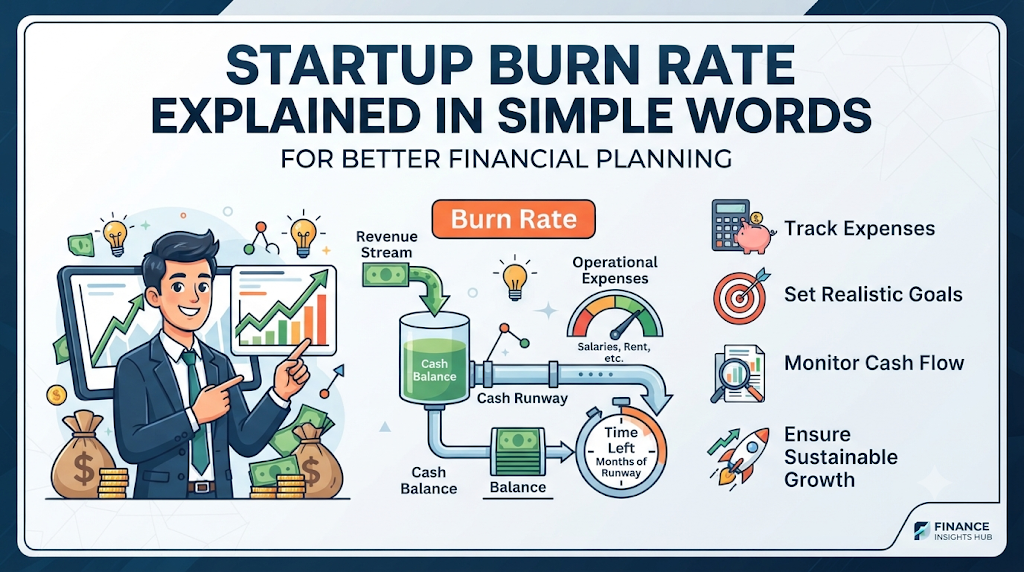
A startup can have a promising product, growing customer interest, and talented employees while still facing serious financial pressure if it spends cash faster than it can replace it. This is where startup burn rate becomes important. In simple terms, burn rate helps founders understand how much cash the business is consuming over a particular period. Beginners often focus on sales, funding, valuation, or customer growth without paying enough attention to how long the available money can support daily operations. That can create difficult decisions later. Understanding burn rate gives founders a clearer view of spending, cash flow, runway, hiring, marketing, technology costs, and fundraising needs. This guide explains the concept in simple language, using practical examples and realistic situations so readers can make better financial decisions without relying on confusing formulas or unrealistic assumptions.
Understanding Startup Burn Rate in Simple Words
Startup burn rate is the rate at which a startup uses cash to operate its business.
The simplest way to understand it is to ask:
“How much money is the business consuming each month?”
Suppose a startup spends $80,000 during a month and receives $30,000 from customers. If we focus on the difference between cash going out and operating cash coming in, the startup has a net burn of approximately $50,000 for that period.
Burn rate is especially important for startups because young businesses often spend money before they become consistently profitable. They may need to pay employees, rent offices, purchase software, run advertising campaigns, develop products, pay contractors, maintain infrastructure, and cover professional services.
There are two commonly discussed forms of burn rate.
Gross burn generally refers to the total amount of cash a startup spends during a period.
Net burn considers operating cash inflows such as revenue and measures how much cash the company is actually losing after those inflows.
For example, a business could have $100,000 of monthly expenses and $40,000 of monthly operating revenue. Its gross burn is $100,000, while its net burn is approximately $60,000.
This distinction matters because two startups with identical expenses can have very different financial situations if one generates considerably more revenue.
A common misunderstanding is that a high burn rate automatically means a startup is badly managed. That is not always true. A startup may deliberately spend heavily while developing a product, entering a new market, hiring key employees, or expanding operations.
The real question is whether the spending is planned, affordable, measurable, and connected to business objectives.
Practical takeaway: Burn rate should not be viewed alone. It should be considered together with cash balance, revenue, growth, expenses, and runway.
Why Startup Burn Rate Is Important
Burn rate matters because cash gives a startup time to operate.
A company may have a valuable product and strong future potential, but it cannot continue normal operations indefinitely without sufficient cash or another source of funding.
Cash Planning
Knowing monthly burn helps founders estimate how much money is leaving the business.
This makes it easier to create realistic budgets and identify unnecessary expenses.
Hiring Decisions
Employees are often one of the largest startup expenses.
Before hiring, founders should consider salary, benefits, taxes, equipment, recruitment costs, and the expected business contribution of the role.
A hiring decision that looks affordable in isolation may significantly change the company’s monthly burn when several positions are added.
Fundraising
Investors may want to understand how efficiently a startup is using its available capital.
A founder who understands burn can better explain how funding is being used and what financial milestones the company intends to achieve.
Runway Planning
Runway represents the approximate amount of time a startup can continue operating before its available cash is exhausted, assuming the burn rate remains similar.
A basic approximation is:
Runway = Available Cash ÷ Monthly Net Burn
For example, if a startup has $600,000 available and its monthly net burn is $50,000, its theoretical runway is about 12 months.
This is only a planning estimate because burn can change.
Risk Awareness
Burn rate also highlights financial risk.
If expenses rise while revenue remains flat, the startup may consume cash faster than expected.
Practical scenario: A startup plans to hire five employees because sales are growing. Before approving the hiring plan, the founder calculates the new monthly payroll, adds related costs, and discovers that the additional hiring could significantly shorten runway. The founder then decides to hire two people immediately and review the remaining positions after measurable revenue milestones.
The important lesson is not “never spend.” It is spend with awareness of the financial consequences.
The Real Problem Founders Face With Startup Burn Rate
The biggest problem is often not calculating burn rate. It is interpreting the number correctly.
Many early-stage founders face several challenges at the same time.
Lack of Financial Awareness
A founder may understand customers and products extremely well but have limited experience with financial forecasting.
That can result in poor assumptions about expenses, taxes, hiring, or cash requirements.
Confusing Revenue With Cash
Revenue and cash are related but are not always identical.
A company may record sales while receiving payment later. Meanwhile, salaries, software bills, suppliers, and other expenses may need to be paid immediately.
Therefore, founders should monitor actual cash movement rather than relying only on sales figures.
Emotional Spending
Startups can become attached to growth.
Founders may approve expensive advertising, office upgrades, events, new software, or additional employees because they feel like signs of progress.
But spending should be connected to measurable business objectives.
Weak Comparison
A founder may compare the company’s burn rate with another startup without considering differences in business model, location, team size, product stage, revenue, and funding structure.
There is no universally correct burn rate for every startup.
Unrealistic Expectations
Some founders assume revenue will increase quickly or that another funding round will arrive before cash becomes tight.
Those assumptions can be dangerous if they are not supported by realistic planning.
Ignoring Risk
Unexpected events can increase expenses or reduce revenue.
A startup therefore needs enough financial awareness to handle uncertainty rather than operating at the absolute edge of its cash position.
Better approach: Review burn rate regularly, separate essential spending from discretionary spending, build realistic scenarios, and connect major expenses to measurable business outcomes.
How Startup Burn Rate Works Step by Step
Step 1: Identify Available Cash
Start by determining how much usable cash the startup currently has.
This may include cash in business bank accounts and other immediately available funds, depending on the company’s financial structure.
Why it matters: Without knowing the starting cash position, runway calculations become unreliable.
How to apply it: Reconcile bank balances and financial records before building the calculation.
Example: A startup believes it has $500,000 available, but $40,000 is already committed to upcoming obligations. The founder should not treat the entire amount as freely available operating cash.
Common mistake: Counting money that is restricted, already committed, or not immediately accessible.
Better approach: Use a realistic available-cash figure.
Step 2: Calculate Monthly Expenses
List recurring and irregular operating expenses.
These may include payroll, software, rent, cloud infrastructure, marketing, contractors, accounting, legal services, insurance, and other business costs.
Why it matters: Founders cannot manage what they cannot see.
How to apply it: Organize expenses into categories and identify which costs are fixed and which vary.
Example: Payroll might remain relatively stable while advertising expenses change considerably from month to month.
Common mistake: Looking only at large bills and ignoring smaller recurring subscriptions.
Better approach: Review the complete expense list.
Step 3: Identify Operating Cash Inflows
Determine how much cash the business receives from customers and other normal operating activities.
Why it matters: Gross spending does not always represent the amount of cash the startup is actually consuming.
How to apply it: Review actual collections rather than assuming every sale has already become cash.
Example: A company invoices $70,000 but collects only $45,000 during the month. Cash planning should reflect the actual collection timing.
Common mistake: Treating invoices as if they were immediately available cash.
Better approach: Track both sales and collections.
Step 4: Calculate Gross Burn
Gross burn provides a view of total spending.
A simplified formula is:
Gross Burn = Total Operating Cash Expenses During the Period
For example, if operating expenses total $90,000 in one month, gross burn is approximately $90,000.
Why it matters: Gross burn helps founders understand the overall cost structure.
Common mistake: Assuming gross burn alone tells the complete financial story.
Better approach: Compare gross burn with revenue and net burn.
Step 5: Calculate Net Burn
Net burn considers operating cash inflows.
A simple calculation is:
Net Burn = Operating Cash Outflows − Operating Cash Inflows
Suppose a startup spends $90,000 and collects $35,000. Its approximate net burn is $55,000.
Why it matters: Net burn provides a more direct view of how much cash the startup is consuming after operating inflows.
Common mistake: Using projected revenue as if it were already collected cash.
Better approach: Use realistic collection assumptions.
Step 6: Estimate Runway
Runway provides an estimate of how long available cash may support the startup.
Runway = Available Cash ÷ Monthly Net Burn
If available cash is $550,000 and monthly net burn is $55,000, the simple runway estimate is 10 months.
Why it matters: It helps founders understand how much time they have to reach important milestones.
Common mistake: Assuming the current burn rate will remain unchanged.
Better approach: Build multiple scenarios, including higher-spending and lower-revenue possibilities.
Step 7: Connect Spending With Milestones
Burn rate becomes much more useful when spending is connected to business objectives.
For example, a marketing budget should ideally have a measurable purpose such as testing customer acquisition channels.
Similarly, a new engineering hire might be connected to product delivery or technical capacity.
Why it matters: Spending should contribute to business progress where possible.
Common mistake: Measuring success only by how much money was spent.
Better approach: Ask what business outcome the spending is expected to support.
Step 8: Review and Adjust Regularly
Burn rate is not a number that should be calculated once and forgotten.
Expenses, revenue, staffing, infrastructure requirements, and business priorities change.
Why it matters: A startup that reviews financial information regularly can identify problems earlier.
Common mistake: Waiting until cash becomes critically low.
Better approach: Review actual spending against the budget and update forecasts as conditions change.
Key Factors That Influence Startup Burn Rate
Payroll
Payroll can become a major part of startup spending.
Founders should consider the complete employment cost rather than only the headline salary.
Technology Costs
Cloud services, software subscriptions, development tools, security products, hosting, and infrastructure can increase as the company grows.
Technology spending should be monitored because some services scale automatically with usage.
Marketing
Marketing expenses can vary significantly.
Advertising should ideally be connected to measurable objectives rather than treated simply as a growth expense.
Office and Operating Costs
Rent, utilities, equipment, insurance, professional services, and administrative expenses can contribute to monthly burn.
Revenue
Revenue can reduce net burn.
However, founders should distinguish between reported sales and actual cash collections.
Business Stage
A pre-revenue startup may naturally have a different burn profile from a mature business with recurring customers.
Growth Strategy
Rapid expansion often requires more spending.
Growth can be valuable, but founders should understand what additional capital and operating resources are required.
Fundraising
Fresh funding can increase the cash balance, but funding itself does not make the underlying spending model automatically sustainable.
The better question is whether capital is being converted into meaningful progress.
Detailed Breakdown of Startup Burn Rate
Gross Burn Versus Net Burn
These two concepts are often confused.
Gross burn looks primarily at spending.
Net burn considers the relationship between cash outflows and operating cash inflows.
A startup can have a high gross burn but a relatively moderate net burn if customer collections are strong.
Conversely, a startup with modest expenses can still experience financial pressure if it generates very little cash.
Both measures can therefore be useful.
Monthly Burn Rate
Monthly burn is popular because many startup expenses are planned monthly.
It gives founders a consistent period for budgeting and forecasting.
However, monthly figures should not hide seasonal or irregular expenses.
A startup might pay annual insurance, equipment costs, or professional fees that create temporary increases in cash usage.
Burn Rate and Startup Runway
Runway is closely connected to burn.
If a startup has $1 million in available cash and burns $100,000 per month, its simple runway calculation is 10 months.
But this does not mean the company definitely has exactly 10 months.
If revenue increases, burn may decline.
If expenses increase, runway may shorten.
If fundraising occurs, available cash may increase.
If unexpected costs appear, the financial position can change quickly.
Therefore, runway should be treated as a planning estimate rather than a guarantee.
Burn Rate and Revenue Growth
Burn rate should be considered alongside revenue growth.
Suppose Startup A spends $100,000 monthly and generates $10,000 in customer cash.
Startup B spends the same amount but generates $80,000.
Their gross burn is similar, but their net cash consumption is very different.
The second business may still have financial risks, but its revenue contribution changes the interpretation of the burn rate.
Burn Rate and Unit Economics
Unit economics examines the economics of individual customers, transactions, or products.
A startup can grow revenue while still having weak economics.
For example, spending heavily to acquire customers without understanding whether those customers generate sufficient value can increase financial pressure.
Burn rate therefore should not be analyzed independently from customer acquisition costs, gross margins, retention, pricing, and other relevant business measures.
Burn Rate and Fundraising
Founders often think about fundraising when runway becomes shorter.
A more disciplined approach is to plan fundraising before financial pressure becomes extreme.
Fundraising takes time and does not always happen according to the founder’s preferred schedule.
A startup should therefore avoid assuming that future capital is guaranteed.
Burn Rate and Cost Cutting
Reducing burn does not simply mean cutting every expense.
Some expenses support revenue, product quality, security, compliance, or customer service.
A poorly planned cost-cutting exercise can damage the business.
The better approach is to separate:
- Essential operating costs
- Revenue-supporting costs
- Strategic investment
- Discretionary spending
- Low-value recurring costs
Then evaluate each category based on business impact.
Burn Rate and Financial Discipline
Financial discipline does not mean refusing to spend.
It means understanding why money is being spent, what outcome is expected, and whether the startup can afford the commitment.
That distinction is important.
A company may spend aggressively for a valid strategic reason, while another company may spend less but have weak financial discipline because it does not track where the money goes.
Common Mistakes Beginners Make With Startup Burn Rate
Mistake 1: Looking Only at Revenue
Strong sales can create a false sense of security.
If expenses are increasing even faster than revenue, cash pressure can continue.
Better approach: Monitor revenue, collections, expenses, gross burn, and net burn together.
Mistake 2: Assuming Funding Will Always Arrive
Future investment should never be treated as guaranteed cash.
Better approach: Build plans that account for the possibility that fundraising takes longer than expected.
Mistake 3: Ignoring Small Recurring Expenses
A few inexpensive software subscriptions may appear insignificant individually.
Together, they can become a meaningful monthly expense.
Better approach: Review recurring charges regularly.
Mistake 4: Hiring Too Quickly
Hiring increases fixed financial commitments.
Better approach: Connect major hiring decisions to business needs and realistic financial capacity.
Mistake 5: Treating Every Expense as Essential
Some spending becomes habitual.
Better approach: Periodically question whether each significant expense is still necessary.
Mistake 6: Confusing Profit With Cash
Accounting profit does not always mean the company has sufficient cash available.
Better approach: Maintain a clear cash-flow view.
Mistake 7: Using Another Startup as the Benchmark
Different businesses have different economics.
Better approach: Compare performance against the company’s own goals and business model.
Mistake 8: Ignoring Taxes and Other Obligations
A cash balance can look comfortable until upcoming obligations become due.
Better approach: Include known financial commitments in cash planning.
Mistake 9: Cutting Costs Without Priorities
Reducing useful expenses can harm growth or operations.
Better approach: Protect expenses that support critical business functions.
Mistake 10: Waiting Too Long to Act
Financial problems become harder to manage when founders delay action.
Better approach: Use regular financial reviews to identify warning signs early.
Don’t Do This Checklist
- Do not assume future funding is guaranteed.
- Do not spend emergency cash on speculative activities.
- Do not confuse sales with collected cash.
- Do not ignore recurring subscriptions.
- Do not hire without considering the complete employment cost.
- Do not blindly copy another startup’s spending model.
- Do not rely only on social media financial advice.
- Do not hide poor financial performance from decision-makers.
- Do not ignore taxes or contractual obligations.
- Do not make major financial decisions under panic or pressure.
Practical Real-Life Examples of Startup Burn Rate
Example 1: Early Software Startup
A software startup has a small team and limited revenue. Its founders notice that cloud infrastructure, salaries, and software subscriptions are consuming cash faster than expected.
The founders review usage, remove unnecessary subscriptions, and establish a monthly spending review.
Learning: Regular expense visibility can reveal problems before they become serious.
Example 2: Growing E-Commerce Business
An online business increases advertising spending because sales are growing. However, customer acquisition costs also rise.
Instead of increasing the advertising budget automatically, the founder compares different channels and pauses campaigns that are not meeting internal performance expectations.
Learning: Higher spending is not automatically better growth.
Example 3: Startup Considering New Hiring
A startup wants to hire four additional employees after receiving customer interest.
The founder calculates the full employment cost and determines that hiring all four immediately would significantly increase monthly burn.
Two positions are filled first, while the remaining roles are reviewed after additional business milestones.
Learning: Hiring can be staged according to financial capacity.
Example 4: Founder Preparing for Fundraising
A startup has eight months of estimated runway.
Instead of waiting until the final months, the founder begins preparing financial records, forecasts, business metrics, and funding requirements early.
Learning: Financial preparation should begin before cash pressure becomes urgent.
Example 5: Small Business Moving Toward a Startup Model
A small business begins investing heavily in technology and employees to develop a scalable product.
The owner starts tracking gross burn, net burn, cash balance, and runway rather than looking only at monthly sales.
Learning: Better financial visibility becomes increasingly important as operational complexity grows.
Table 1: Important Startup Burn Rate Concepts
| Concept | Simple Meaning | Why It Matters |
|---|---|---|
| Gross Burn | Total operating cash spending during a period | Shows overall spending level |
| Net Burn | Cash outflows minus operating cash inflows | Shows approximate cash consumption |
| Cash Balance | Available business cash | Indicates current financial resources |
| Runway | Estimated time before available cash is exhausted | Supports planning and timing decisions |
| Operating Expenses | Costs required to operate the business | Helps identify spending drivers |
| Cash Flow | Movement of money into and out of the business | Shows actual cash position |
| Financial Forecast | Estimate of future income and expenses | Supports forward planning |
Table 2: Burn Rate Warning Signs and Better Responses
| Warning Sign | Potential Concern | Better Response |
|---|---|---|
| Expenses rising rapidly | Runway may shorten | Review major spending categories |
| Revenue below expectations | Net burn may increase | Update the financial forecast |
| Frequent unplanned purchases | Budget control may be weak | Introduce approval rules |
| Hiring ahead of need | Fixed costs may increase unnecessarily | Link hiring to milestones |
| Heavy reliance on future funding | Cash plan may be fragile | Build alternative scenarios |
| Rising software costs | Technology expenses may be scaling | Audit subscriptions and usage |
| Low cash visibility | Decisions may rely on outdated information | Review cash position regularly |
Tools, Methods, and Frameworks Readers Can Use
Monthly Cash Flow Sheet
A simple spreadsheet can track opening cash, operating inflows, expenses, closing cash, and monthly burn.
It helps beginners see how spending affects the available cash position.
The main mistake it helps prevent is making decisions based on assumptions rather than actual numbers.
Burn Rate Dashboard
A dashboard can bring key metrics into one place.
Useful fields may include cash balance, gross burn, net burn, revenue, major expenses, and estimated runway.
This makes financial reviews faster and easier to understand.
Expense Categorization Framework
Divide expenses into categories such as payroll, technology, marketing, administration, professional services, and other operating costs.
This makes it easier to identify where spending is concentrated.
Scenario Planning
Create at least three financial scenarios:
- Lower-spending scenario
- Expected scenario
- Higher-burn or lower-revenue scenario
This helps founders understand how runway may change under different conditions.
Hiring Impact Calculator
Before hiring, estimate salary and other associated costs.
Then calculate the expected impact on monthly burn and runway.
This prevents founders from considering only the headline salary figure.
Expense Review Calendar
Set a recurring schedule for reviewing subscriptions, vendors, advertising, contractors, and other expenses.
The purpose is not to cut everything but to ensure spending remains relevant.
Runway Monitoring Method
Instead of checking runway only when cash becomes tight, monitor it as a regular financial indicator.
If runway changes sharply, investigate the reason.
Decision Journal
For major spending decisions, record the reason for the expense, expected outcome, estimated cost, and review date.
This helps founders learn from previous financial decisions.
Expert Tips to Make Better Startup Burn Rate Decisions
1. Track Cash Before Making Growth Decisions
Growth decisions should consider their cash consequences. Before approving major spending, estimate how it affects monthly burn and runway.
2. Separate Essential and Discretionary Costs
Not every expense has the same importance. Categorizing expenses makes it easier to decide where adjustments can be made if cash pressure increases.
3. Monitor Net Burn Alongside Gross Burn
Gross burn shows spending, while net burn provides additional context by considering operating cash inflows. Reviewing both gives a more complete picture.
4. Use Realistic Revenue Assumptions
Avoid building the financial plan around the most optimistic sales forecast. Use assumptions that can be explained and monitored.
5. Review Major Expenses Regularly
Payroll, technology, marketing, and contractors can change significantly as a startup evolves. Review these categories instead of assuming old budgets remain appropriate.
6. Protect Emergency Cash
Do not treat every dollar in the bank as available for expansion. Consider upcoming obligations and unexpected events when evaluating usable cash.
7. Connect Spending to Milestones
Major spending should have a clear purpose. The milestone may involve product development, customer acquisition, operational capacity, or another measurable objective.
8. Avoid Automatic Hiring
Hiring should be based on genuine business requirements and financial capacity rather than simply because another startup is expanding its team.
9. Understand Collection Timing
Sales do not necessarily mean cash has already arrived. Monitor payment timing because delayed collections can create cash pressure.
10. Review Technology Usage
Software and cloud expenses can grow gradually. Regular usage reviews can identify services that are no longer necessary.
11. Prepare Multiple Scenarios
Financial plans are estimates. Scenario planning helps founders prepare for weaker revenue, higher expenses, or slower growth.
12. Start Financial Reviews Early
Founders should not wait for a crisis to understand their cash position. Early visibility provides more options.
13. Keep Financial Records Organized
Clean financial records make it easier to understand burn rate and communicate with accountants, advisors, lenders, or potential investors.
14. Avoid Comparing Without Context
Another company’s burn rate may be unsuitable as a benchmark because its revenue, market, team, funding, and operating model may be completely different.
15. Ask for Professional Help When Necessary
Complex tax, accounting, legal, investment, or corporate-finance questions may require a qualified professional. Knowing when to seek expert support is part of responsible financial management.
Case Studies: How Better Understanding Changes Decisions
Case Study 1: The Fast-Hiring Startup
Profile: A small technology startup with growing customer interest.
Situation: The founders believe rapid hiring will help them capture the opportunity.
Problem: Adding several employees at once would substantially increase monthly expenses.
Wrong approach: Hire the entire planned team immediately based only on expected future revenue.
Better approach: Calculate the complete employment cost, estimate the effect on runway, and prioritize the roles most directly connected to current business needs.
Result or learning: The company creates more time to evaluate revenue growth before committing to all planned positions.
Key takeaway: Hiring decisions should consider both operational needs and financial runway.
Case Study 2: The Marketing Spending Problem
Profile: An early-stage consumer startup.
Situation: Customer acquisition appears to improve when advertising spending increases.
Problem: The founder cannot clearly determine which campaigns are producing sustainable customer value.
Wrong approach: Increase the entire advertising budget because sales are increasing.
Better approach: Separate campaigns, track relevant internal performance measures, and evaluate whether increased spending is producing useful business outcomes.
Result or learning: The startup gains better visibility into which expenses deserve continued investment.
Key takeaway: A higher marketing budget should have a clear business rationale.
Case Study 3: The Fundraising Deadline
Profile: A startup with several months of available runway.
Situation: The founders expect to raise additional capital.
Problem: They assume the funding process will happen quickly.
Wrong approach: Continue spending at the current rate without considering delays or weaker fundraising outcomes.
Better approach: Prepare a base financial plan and a more conservative scenario. Begin fundraising preparation early and identify expenses that could be adjusted if necessary.
Result or learning: The founders have more options because they planned before the cash position became critical.
Key takeaway: Fundraising should be part of forward financial planning, not a last-minute emergency response.
Risk Awareness: What Readers Must Check First
Cash Flow Risk
A startup may have revenue but still experience cash pressure because collections and payments occur at different times.
Risk reduction: Monitor actual cash movements and payment schedules.
Revenue Risk
Expected revenue may not materialize at the expected speed.
Risk reduction: Use realistic forecasts and update them when new information appears.
Cost Inflation Risk
Supplier, payroll, technology, or operating costs may increase.
Risk reduction: Review major cost categories regularly.
Funding Risk
A planned investment round may take longer than expected or may not happen on preferred terms.
Risk reduction: Avoid relying entirely on unconfirmed future funding.
Growth Risk
Rapid expansion can increase expenses before revenue catches up.
Risk reduction: Connect expansion decisions with measurable milestones.
Technology Risk
Cloud usage and software costs can increase as customers and workloads grow.
Risk reduction: Monitor usage and review technology contracts and subscriptions.
Fraud Risk
Financial information can be targeted by scams, fraudulent invoices, or unauthorized transactions.
Risk reduction: Use appropriate financial controls and verify payment instructions.
Data Privacy Risk
Financial records may contain sensitive business information.
Risk reduction: Limit access, use secure systems, and follow appropriate security practices.
Tax and Compliance Risk
Startups have financial and regulatory obligations that can vary by jurisdiction and business structure.
Risk reduction: Maintain accurate records and consult qualified professionals where required.
Emotional Decision Risk
Fear of missing an opportunity can encourage excessive spending, while fear of running out of money can cause harmful cost-cutting.
Risk reduction: Use written financial criteria instead of making major decisions purely under emotional pressure.
Misinformation Risk
Online startup and finance advice can be incomplete or based on another company’s circumstances.
Risk reduction: Verify important information and consider professional advice for significant decisions.
Checklist Before Taking Action
Before making a major startup spending or financial decision, review the following:
- Do I understand the current cash position?
- Have I calculated current gross and net burn?
- Have I reviewed major recurring expenses?
- Do I know the estimated runway?
- Are revenue assumptions realistic?
- Have I considered actual cash collections?
- Have upcoming obligations been included?
- Does the planned spending have a clear purpose?
- Can the expense be connected to a measurable business objective?
- Have alternative spending options been considered?
- Have potential downside scenarios been reviewed?
- Am I relying on unconfirmed future funding?
- Is personal or business financial information adequately protected?
- Have tax, accounting, or legal implications been considered?
- Should a qualified professional review the decision?
This checklist should be used before major hiring, marketing, technology, fundraising, expansion, or other financial commitments. It does not replace professional financial advice, but it can encourage a more disciplined decision-making process.
Strategic Insights for Better Decision-Making
Build Around Runway, Not Just Cash Balance
A large cash balance may look reassuring, but its usefulness depends on the rate at which money is being consumed.
A startup with substantial cash and extremely high burn may have less practical flexibility than expected.
Use Milestone-Based Spending
Instead of approving spending indefinitely, founders can connect certain investments to milestones.
For example, a marketing expansion might depend on evidence from an earlier campaign.
Review Fixed Costs Carefully
Fixed expenses can become difficult to reduce quickly.
Payroll commitments, long contracts, leases, and other recurring obligations should therefore receive careful consideration before being approved.
Protect Strategic Capacity
Cost reduction should not damage critical operations.
A startup may need certain spending for cybersecurity, product development, customer support, accounting, or compliance.
The goal is controlled spending rather than indiscriminate cuts.
Maintain a Conservative Planning Scenario
A conservative scenario can show what happens if revenue grows more slowly or costs rise.
This gives founders an opportunity to prepare responses before conditions become difficult.
Watch the Direction of Burn
The trend can be more useful than a single monthly number.
If burn is consistently increasing, the founder should understand why.
If burn is declining because revenue is increasing or costs are being controlled, the change should also be understood.
Connect Financial Planning With Strategy
Burn rate should not exist separately from business strategy.
Product decisions, hiring, marketing, pricing, expansion, and fundraising can all affect cash consumption.
A strong financial review connects these decisions together.
Key Terms Explained for Beginners
- Burn Rate: The rate at which a startup consumes cash over a specific period.
- Gross Burn: The total operating cash spending during a particular period before considering operating cash inflows.
- Net Burn: The approximate amount of cash consumed after subtracting operating cash inflows from operating cash outflows.
- Runway: An estimate of how long a startup can continue operating with its available cash at a particular burn rate.
- Cash Flow: The movement of money into and out of a business.
- Cash Balance: The amount of cash currently available to the business.
- Operating Expense: A cost associated with running the business, such as payroll, software, marketing, or office expenses.
- Revenue: Money generated from selling products or services. Revenue should not automatically be treated as immediately available cash.
- Cash Collection: The actual receipt of money from customers or other operating sources.
- Forecast: An estimate of future financial performance based on assumptions and available information.
- Fixed Cost: An expense that generally does not change directly with short-term business activity, although it may change over time.
- Variable Cost: An expense that can change as business activity or usage changes.
- Cash Runway: Another common expression for the estimated period a company can operate before its available cash is exhausted.
- Financial Discipline: The practice of making spending and financial decisions based on structured planning, evidence, and business priorities.
- Milestone: A measurable business objective used to assess progress and guide decisions.
Who Should Read This Blog
Beginners
People new to startup finance can use this guide to understand burn rate without needing advanced accounting knowledge.
Students
Students studying entrepreneurship, business, accounting, or finance can use the examples to understand how startup cash management works.
Salaried Employees
Employees considering entrepreneurship can learn why personal savings, startup expenses, and business cash requirements should be considered separately.
Small Business Owners
Owners planning to scale their operations can use burn-rate thinking to understand how additional employees, technology, and marketing affect cash.
New Investors
People learning about startup investing can use burn rate as one part of understanding a company’s financial position.
Traders
Traders who are expanding their knowledge of business finance can use this topic to understand how operating cash consumption differs from market-related concepts.
Loan Seekers
Entrepreneurs considering business borrowing can use burn-rate analysis when thinking about repayment capacity and ongoing cash requirements.
Crypto Learners
Crypto entrepreneurs and learners can apply the same cash-management principles to businesses operating around blockchain products or services.
Finance Bloggers
Writers covering startups and personal finance can use burn-rate concepts to create more accurate educational content.
Startup Founders
Founders can use the frameworks in this article to improve cash visibility, budgeting, runway planning, and financial decision-making.
People Improving Money Awareness
Anyone trying to understand how businesses manage cash can benefit from learning how spending, revenue, and runway interact.
People Trying to Avoid Financial Mistakes
Readers who want to make more careful financial decisions can use the checklists and examples to identify risks before committing money.
Frequently Asked Questions
1. What is startup burn rate in simple words?
Startup burn rate describes how quickly a startup uses cash to operate its business. It is usually reviewed over a specific period, such as a month. Understanding it helps founders evaluate spending, cash needs, and estimated runway.
2. Why is startup burn rate important for beginners?
Startup burn rate helps beginners understand how operating expenses affect available cash. It can make financial planning easier by showing whether spending is increasing, decreasing, or staying relatively stable.
3. What is the difference between gross burn and net burn?
Gross burn focuses on total operating cash spending. Net burn considers operating cash inflows as well. A startup can therefore have a high gross burn while having a lower net burn if it generates meaningful operating cash.
4. How do you calculate startup runway?
A basic runway estimate can be calculated by dividing available cash by monthly net burn. For example, $400,000 of available cash divided by $40,000 of monthly net burn produces a simple estimate of 10 months.
5. Is a high burn rate always bad?
Not necessarily. A startup may deliberately spend more while developing a product, hiring, or expanding. The important issue is whether the spending is affordable, planned, and connected to meaningful business objectives.
6. How can a startup reduce its burn rate?
A startup can review recurring expenses, hiring plans, technology usage, marketing spending, vendor costs, and other operating commitments. Cost reductions should be prioritized carefully so essential business functions are not unnecessarily damaged.
7. How often should founders review burn rate?
Many startups benefit from reviewing cash usage regularly rather than waiting for financial pressure. The appropriate frequency depends on the business, but significant changes in revenue, expenses, or cash availability should trigger an updated review.
8. Does revenue reduce startup burn rate?
Operating revenue can reduce net cash consumption when the business actually collects the money. However, founders should distinguish between reported sales and cash received because payment timing can affect the actual cash position.
9. Should startups use burn rate when planning fundraising?
Yes. Burn rate can help founders estimate how much operating time remains and when additional capital may be needed. However, future funding should never be treated as guaranteed.
10. What is the biggest startup burn rate mistake?
One major mistake is assuming that the current financial situation will remain unchanged. Revenue, expenses, hiring, technology usage, and other factors can change quickly, so forecasts should be reviewed and updated.
11. Can Startup Burn Rate Explained in Simple Words help new founders?
Yes. Understanding the concept can give new founders a practical starting point for reviewing expenses, cash flow, runway, and financial risk. It should be combined with accurate financial records and appropriate professional advice.
12. What should I do after learning about startup burn rate?
Start by reviewing the startup’s available cash, operating expenses, cash collections, gross burn, net burn, and estimated runway. Then identify major spending drivers and create realistic financial scenarios before making significant commitments.
Conclusion
Understanding startup burn rate is less about memorizing a financial formula and more about developing a clear view of how a business uses cash. A startup can have an exciting product, strong customer interest, talented employees, and significant growth potential, but financial pressure can still develop if cash is consumed faster than expected. That is why founders should look beyond revenue and understand gross burn, net burn, cash flow, available cash, and runway together. The most useful approach is to regularly review where money is going, distinguish essential costs from discretionary spending, evaluate hiring and marketing commitments carefully, and connect major expenses with measurable business objectives. Founders should also avoid assuming that future revenue or fundraising will arrive exactly when expected. A realistic financial plan should consider uncertainty and include more than one possible scenario. If burn begins increasing, the reason should be investigated rather than ignored. Likewise, cost cutting should be thoughtful because removing important spending can weaken product quality, security, customer service, or future growth. Beginners should remember that there is no single “correct” burn rate for every startup. Business model, stage, market, team size, revenue, funding structure, and strategic goals all influence the appropriate level of spending. Startup Burn Rate Explained in Simple Words is ultimately about financial awareness: knowing what is happening today, understanding what could happen next, and making decisions before circumstances become urgent.
#StartupFinance, #FinancialPlanning, #CashFlowManagement, #StartupManagement, #BusinessFinance, #Entrepreneurship