As modern technology environments expand to encompass cloud infrastructure, data pipelines, machine learning models, and automated security, managing these components separately creates significant bottlenecks. Traditional IT silos often lead to fragmented tooling, communication gaps, and slower delivery cycles, making it difficult for organizations to maintain reliable systems at scale. To address these challenges, the technology landscape has embraced a unified operational approach that connects previously isolated practices.
This comprehensive guide examines how XOps serves as an overarching framework to bridge these operational disciplines, exploring major practices, essential tools, structured learning paths, and how educational resources like XOpsSchool help professionals navigate modern IT operations.
What is XOps?
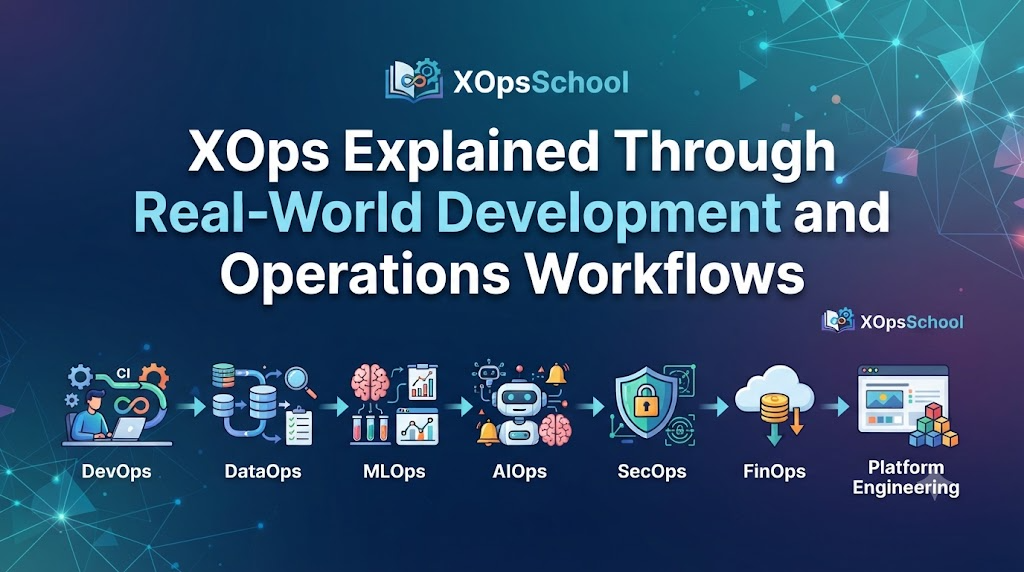
To understand What is XOps, it helps to look at the “X” as a variable representing different operational disciplines. Rather than treating DevOps, DataOps, MLOps, AIOps, SecOps, and FinOps as disconnected islands, XOps brings them together under a single umbrella approach.
At its core, XOps focuses on shared automation, standardized workflows, continuous feedback, and collaborative practices. Instead of forcing teams to work in isolation, XOps recognizes that modern applications rely on software, data, machine learning, and cloud infrastructure simultaneously.
Why the “X” Represents Connected Operations
In mathematics, “X” stands for an unknown variable. In the context of modern technology, “X” stands for whatever operational discipline an organization needs to integrate.
- DevOps handles application delivery and infrastructure automation.
- DataOps manages reliable data pipelines and quality.
- MLOps oversees machine learning lifecycles.
- AIOps applies artificial intelligence to IT operations and monitoring.
- SecOps embeds security into every operational stage.
- FinOps manages cloud and operational costs.
XOps does not mean replacing these specialized practices. Instead, it means recognizing that they share common foundations, such as version control, CI/CD principles, automation, observability, and governance. By treating operations as an integrated whole, organizations can reduce bottlenecks and build more resilient systems.
Why XOps Matters in Modern IT
Technology operations have changed dramatically over the last decade. Moving from physical servers to cloud-native architectures, containerization, and serverless computing increased both speed and complexity. When applications depend on complex data streams and machine learning models, traditional operational models are no longer sufficient.
Coordinated operations matter because disconnected processes create predictable challenges:
- Siloed Knowledge: Teams struggle to understand how changes in data pipelines affect application performance.
- Inconsistent Tooling: Different departments adopt conflicting automation and monitoring tools, leading to blind spots in observability.
- Slower Delivery: Manual handoffs between security, development, and infrastructure teams delay software releases.
XOps thinking addresses these challenges by encouraging automation, shared observability, continuous improvement, and faster feedback loops. By establishing common operational standards, teams can respond to incidents faster, maintain better security posture, and manage cloud resources more efficiently.
Major XOps Disciplines
XOps is made up of several specialized operational areas. While each discipline has its own focus, they all contribute to the broader goal of reliable, automated, and scalable technology operations.
DevOps
DevOps focuses on bridging the gap between software development and IT operations. It emphasizes continuous integration and continuous delivery (CI/CD), infrastructure automation, containerization, and collaborative workflows. DevOps forms the foundational layer for most modern operational practices.
DataOps
DataOps applies agile and automated practices to data engineering. It focuses on building reliable data pipelines, maintaining data quality, automating orchestration, and ensuring continuous data delivery so that analytics and machine learning models have access to clean, timely data.
MLOps
MLOps brings machine learning models out of the experimental phase and into production. It covers model deployment, lifecycle management, automated testing, versioning, and continuous monitoring to ensure that models remain accurate and reliable over time.
AIOps
AIOps uses artificial intelligence and machine learning to improve IT operations. It helps teams process massive volumes of monitoring data, detect anomalies early, correlate related alerts, and automate incident response workflows.
SecOps
SecOps integrates security practices directly into operational workflows. Rather than treating security as a final gatekeeper, SecOps ensures that vulnerability scanning, compliance checks, and access controls are automated throughout the software and infrastructure delivery lifecycle.
FinOps
FinOps brings financial accountability to cloud-native operations. It helps engineering, finance, and business teams collaborate to track, analyze, and optimize cloud spending without sacrificing performance or reliability.
Platform Engineering
Platform engineering focuses on building internal developer platforms (IDPs). By creating reusable infrastructure components and self-service workflows, platform engineers help development teams ship code faster while maintaining organizational governance and security standards.
XOps Training
Building expertise in modern operations requires structured guidance. XOps Training programs are designed to help learners move beyond isolated tool usage and understand the relationships between different operational domains.
A well-structured training path typically covers:
- XOps Fundamentals: Understanding the core philosophy of connected operations.
- DevOps Foundations: Mastering source control, CI/CD pipelines, and containerization.
- Cloud Infrastructure: Learning cloud platforms, networking, and infrastructure as code.
- Automation: Building repeatable workflows for deployment and configuration management.
- Observability: Setting up monitoring, logging, tracing, and alerting systems.
- Data and ML Operations: Exploring how data pipelines and machine learning models operate in production.
- Security and Governance: Integrating compliance and security into daily operational tasks.
Through structured learning resources like those found on platforms such as XOpsSchool, professionals can build a balanced skill set that spans multiple operational areas rather than focusing narrowly on a single tool.
XOps Certification
For many technology professionals, validating knowledge is an important step in career development. An XOps Certification can help individuals structure their study habits, test their understanding of complex concepts, and demonstrate familiarity with modern operational frameworks.
The primary purpose of certification preparation is not just passing an exam, but organizing a vast body of knowledge into a coherent framework. Preparing for certification helps learners:
- Follow a structured syllabus covering essential operational domains.
- Identify knowledge gaps across cloud infrastructure, automation, and reliability.
- Test theoretical understanding against practical scenarios.
It is important to remember that certification alone does not equal practical expertise. Real-world experience, problem-solving skills, and hands-on practice remain essential for mastering modern IT operations.
XOps Course
Choosing the right educational content is critical for effective learning. A comprehensive XOps Course should take learners through a logical progression, starting with basic concepts and moving toward advanced integrations.
A typical logical course progression includes:
- Introduction to XOps: Understanding the umbrella approach and operational silos.
- DevOps Essentials: Core concepts of software delivery and infrastructure automation.
- Cloud and Infrastructure: Working with cloud environments and provisioning tools.
- Automation Principles: Reducing manual toil through scripting and configuration management.
- Data Operations: Managing reliable data flows and data quality checks.
- Machine Learning and AI Operations: Deploying and monitoring models in production.
- Observability and Reliability: Tracking system health and managing incidents.
- Security and Governance: Implementing secure operational workflows.
- Cross-Disciplinary Integration: Connecting multiple operational practices into a unified workflow.
Learners should choose course depth according to their existing technical background, gradually expanding their knowledge into unfamiliar domains.
XOps Tutorial
Theoretical knowledge becomes truly valuable when applied in practice. An XOps Tutorial provides step-by-step guidance that helps learners understand how theoretical concepts translate into real-world configurations.
Practical tutorials help learners understand:
- Setting up basic configuration files and automation scripts.
- Building simple CI/CD pipelines for software deployment.
- Configuring container runtimes and orchestration platforms.
- Setting up basic monitoring dashboards and log aggregation.
- Establishing simple data pipelines or model deployment workflows.
While reading a tutorial is a great way to learn syntax and configuration steps, true technical proficiency comes from experimenting, breaking things, and troubleshooting issues in lab environments.
XOps Tools
XOps is not a single piece of software or a proprietary platform. Instead, it relies on a diverse ecosystem of tools that help teams automate, monitor, and manage their technology stacks. Tool selection depends heavily on architecture, team skills, scale, and security requirements.
Source Control and Collaboration
Git and collaborative platforms serve as the foundation for version control, code review, and collaborative development across all operational disciplines.
CI/CD
Technologies like GitHub Actions, GitLab CI/CD, and Jenkins automate the process of building, testing, and deploying applications and infrastructure.
Containers and Orchestration
Docker provides containerization for consistent application packaging, while Kubernetes acts as the standard for container orchestration at scale.
Infrastructure Automation
Tools like Terraform and Ansible allow teams to define and provision cloud infrastructure using code, ensuring consistency across environments.
Observability
Prometheus, Grafana, and OpenTelemetry provide deep visibility into system performance through metrics, logs, and distributed traces.
GitOps
Argo CD and Flux enable declarative infrastructure and application management where Git repositories serve as the single source of truth.
Data and MLOps Tools
Specialized orchestration engines, pipeline monitors, and model registry tools help manage data flows and machine learning lifecycles.
DevOps Training
Because DevOps forms the bedrock of modern operations, DevOps Training is an essential starting point for anyone exploring XOps.
A strong DevOps foundation covers:
- Version control workflows using Git.
- Building automated CI/CD pipelines.
- Packaging applications in Docker containers.
- Managing containerized workloads with Kubernetes.
- Provisioning infrastructure using Terraform or Ansible.
- Implementing monitoring and logging practices.
Understanding these foundational concepts makes it much easier to transition into more specialized areas like DataOps, MLOps, or AIOps.
AIOps Training
As system complexity increases, human operators can no longer manually parse every alert and log entry. AIOps Training helps professionals understand how artificial intelligence can support IT operations.
Key areas covered in AIOps learning include:
- Processing high volumes of operational telemetry data.
- Using machine learning for automated anomaly detection.
- Correlating related alerts to reduce alert fatigue.
- Assisting incident analysis and root-cause identification.
While AI is a powerful assistant for spotting patterns and reducing manual toil, human judgment remains essential for making critical architectural and operational decisions.
MLOps Training
Deploying machine learning models into production introduces unique challenges that traditional software deployment pipelines cannot always handle. MLOps Training bridges the gap between data science and operational engineering.
Key topics in MLOps include:
- Managing the machine learning model development lifecycle.
- Automating model training, testing, and validation.
- Versioning data sets and model weights.
- Monitoring model performance in production to detect data drift.
- Maintaining reliable deployment pipelines for AI applications.
Effective MLOps ensures that machine learning models deliver reliable, reproducible business value over time.
DataOps Training
Data is the lifeblood of modern applications and AI models. DataOps Training focuses on applying agile and automated principles to data engineering and analytics.
Core concepts include:
- Building robust and scalable data pipelines.
- Implementing automated data quality checks and testing.
- Orchestrating complex data workflows.
- Setting up data observability to catch pipeline failures early.
- Ensuring continuous data delivery to downstream consumers.
DataOps helps organizations trust their data by bringing operational rigor to data engineering practices.
How XOps Connects DevOps, DataOps, MLOps, and AIOps
To fully grasp XOps, it is helpful to see how its individual disciplines relate to one another without losing sight of their unique purposes:
- DevOps supports application delivery and infrastructure reliability.
- DataOps supports reliable data movement, transformation, and quality.
- MLOps supports the machine learning model lifecycle and deployment.
- AIOps applies AI techniques to operational monitoring, anomaly detection, and incident management.
These areas connect by sharing core operational principles. They all rely on automation, version control, CI/CD pipelines, observability, and governance. When an organization aligns these practices, changes in data pipelines trigger appropriate model retraining, which in turn feeds reliable application features, all while automated monitoring and AI-driven alerting keep the underlying infrastructure stable.
Who Can Benefit from XOpsSchool?
Learning platforms like XOpsSchool cater to a wide range of technology professionals looking to expand their operational knowledge.
1. DevOps and Cloud Engineers
Professionals with a background in infrastructure and application delivery can broaden their understanding by exploring how data pipelines, machine learning models, and AI-driven operations integrate with cloud environments.
2. Data Engineers
Data professionals can use XOps concepts to improve operational thinking around data pipelines, data quality, monitoring, and continuous delivery.
3. Machine Learning Professionals
Data scientists and ML engineers can leverage MLOps concepts to connect experimental models with reliable deployment pipelines and ongoing production monitoring.
4. IT Operations and SRE Professionals
Site Reliability Engineers and traditional operations staff can complement their existing skills by exploring AIOps, advanced observability, platform engineering, and automation frameworks.
5. Developers and Technical Learners
Software developers can gain a deeper understanding of the operational lifecycle, learning how their code runs, scales, and is monitored in production environments.
6. Technology Teams and Organizations
Entire engineering teams can use XOps knowledge to establish common operational language and bridge communication gaps between development, infrastructure, data, and security groups.
| XOps Discipline | Main Focus | Common Learning Areas |
| DevOps | Application delivery and infrastructure automation | CI/CD, Git, Docker, Kubernetes, Terraform |
| DataOps | Reliable data pipelines and data quality | Orchestration, data testing, pipeline monitoring |
| MLOps | Machine learning lifecycle and model deployment | Model versioning, drift detection, experiment tracking |
| AIOps | AI-assisted IT operations and monitoring | Anomaly detection, alert correlation, incident automation |
| SecOps | Security integration and compliance | Vulnerability scanning, access controls, compliance checks |
| FinOps | Cloud cost management and optimization | Cost tracking, resource allocation, budgeting |
| Platform Engineering | Internal developer platforms and self-service | Developer portals, reusable templates, governance |
Common Mistakes When Learning XOps
When approaching a broad field like XOps, learners often run into a few common pitfalls:
- Treating XOps as a Single Tool: Expecting to find one piece of software that solves all operational challenges. XOps is a methodology and framework, not a single product.
- Learning Tools Without Concepts: Memorizing command-line flags or UI clicks without understanding the underlying architectural principles.
- Trying to Learn Everything at Once: Attempting to master DevOps, DataOps, MLOps, and SecOps simultaneously, leading to burnout.
- Ignoring Foundations: Skipping basic DevOps and cloud concepts before jumping into advanced AI or machine learning operations.
- Focusing Solely on Certification: Collecting certificates without building practical projects or gaining hands-on experience.
- Neglecting Observability: Building complex pipelines or applications without setting up proper monitoring and logging.
Avoiding these mistakes requires patience, starting with strong fundamentals, and taking a step-by-step approach to learning.
Best Practices for Learning XOps
To build sustainable and practical expertise in XOps, consider following these learning habits:
- Start with strong DevOps and cloud fundamentals before exploring specialized domains.
- Focus on understanding operational concepts rather than memorizing specific tool interfaces.
- Practice infrastructure as code and automation early in your learning journey.
- Set up basic monitoring and observability for every project you build.
- Explore data workflows and machine learning operations gradually as your confidence grows.
- Build small, integrated projects that combine two or three operational areas.
- Document your learning process and review real-world operational problem-solving patterns.
| Learning Goal | Recommended XOps Area | Skills to Develop |
| Application delivery | DevOps | CI/CD pipelines, containerization, Git workflows |
| Cloud infrastructure | Cloud Engineering & DevOps | Infrastructure as code, networking, server provisioning |
| Data pipelines | DataOps | Data orchestration, quality testing, pipeline monitoring |
| Machine-learning deployment | MLOps | Model serving, versioning, drift monitoring |
| Intelligent operations | AIOps | Alert correlation, anomaly detection, automated remediation |
| Platform engineering | Platform Engineering | Developer self-service portals, template creation |
| System reliability | SRE & Observability | Metrics, logging, tracing, incident management |
8-Step XOps Learning Guide
Step 1: Understand What XOps Means
Learn the basic philosophy of connected operational disciplines and why organizations are moving away from isolated operational silos.
Step 2: Build DevOps Foundations
Master source control with Git, containerization with Docker, and basic CI/CD pipeline automation.
Step 3: Learn Cloud and Infrastructure
Study cloud computing fundamentals, networking basics, and infrastructure as code using tools like Terraform.
Step 4: Learn Observability and Reliability
Understand monitoring, logging, metrics, traces, alerting, and basic incident management practices.
Step 5: Explore DataOps
Learn how reliable data pipelines, automated testing, orchestration, and data observability work in practice.
Step 6: Explore MLOps and AIOps
Understand the machine learning lifecycle, model deployment, and how AI techniques assist IT monitoring.
Step 7: Learn Security, Governance, and Cost Awareness
Study SecOps principles, compliance automation, and basic FinOps cloud cost management.
Step 8: Build an Integrated Practical Project
Combine several relevant disciplines into a small, end-to-end practical project to see how different operational areas work together.
Practical XOps Learning Approach
Moving from theory to practical capability requires hands-on experimentation. Learners should look for opportunities to build small projects and test configurations in sandbox environments.
Instead of just reading about CI/CD, set up a simple pipeline that automatically tests and builds a containerized application. Instead of studying monitoring theory, deploy a basic application and configure metrics and log collection. By experimenting with infrastructure automation, simple data pipelines, and basic deployment workflows, you can bridge the gap between theoretical knowledge and real-world competence.
How to Choose XOps Tools
With countless tools available in the modern technology ecosystem, choosing the right technology can be challenging. Tool selection should always be guided by practical considerations rather than hype:
- Business Requirements: What specific operational problem are you trying to solve?
- Technical Architecture: Does the tool fit into your existing cloud and application stack?
- Team Skills: Does your team have the experience required to maintain and operate the tool?
- Integration Capabilities: How well does the tool integrate with your existing CI/CD and monitoring systems?
- Security and Compliance: Does the tool meet your organization’s security standards?
- Community and Support: Is the tool actively maintained with healthy community support?
Choosing tools simply because they are popular often leads to unnecessary complexity and maintenance overhead.
XOps Career and Skill Development
Knowledge of XOps helps technical professionals broaden their perspective across multiple operational domains. Rather than being restricted to a single narrow toolset, skilled professionals understand how applications, infrastructure, data, and security intersect.
Valuable skill areas include automation, cloud provisioning, CI/CD, observability, data engineering, and reliability engineering. Developing these skills requires a combination of practical hands-on experience, strong communication, and a willingness to continuously learn as technology evolves.
Using XOpsSchool as a Learning Resource
Approaching a platform like XOpsSchool effectively means treating it as a structured knowledge repository rather than a shortcut to expertise. A recommended learning workflow includes:
- Start by exploring XOps fundamentals to understand the big picture.
- Identify the specific operational discipline closest to your current daily role.
- Learn the core concepts and relevant tools associated with that discipline.
- Use tutorials to understand practical configuration and setup steps.
- Practice through hands-on labs or small personal projects.
- Gradually explore adjacent XOps disciplines to broaden your operational scope.
- Use certification-related learning paths for structured revision when appropriate.
- Continue learning through real-world problem-solving and community engagement.
Frequently Asked Questions (FAQs)
1. What is XOps in simple terms?
XOps is an umbrella approach that connects various IT operational disciplines—such as DevOps, DataOps, MLOps, and SecOps—under a unified framework of automation, collaboration, and shared practices.
2. How is XOps different from DevOps?
DevOps primarily focuses on software delivery and infrastructure automation. XOps expands on this by encompassing DevOps while also integrating data operations, machine learning operations, AI operations, security, and cost management.
3. What disciplines are included in XOps?
Common disciplines include DevOps, DataOps, MLOps, AIOps, SecOps, FinOps, and Platform Engineering.
4. Is XOps suitable for beginners?
Yes, provided learners start with the fundamentals—such as basic DevOps, cloud concepts, and version control—before tackling more specialized areas like MLOps or AIOps.
5. What should an XOps training path include?
A robust training path should cover DevOps foundations, cloud infrastructure, automation, observability, data operations, model operations, security, and governance.
6. What is the purpose of XOps certification?
Certification preparation helps learners structure their knowledge, follow a comprehensive syllabus, test their conceptual understanding, and identify knowledge gaps.
7. What should learners look for in an XOps course?
A good course should offer a logical progression from fundamentals to advanced integrations, focusing heavily on core concepts and practical understanding.
8. Which tools are commonly associated with XOps?
Common tools include Git, GitHub Actions, Docker, Kubernetes, Terraform, Ansible, Prometheus, Grafana, and various CI/CD and pipeline orchestration platforms.
9. How are DevOps, DataOps, MLOps, and AIOps connected?
They share foundational operational principles such as automation, version control, CI/CD, observability, and governance, allowing software, data, and machine learning models to work together reliably.
10. How can someone start learning XOps?
Begin by understanding the basic philosophy of connected operations, build solid DevOps and cloud foundations, explore observability and automation, and gradually practice integrating different operational workflows.
Conclusion
The evolution of modern technology demands a shift away from isolated operational silos toward a fully connected, collaborative strategy. By bringing application delivery, data management, machine learning lifecycles, and security under a single umbrella, XOps enables engineering teams to build more resilient, scalable, and automated systems. Platforms like XOpsSchool provide the structured learning paths, tutorials, and knowledge resources necessary to help professionals master these interconnected disciplines, ensuring that technical learners and experienced operators alike can thrive in a rapidly changing technological world.