Introduction
The modern software engineering landscape moves incredibly fast. For systems to remain fast, secure, and resilient, engineering teams have completely shifted how they build, deploy, and manage applications. This transformation has turned specialized operations and automation skills into some of the most sought-after assets in the global tech industry. However, with dozens of platforms, methodologies, and tools emerging every year, professionals often struggle to determine which credentials carry actual weight in the market. Navigating this vast ecosystem can be overwhelming, leading to career stagnation or wasted effort on redundant training.
Securing a recognized, high-quality certification is one of the most effective ways to cut through the noise, build structure around your learning, and signal engineering excellence to hiring managers. Choosing the right learning path bridges the gap between theoretical knowledge and production-ready implementation. This comprehensive guide breaks down the absolute best paths to master infrastructure as code, container ecosystem orchestration, site reliability engineering, continuous security integration, and advanced automation workflows.
What is a DevOps Certification?
A Best DevOps certification is an independent, industry-recognized credential that validates a professional’s technical competency in bridging the gap between software development and systems operations. Rather than just proving that you understand conceptual philosophies, these certifications focus heavily on your ability to implement automated pipelines, manage infrastructure via code, and ensure high availability across complex systems. They provide a structured, rigorous curriculum designed to take engineers out of their comfort zones and expose them to standardized, real-world engineering practices.
Most modern DevOps certifications go far beyond multiple-choice questions. They feature hands-on, performance-based examinations where candidates must configure live infrastructure, debug failing clusters, or patch security vulnerabilities under tight time constraints. Obtaining one of these credentials demonstrates to employers that you have undergone disciplined, structured preparation and possess verified, hands-on experience with the exact toolsets utilized by elite engineering teams worldwide.
Why DevOps Certifications Matter
The global demand for cloud automation and infrastructure engineers far exceeds the supply of qualified talent, making professional validation more critical than ever. Organizations are actively migrating away from brittle legacy architectures toward highly resilient, cloud-native environments that require constant optimization. A validated certification changes how you are perceived in the job market, unlocking complex engineering roles and separating your profile from unverified applicants.
+-------------------------------------------------------------------+
|               THE CERTIFICATION VALUE CYCLE                       |
+-------------------------------------------------------------------+
|  [1. Structured Blueprint] -> Clears confusion & gaps in knowledge  |
|               |                                                   |
|               v                                                   |
|  [2. Hands-on Validation] -> Builds muscle memory via live labs   |
|               |                                                   |
|               v                                                   |
|  [3. Market Signaling]    -> Bypasses generic resume screeners    |
|               |                                                   |
|               v                                                   |
|  [4. Production Execution] -> Lowers system downtime & errors     |
+-------------------------------------------------------------------+
To maximize the impact of your certification journey, follow this systematic four-step process:
- Align with Career Objectives: Analyze your current technical baseline and select a certification tracking toward your target role, such as focusing on container orchestration if you aim to become a platform engineer.
- Commit to Hands-On Laboratory Practice: Avoid relying solely on text or video materials; build, break, and fix actual environments using interactive labs to develop deep muscle memory.
- Study Official Architecture Blueprints: Deeply evaluate the official exam documentation, whitepapers, and failure modes to understand how tools behave under stress in production environments.
- Deploy a Real-World Capstone Project: Apply your newly certified skills by building an end-to-end automated system outside of the exam environment to showcase your capabilities to potential employers.
Who Should Take DevOps Certifications?
DevOps certifications are not reserved strictly for systems administrators or traditional infrastructure teams. The modern cloud ecosystem requires a shared understanding of automation, reliability, and security across the entire engineering lifecycle. As teams shift toward cross-functional platform engineering, professionals from various technical disciplines find immense value in validating their infrastructure and pipeline mastery.
This comprehensive guide and the underlying certification pathways are explicitly built for:
- Students and Freshers: Aspiring engineers looking to break into the tech industry by substituting a lack of enterprise employment history with rigorous, verified technical credentials.
- Software and QA Engineers: Developers wanting to master continuous integration and deployment pipelines to accelerate code delivery and improve automated test environments.
- System Administrators and Cloud Engineers: Traditional IT professionals aiming to pivot into modern infrastructure-as-code roles and scale their systems across multi-cloud environments.
- DevOps and SRE Professionals: Experienced practitioners seeking to formalize their production expertise, validate their advanced architectural knowledge, and qualify for senior or principal engineering positions.
- DevSecOps and Platform Engineers: Security and operations specialists looking to integrate automated guardrails directly into the software development lifecycle.
- Data and Machine Learning Engineers: Professionals focused on automating the training, deployment, tracking, and scaling of analytical models via MLOps and GitOps workflows.
- IT Managers and Directors: Technical leaders needing a deep conceptual and architectural understanding of automated ecosystems to effectively guide engineering strategy and team training.
Core Skills Covered
A well-rounded, industry-standard training path covers several critical pillars of modern systems architecture. These technical domains form the foundation of any high-performing engineering organization:
- Continuous Integration and Continuous Delivery (CI/CD): Building automated, reproducible pipelines that automatically lint, test, build, package, and deploy code updates with minimal manual intervention.
- Infrastructure as Code (IaC): Treating infrastructure precisely like application software by writing declarative configuration files to provision, update, and version control entire environments.
- Containerization and Orchestration: Packaging applications into isolated, portable runtime units and managing their lifecycle, scaling, and networking across large distributed clusters.
- Site Reliability and Observability: Implementing granular tracking systems using metrics, logs, and traces to detect anomalies, optimize system latency, and maintain strict service-level agreements.
- Cloud Architecture and Security: Designing cost-effective, fault-tolerant cloud environments while embedding automated compliance checks and security scanning at every step of the pipeline.
Best DevOps Certifications
| Certification Name | Best For | Skill Level | Career Direction |
| DevOps Certified Professional (DCP) | Core DevOps Foundation & Multi-Tool Mastery | Beginner to Intermediate | DevOps Engineer, Systems Automation Engineer |
| DevSecOps Certified Professional (DSOCP) | Automated Security Integration & Vulnerability Shifting | Intermediate to Advanced | DevSecOps Engineer, Cloud Security Specialist |
| Site Reliability Engineering (SRE) Certified Professional | Enterprise System Reliability, SLOs & Incident Automation | Intermediate to Advanced | Site Reliability Engineer (SRE), Operations Architect |
| Master in DevOps Engineering (MDE) | Comprehensive Advanced CI/CD & Pipeline Architecture | Intermediate to Advanced | Principal DevOps Engineer, Infrastructure Lead |
| Master in Azure DevOps | End-to-End Enterprise Automation inside Microsoft Azure | Intermediate to Advanced | Azure Cloud Engineer, Platform Engineer |
| AWS Certified DevOps Engineer – Professional | Large-Scale Automation & Operations on Amazon Web Services | Advanced | AWS Solutions Architect, Cloud DevOps Engineer |
| Master in Python Programming | Infrastructure Scripting, Custom Tooling & Automation | Beginner to Advanced | Automation Engineer, Systems Programmer |
| HashiCorp Certified: Terraform Associate | Declarative Infrastructure Provisioning & State Management | Intermediate | Cloud Architect, Infrastructure Engineer |
| Certified Kubernetes Administrator (CKA) | Production Cluster Management & Workload Orchestration | Intermediate to Advanced | Kubernetes Administrator, Platform Engineer |
| Docker Certified Associate (DCA) | Container Runtime Management & Multi-Container Packaging | Intermediate | Container Engineer, DevOps Specialist |
| Envoy ISTIO Certification Training | Microservices Networking, Service Mesh & Traffic Routing | Advanced | Service Mesh Engineer, Network Architect |
| MLOps Certification Training Course | Automating Machine Learning Pipelines & Model Deployments | Intermediate to Advanced | MLOps Engineer, Data Science Automation Specialist |
| Google Cloud Professional Cloud DevOps Engineer | Site Reliability Engineering & Automation on Google Cloud | Advanced | GCP Cloud Engineer, SRE Professional |
| Master in Machine Learning | Statistical Model Engineering & Predictive Data Systems | Intermediate to Advanced | Machine Learning Engineer, Data Scientist |
| Master in Artificial Intelligence | Advanced Neural Architectures & Cognitive Applications | Advanced | AI Engineer, Intelligent Systems Architect |
| Master in AppDynamics | Enterprise Application Performance Monitoring & Telemetry | Intermediate to Advanced | Observability Engineer, Performance Analyst |
| Master in Data Science | Advanced Analytical Workflows & Data Pipeline Systems | Intermediate to Advanced | Data Scientist, Big Data Engineer |
| Master in Deep Learning | Multi-Layered Neural Networks & Complex Pattern Analysis | Advanced | Deep Learning Researcher, AI Specialist |
| Prometheus with Grafana | Open-Source Systems Monitoring, Alerting & Dashboards | Intermediate | Observability Engineer, Systems Monitor |
| GitOps Certified Professional (GOCP) | Declarative Continuous Delivery & Git-Driven Operations | Intermediate to Advanced | GitOps Engineer, Platform Automation Architect |
Certification Deep Dive
Real-World Use Case
Consider an enterprise financial institution migrating a legacy monolithic application to a cloud-native, microservices-based distributed system. This architecture requires zero-downtime rolling updates, strict compliance guardrails, real-time telemetry, and automated infrastructure provisioning. The engineering team leverages a standardized toolchain where infrastructure is declared via Terraform, container runtimes are managed by Docker, application workloads are scaled using Kubernetes, network traffic is governed via an Istio service mesh, and delivery pipelines are automated through GitOps principles. If a critical traffic spike occurs, automated monitoring triggers auto-scaling policies while embedded security scanners continuously audit the running containers for vulnerabilities.
Skills You Will Learn
- Declarative Infrastructure Provisioning: Designing, refactoring, and maintaining modular configuration code to predictably deploy highly available cloud components.
- Advanced Cluster Orchestration: Configuring multi-node container environments, tuning network policy schemas, managing persistent data volumes, and debugging production workloads.
- Automated Delivery Pipeline Engineering: Writing clean, maintainable automation scripts and declarative pipeline logic to build, test, and release software.
- Production Observability and Telemetry: Building robust monitoring frameworks with custom dashboards, distributed tracing, and context-rich alerting rules.
- Continuous Security and Guardrails: Integrating automated code analysis, dependency scanning, and secret management tools directly into standard workflows.
Career Scope
Completing rigorous industry certifications completely reshapes your professional trajectory. Organizations are looking for verified engineers capable of immediately contributing to production systems. Certified professionals routinely move into critical roles such as Platform Engineer, Site Reliability Engineer, DevSecOps Architect, or Infrastructure Director, commanding premium compensation and driving major architectural decisions within enterprise teams.
Difficulty Level
The difficulty level across these certifications ranges from Intermediate to Advanced. Performance-based exams (such as the CKA or standard hands-on technical labs) require real-time problem-solving under strict time constraints, demanding a clear understanding over simple memorization.
Best Career Fit & Who Should Take It
These validation pathways are ideal for technical professionals who want to move past manual operations and GUI-driven management. It is best suited for engineers seeking to run scalable, highly reliable production environments using software engineering principles.
Hands-On Projects
- The Multi-Cloud Declarative Infrastructure Matrix: Writing reusable Terraform modules to launch secure, private networks, auto-scaling compute groups, and managed databases across multiple providers simultaneously.
- The Production-Grade GitOps Microservices Cluster: Setting up a multi-node Kubernetes cluster orchestrated via GitOps tools, completely automated from a single Git code repository.
- The Automated Zero-Trust Security Pipeline: Designing a complete delivery pipeline that automatically halts compilation if open-source software dependencies contain critical vulnerabilities or if plain-text secrets are discovered in the source code.
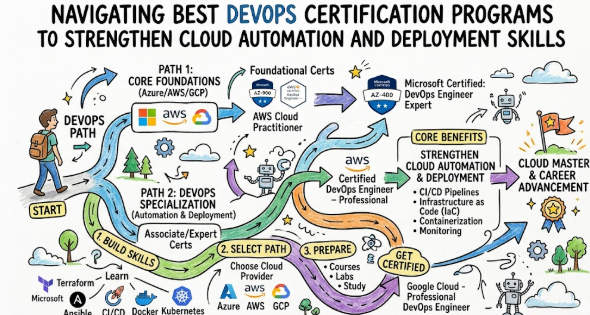
DevOps Certification Roadmap
| Career Goal | Recommended Certification Path | Why It Fits |
| Enterprise DevOps Lead | DCP $\rightarrow$ CKA $\rightarrow$ AWS/Azure DevOps Professional | Establishes a tool-agnostic foundation before mastering high-scale cluster orchestration and cloud architecture. |
| Cloud Security Architect | DCP $\rightarrow$ DCA $\rightarrow$ DSOCP | Transitions an engineer from basic automation workflows directly into secure container runtimes and automated security compliance. |
| Site Reliability Engineer | Master in DevOps $\rightarrow$ Prometheus/Grafana $\rightarrow$ SRE Professional | Pairs deep pipeline automation experience with precise systems telemetry, alerting design, and incident mitigation frameworks. |
| Platform / Core Infra Engineer | Terraform Associate $\rightarrow$ CKA $\rightarrow$ Envoy Istio Training | Provides complete control over the entire modern cloud-native stack, from infrastructure code up through the networking fabric. |
| MLOps / Data AI Engineer | Python Mastery $\rightarrow$ Master in Data Science $\rightarrow$ MLOps Training | Combines core software programming with advanced analytical workflows and automated model deployment structures. |
Types of DevOps Certifications
Navigating the certification landscape becomes significantly easier when you categorize options by their architectural focus and operational purpose. Instead of treating every certification as an identical credential, successful engineers choose their tracks based on the specific operational paradigms required by their organizations.
+--------------------------------------------------------------------------------------------------+
|                                MODERN DEVOPS CERTIFICATION CATEGORIES                           |
+--------------------------------------------------------------------------------------------------+
|  [FOUNDATIONAL & METHODS] -> Broad toolsets, cultural dynamics, and pipeline fundamentals        |
|                                                                                                  |
|  [CLOUD-SPECIFIC PLATFORMS] -> Deep ecosystems tied to hyperscalers (AWS, Azure, GCP)            |
|                                                                                                  |
|  [CLOUD-NATIVE OPERATING]  -> High-performance environments (Docker, CKA Kubernetes, Istio Mesh) |
|                                                                                                  |
|  [INFRASTRUCTURE AS CODE]  -> Declarative configuration management and state systems (Terraform)  |
|                                                                                                  |
|  [SPECIALIZED DATA PIPES]  -> High-scale data integration, model operations, and AI deployment   |
+--------------------------------------------------------------------------------------------------+
Certification Path by Role
1. General & Methodology-Focused Certifications
These options focus heavily on core automation patterns, pipeline design, and cultural alignment. They are deliberately tool-agnostic or bundle major systems together to ensure you understand how various tools integrate cleanly without getting locked into a single ecosystem.
- Examples: DevOps Certified Professional (DCP), Master in DevOps Engineering (MDE).
2. Cloud Provider Specific Certifications
These tracks focus directly on the native services, security models, identity abstractions, and cost-management frameworks of individual cloud hyperscalers. They validate your ability to build stable architectures utilizing a provider’s specific tools.
- Examples: AWS Certified DevOps Engineer – Professional, Master in Azure DevOps, Google Cloud Professional Cloud DevOps Engineer.
3. Cloud-Native & Containerization Certifications
These certifications validate your ability to package, run, isolate, network, and orchestrate complex applications within distributed systems. They focus intensely on open-source, cloud-native standards.
- Examples: Certified Kubernetes Administrator (CKA), Docker Certified Associate (DCA), Envoy ISTIO Certification Training, GitOps Certified Professional (GOCP).
4. Automation & Infrastructure as Code (IaC) Certifications
These technical credentials focus on replacing manual configurations with version-controlled code. They test your ability to declare desired state, safely refactor running architectures, and manage infrastructure changes across team environments.
- Examples: HashiCorp Certified: Terraform Associate, Master in Python Programming.
5. Specialized Data & AI/ML Operations Certifications
These tracks bridge the gap between traditional software systems and modern, data-driven applications. They focus on the specialized delivery pipelines required to clean data, train models, and manage live AI systems at scale.
- Examples: MLOps Certification Training Course, Master in Machine Learning, Master in Artificial Intelligence, Master in Data Science, Master in Deep Learning.
6. Observability & Performance Management Certifications
These options center around telemetry data collection, user-experience tracking, system behavior visibility, and alerting design. They ensure engineers can quickly diagnose issues and keep large-scale systems performing optimally.
- Examples: Prometheus with Grafana, Master in AppDynamics.
Common Mistakes to Avoid
- Relying on Exam Dumps: Memorizing exact questions and answers can help pass low-tier multiple-choice exams, but leaves you completely unprepared for real-world, performance-based troubleshooting environments.
- Ignoring the Software Engineering Foundations: Attempting to build advanced automation pipelines without a solid grasp of core programming concepts, source control systems, and basic networking principles.
- Collecting Certifications Indiscriminately: Accumulating entry-level credentials across dozens of unrelated topics rather than building deep, specialized expertise within a clear career path.
- Neglecting Post-Failure Analysis and SRE Culture: Focusing exclusively on building systems while ignoring how to monitor them, establish clear alert thresholds, or run blameless post-mortems when things break.
- Treating Local Labs as Production Environments: Assuming a configuration that works perfectly on a single local computer will automatically behave the same way under intense load or strict cloud security policies.
Real-Life Examples
1. Multi-Region Retail Pipeline Optimization
A global retail enterprise experienced frequent system crashes during high-traffic shopping events due to manual configuration errors. By adopting modern DevOps standards and rewriting their infrastructure into modular code, their engineering team automated their entire scaling strategy. This shift allowed the platform to effortlessly handle multi-million-user traffic spikes while cutting delivery times down to minutes.
2. Financial Platform Vulnerability Shifting
A growing financial technology company struggled with security review bottlenecks that routinely delayed critical product updates. By integrating automated vulnerability scanners directly into their application pipelines, they began identifying code flaws immediately during development. This automated protection drastically reduced exposure risks without slowing down production releases.
3. Media Streaming Availability Architecture
An international streaming platform faced frequent microservice communication failures and difficult-to-track system latency. By deploying an organized service mesh and pairing it with a comprehensive monitoring stack, they gained clear visibility into their application dependencies. This allowed their reliability engineers to identify and resolve performance issues before users noticed any service degradation.
4. Healthcare Data Migration and Automation
A large healthcare provider needed to move sensitive patient records into a secure cloud system while adhering to strict regulatory requirements. The engineering team used version-controlled infrastructure configurations to provision isolated environments with built-in encryption guardrails. This automated compliance allowed them to complete the migration securely and pass auditing reviews with ease.
5. Automated Predictive Supply Chain Scaling
A large logistics business needed to automate the deployment and scaling of its machine learning demand models. By building a dedicated MLOps pipeline, they automated data validation, model retraining, and containerized deployments across their distribution centers. This automation improved inventory tracking accuracy while ensuring system resources automatically scaled with analytical demands.
Frequently Asked Questions (FAQs)
1. Which DevOps certification is best for absolute beginners?
The DevOps Certified Professional (DCP) is an exceptional starting point because it builds a tool-agnostic foundational baseline. It introduces core pipeline concepts, basic automation, and source control workflows before exposing you to complex cloud architectures. This ensures you master foundational engineering concepts before tackling advanced cloud configurations.
2. Are performance-based exams like the CKA harder than multiple-choice options?
Yes, performance-based examinations are generally more challenging because they test practical application over simple memorization. Instead of selecting an answer from a pre-defined list, you are given a terminal connected to live, broken environments and tasked with configuring or repairing systems within a strict timeframe. This style requires hands-on experience and real-world troubleshooting skills.
3. Do I need to be a skilled software programmer to work in DevOps?
You do not need to be an expert application developer, but a solid understanding of software logic and scripting is essential. Mastering a language like Python is critical for writing custom automation scripts, interacting with system APIs, and managing advanced infrastructure-as-code configurations.
4. What is the main difference between DevOps and DevSecOps certifications?
Traditional DevOps credentials focus primarily on speed, automation, collaboration, and deployment reliability. DevSecOps certifications intentionally inject security checkpoints throughout that entire process, teaching you how to embed automated compliance checks, secret management, and vulnerability scanning directly into your pipelines.
5. Can certifications replace actual on-the-job experience?
Certifications cannot fully replace real-world experience, but they serve as an excellent accelerator and technical validation tool. They prove you possess a structured baseline of knowledge, understand industry-standard toolchains, and have the discipline to master complex technical concepts.
6. How often do these cloud and container certifications expire?
Most major credentials expire every two to three years due to how rapidly the underlying technology evolves. Recertification typically requires passing an updated version of the exam or earning a higher-tier credential, ensuring your skills remain sharp and aligned with current production standards.
7. Why should I learn Terraform over cloud-native tools like CloudFormation?
Terraform uses a single, consistent declarative language to manage resources across multiple cloud providers simultaneously. Learning it allows you to build multi-cloud architectures using a uniform workflow, making your skills highly transferable across different infrastructure environments.
8. What role does Git play in modern infrastructure management?
Git serves as the single source of truth for both application code and system infrastructure configuration. Under a modern GitOps framework, any change to your production environment must be declared within a Git repository first, providing a clear audit log and automated rollback capabilities.
9. Why is monitoring and observability considered a core DevOps skill?
You cannot reliably manage or optimize systems you cannot see. Observability frameworks ensure you track detailed metrics, logs, and traces, giving you the visibility needed to catch performance drops, diagnose system failures, and keep applications running smoothly.
10. How does MLOps differ from standard software DevOps?
Standard DevOps manages stable, versioned application code and static infrastructure components. MLOps introduces the challenge of tracking changing datasets and evolving statistical models, requiring specialized pipelines to handle automated model retraining, tracking, and continuous deployment.
Conclusion
Building a successful career in automation requires moving past manual configurations and embracing a culture of continuous improvement, version-controlled infrastructure, and deep system visibility. True technical mastery comes from a structured combination of theoretical blueprints, disciplined certification study, and extensive hands-on experimentation. By selecting a role-specific learning pathway, you can systematically close your technical gaps and build the expertise required to run modern, resilient production environments.
As you move forward, focus your efforts on designing robust, automated pipelines, mastering container orchestration, and embedding security guardrails into every layer of your architecture. Practical application is what transforms conceptual knowledge into production-ready capability.