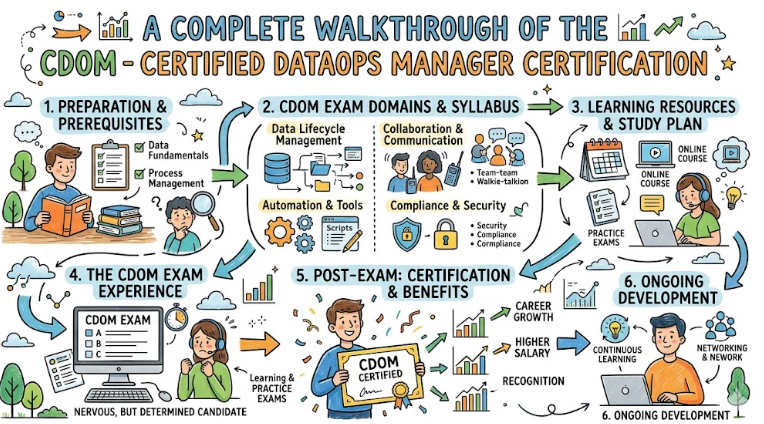
Introduction
A shift in how information is handled has been observed globally. Traditional methods are being replaced by automated, agile workflows. As more organizations move to the cloud, the complexity of data pipelines is increased. Therefore, a structured approach to managing these pipelines is needed.
The CDOM – Certified DataOps Manager program is created to address these modern challenges. It is not just about tools; it is about mindset and culture. Efficiency is prioritized, and manual errors are reduced. This guide is written to help professionals understand how this certification can change their career trajectory.
What is CDOM – Certified DataOps Manager
The CDOM – Certified DataOps Manager is a professional designation. It confirms that an individual possesses the skills to manage data lifecycles using DevOps principles. Reliability and quality are ensured throughout the data delivery process.
The focus is placed on automation, orchestration, and monitoring. Instead of treating data as a static asset, it is treated as a flowing product. By earning this title, a professional is recognized as an expert in streamlining data operations. Leadership and technical mastery are combined in this single program.
Why it matters today?
In the current market, data is considered the new oil. However, raw oil is useless without refinement. Data must be cleaned, moved, and analyzed quickly. If the data delivery is slow, business decisions are delayed. This causes a loss in competitive advantage.
DataOps is adopted to solve these bottlenecks. Collaboration is improved between data scientists and IT operations. Since the volume of data is growing exponentially, manual management is no longer possible. Automated systems are required to maintain high standards of data integrity.
Why CDOM – Certified DataOps Manager certifications are important?
A standardized way of working is provided by this certification. Without formal training, teams often struggle with inconsistent processes. When a manager is certified, a common language is used by the entire department. This leads to fewer misunderstandings and faster project completion.
Furthermore, trust is built with stakeholders. When a CDOM – Certified DataOps Manager leads a project, higher success rates are expected. Career growth is also accelerated. Certified professionals are often preferred for high-level leadership roles in top-tier companies.
Why choose DataOpsSchool?
When it comes to specialized training, DataOpsSchool is widely respected. Practical, hands-on learning is prioritized over theoretical knowledge. The curriculum is updated regularly to reflect current industry trends. High-quality resources are provided to every student.
The instructors at DataOpsSchool are industry veterans. Complex concepts are explained in simple, easy-to-understand language. A global community is offered, allowing students to network with peers. Support is provided throughout the learning journey, ensuring that certification goals are met.
Certification Deep-Dive: CDOM – Certified DataOps Manager
What is this certification?
The CDOM – Certified DataOps Manager is a high-level credential. It validates the ability to oversee data operations and implement agile methodologies in data environments.
Who should take this certification?
This program is ideal for Data Engineers, DevOps Engineers, and Engineering Managers. It is also suitable for anyone responsible for data quality and delivery speed within an organization.
Certification Overview Table
| Track | Level | Who it’s for | Prerequisites | Skills Covered | Recommended Order |
|---|---|---|---|---|---|
| DataOps Foundation | Beginner | Newcomers to Data | Basic IT Knowledge | Agile, Data Flow | 1 |
| DataOps Engineer | Intermediate | Software Engineers | Coding Skills | Pipelines, CI/CD | 2 |
| DataOps Architect | Advanced | Senior Engineers | Infrastructure Knowledge | Scaling, Cloud Ops | 3 |
| CDOM – Manager | Expert | Leads & Managers | Team Management | Governance, Strategy | 4 |
| Cloud DataOps | Specialist | Cloud Engineers | AWS/Azure/GCP | Multi-cloud Data | 5 |
Skills you will gain
- Data pipeline automation is mastered.
- Quality control measures are implemented.
- Agile methodologies are applied to data projects.
- Team collaboration is enhanced.
- Resource allocation is optimized.
- Data governance and security are maintained.
- Monitoring tools are effectively utilized.
- Cloud-native data strategies are developed.
Real-world projects you should be able to do after this certification
- An end-to-end automated data pipeline is built.
- A data quality dashboard is created for real-time monitoring.
- Version control for data assets is implemented.
- A collaborative environment for data and ops teams is established.
- Migration of on-premise data to a cloud environment is managed.
- Disaster recovery plans for data systems are designed.
Preparation plan
7–14 days plan: The core concepts of DataOps are reviewed. The official documentation is read thoroughly. Basic automation tools are explored briefly to understand the workflow.
30 days plan: Deep dives into pipeline orchestration are conducted. Practice exams are taken to identify weak areas. Real-world case studies are analyzed to understand practical applications.
60 days plan: Advanced topics like data governance and multi-cloud strategies are mastered. Hands-on projects are completed. Peer reviews and mock interviews are participated in for total readiness.
Common mistakes to avoid
- Theoretical learning is focused on too much, while practical practice is ignored.
- The importance of team culture is underestimated.
- Security measures are added as an afterthought.
- Documentation is neglected during the build phase.
- Inconsistent naming conventions are used in pipelines.
Best next certification after this
- Same track: Certified DataOps Architect (CDOA)
- Cross-track: Certified AIOps Professional
- Leadership / management: ITIL Master or PMP
Choose Your Learning Path
DevOps Path: This path is chosen by those who want to integrate data into their existing CI/CD workflows. It is best for systems administrators moving toward data-centric roles.
DevSecOps Path: Security-focused professionals choose this path. The integration of security protocols into data pipelines is the main objective here.
Site Reliability Engineering (SRE) Path: This is selected by engineers who care about the uptime and reliability of data services. Error budgets and monitoring are prioritized.
AIOps / MLOps Path: Professionals working with Artificial Intelligence and Machine Learning choose this. Data delivery for model training is optimized.
DataOps Path: The core path for data professionals. It is best for those who want a pure focus on the lifecycle of data management.
FinOps Path: This is chosen by those responsible for the costs of cloud data. Financial accountability is linked to data operations.
Role → Recommended Certifications Mapping
| Role | Recommended Certification | Key Focus |
|---|---|---|
| DevOps Engineer | CDOM / Certified DevOps Master | Integration & Automation |
| SRE | Certified SRE Professional | Reliability & Monitoring |
| Platform Engineer | Certified Platform Specialist | Infrastructure as Code |
| Cloud Engineer | Certified Cloud Operations | Cloud Native Services |
| Security Engineer | Certified DevSecOps Engineer | Compliance & Security |
| Data Engineer | CDOM – Certified DataOps Manager | Pipeline Management |
| FinOps Practitioner | Certified FinOps Specialist | Cost Optimization |
| Engineering Manager | CDOM / Leadership Track | Strategy & Team Growth |
Next Certifications to Take
One same-track certification: The Certified DataOps Architect is recommended. Further technical depth in designing complex data systems is gained through this program.
One cross-track certification: The Certified AIOps Professional is suggested. An understanding of how AI can automate IT operations is provided, which complements DataOps skills.
One leadership-focused certification: The Certified Engineering Manager program is advised. Skills in conflict resolution, budgeting, and strategic planning are enhanced for long-term career success.
Training & Certification Support Institutions
DevOpsSchool: A wide range of technical courses is offered by this institution. It is known for its comprehensive training modules and expert-led sessions.
Cotocus: Support for various IT certifications is provided. Consulting services and tailored training programs are available for corporate teams.
ScmGalaxy: A massive library of resources for DevOps and DataOps is maintained. Community support and technical blogs are highly valued by learners.
BestDevOps: Specialized bootcamps are conducted here. A hands-on approach is taken to ensure every student gains practical experience.
devsecopsschool.com: The focus is placed entirely on the intersection of security and operations. Certification support for security professionals is provided.
sreschool.com: Training for Site Reliability Engineering is the specialty here. Best practices for system stability are taught.
aiopsschool.com: Courses on AI-driven operations are offered. It is a leading source for MLOps and AIOps training.
dataopsschool.com: This is the primary home for DataOps certifications. Extensive support for the CDOM program is found here.
finopsschool.com: Financial management in the cloud is taught. It is the go-to place for FinOps certification preparation.
FAQs Section
1. What is the difficulty level of the CDOM exam? The exam is considered moderate to advanced. A deep understanding of both technical tools and management principles is required.
2. How much time is required for preparation? Usually, 30 to 60 days are needed if a consistent study schedule is followed.
3. Are there any prerequisites for CDOM? A basic understanding of data pipelines and agile methodologies is recommended.
4. What is the recommended certification sequence? The Foundation level is started first, followed by the Engineer and Architect tracks before attempting the Manager level.
5. What is the career value of this certification? Significant salary increases are often reported. It also opens doors to senior leadership roles in data-driven companies.
6. Which job roles are most suitable for CDOM holders? Data Manager, DataOps Lead, and Senior Data Engineer are common roles.
7. Is the certification recognized globally? Yes, it is respected by organizations across India and international markets.
8. Can the exam be taken online? Yes, the exam is available through an online proctored system for convenience.
9. How long is the certification valid? It is typically valid for two to three years, after which renewal or recertification is required.
10. Are practice tests provided? Yes, mock exams are usually included in the training packages provided by official partners.
11. Is hands-on experience mandatory? While not strictly required, practical knowledge of tools like Jenkins or Airflow is very helpful.
12. How does CDOM help in team growth? A structured framework is provided to the team, which leads to better productivity and morale.
Additional FAQs for CDOM – Certified DataOps Manager
1. Does CDOM cover specific tools? The focus is kept on methodologies, but common tools like Git, Docker, and Kubernetes are discussed.
2. Is coding required for this certification? Basic scripting knowledge is helpful, but the exam focuses more on management and workflow design.
3. How is the CDOM exam structured? A mix of multiple-choice questions and scenario-based problems is used to test the candidate.
4. Are there group discounts for corporate teams? Yes, corporate training programs often offer discounted rates for larger groups.
5. What makes CDOM different from a standard Data Engineering certificate? Management, culture, and operational efficiency are prioritized over just building data pipelines.
6. Can a non-technical manager take this course? It is possible, but a background in IT or data is highly recommended for better understanding.
7. Is cloud experience necessary? Since most DataOps is done in the cloud, familiarity with AWS or Azure is beneficial.
8. Is there a community for CDOM professionals? Yes, a dedicated group is maintained by DataOpsSchool for ongoing support and networking.
Testimonials
Aarav Sharma: The way data is handled in my organization was completely changed after this certification. Clarity in my daily tasks was gained, and my confidence was significantly boosted.
Sarah Jenkins: A deep understanding of data quality was provided by the CDOM program. Practical solutions were implemented in my current projects, and immediate results were seen by my team.
Vikram Mehta: My career path was stagnant before taking this course. Now, I lead a team of ten engineers with a clear strategy. The real-world application of the lessons is truly valuable.
Elena Rodriguez: The gap between security and data was bridged by this training. My ability to manage complex cloud environments was enhanced, and I feel much more prepared for leadership.
David Thompson: Complex concepts were simplified by the instructors. I was able to automate our legacy pipelines within weeks of completing the certification. It was a great investment for my career.
Conclusion
The decision to pursue the CDOM – Certified DataOps Manager certification is seen as a strategic investment in professional longevity. As organizations move away from slow, manual data processes, the demand for certified leaders will only continue to rise. Mastery of these agile methodologies ensures that a professional remains relevant and valuable in a rapidly changing tech world.
Long-term benefits include not only better employment opportunities but also the ability to drive meaningful efficiency within an organization. Strategic planning for a certification journey is highly encouraged for every engineer and manager. By taking this step today, a successful and stable future in the data industry is firmly established.