Introduction
For many, the dream of moving to a new country represents more than just a change of scenery; it is a quest for better opportunities, safety, and a higher quality of life. However, the first hurdle is often the most confusing: Eligibility.
Take the story of Liam, a project manager who spent months researching visas for Australia. He was overwhelmed by conflicting information online. He didn’t know if his ten years of experience carried more weight than his master’s degree or if his age would work against him. He felt stuck until he found a PR Points Calculator. By spending just ten minutes inputting his details, Liam realized that while his age was a slight disadvantage, his high English test scores made him a competitive candidate. This clarity gave him the confidence to stop researching and start applying.
A PR Points Calculator is a digital tool designed to simplify the complex world of immigration. It uses a mathematical approach to evaluate your profile, giving you a clear score that determines whether you are eligible to apply for permanent residency. In this guide, we will explore how these systems work and how you can use them to secure your future abroad.
What Is a PR Points Calculator?
In the world of immigration, “PR” stands for Permanent Residency. This status allows you to live, work, and study in a country indefinitely without the restrictions of a temporary work permit.
Concept of Points-Based Immigration
Most developed nations prefer “Points-Based Systems” (PBS). Instead of a random lottery or a first-come, first-served queue, these countries rank applicants based on their potential to contribute to the local economy. It is essentially a “merit system” for migration.
How PR Points Determine Visa Eligibility
When you use a calculator, you are essentially pre-screening yourself against the government’s criteria.
- The Threshold: Every system has a “pass mark” or “minimum score.” If you are below this, your application is automatically rejected.
- The Competition: Many systems, like Canada’s, are competitive. Even if you pass the minimum, you are ranked against thousands of other people. Only the highest-scoring individuals are invited to apply for a visa.
How Points Systems Work
While every country has its own specific rules, most share a common foundation. They look at “Human Capital” factors that suggest you will be a successful, tax-paying resident.
Key Factors for Immigration Scoring
The following table provides a general overview of how points are typically distributed across major systems:
| Factor | Description | Scoring Impact |
| Age | Most systems favor young adults (25–35). | Very High |
| Education | Recognizes diplomas, degrees, and doctorates. | High |
| Language | Tests proficiency in English or French. | Critical |
| Work Experience | Years of skilled employment in your field. | High |
| Job Offer | Having a contract from a local employer. | Bonus/Major Boost |
| Spouse Skills | Partner’s education and language levels. | Moderate |
| Regional Needs | Willingness to live in less populated areas. | Bonus Points |
How These Factors are Scored
Each factor is assigned a numerical value. For example, a Master’s degree might give you 135 points, while a Bachelor’s degree gives you 120. These numbers are added together to create your Total Profile Score.
Example Scenarios
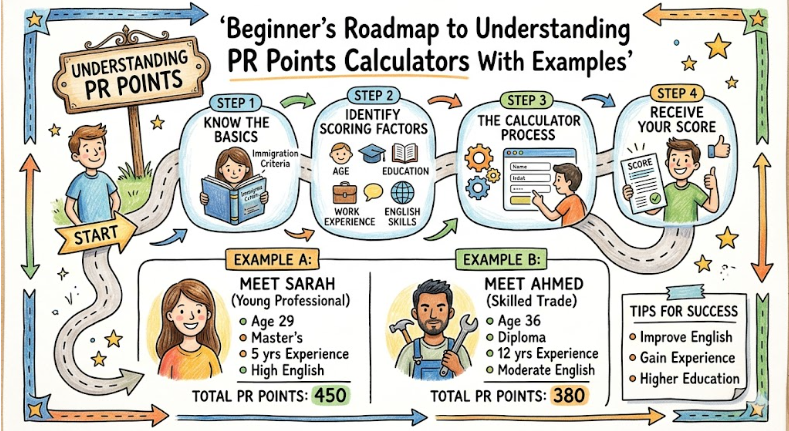
- Applicant A: 28 years old, Master’s degree, 5 years experience, Perfect English. (Highly Likely to succeed).
- Applicant B: 42 years old, Bachelor’s degree, 15 years experience, Average English. (Will likely need a job offer or regional nomination to qualify).
Country-Specific Sections
Canada PR Points Calculator
Canada uses the Express Entry system. Your score is called the Comprehensive Ranking System (CRS) score.
The CRS Distribution:
- Core Factors: Age, education, and language (Max 600 points).
- Skill Transferability: Combining your factors (e.g., Education + Language) for extra points (Max 100 points).
- Additional Points: Provincial nominations, siblings in Canada, or French language skills (Max 600 points).
Point Distribution Breakdown:
- Age: Max points at age 20-29 (110 pts).
- Education: PhD (150 pts), Master’s (135 pts).
- Language: High-level English (CLB 9+) can gain you nearly 130 points.
Australia PR Points Calculator
Australia utilizes the SkillSelect system for subclasses like the 189 (Independent), 190 (State Nominated), and 491 (Regional).
Factors for Australia:
- Age: 25–32 years (30 pts).
- English: Superior English (20 pts).
- Employment: 8+ years outside Australia (15 pts).
- Professional Year: Completing a local professional year (5 pts).
Example: A software engineer with a Bachelor’s degree, 8 years of experience, and “Proficient” English would usually sit at around 75–80 points.
New Zealand PR Points Calculator
New Zealand recently simplified its Skilled Migrant Category (SMC) into a 6-point system.
Scoring Examples:
To apply, you need 6 points. You can get these from:
- Qualifications: A Bachelor’s (3 pts), Master’s (5 pts), or PhD (6 pts).
- Income: Earning 1.5x to 3x the median wage (3–6 pts).
- Registration: Occupational registration in certain fields (3–6 pts).
Japan / Other Countries
Japan offers a unique Highly Skilled Professional (HSP) visa. It is a fast-track to permanent residency.
HSP Points Breakdown:
- Academic: Degrees from top 300 global universities gain bonus points.
- Salary: Unlike many other countries, Japan gives significant points for high annual income (e.g., 10-40 points).
- Research: Patents or published papers provide extra weight.
Global Immigration Overview Table
| Country | System Name | Min. Entry Points | Competitive Score | Key Advantage |
| Canada | Express Entry (CRS) | None (Draw based) | 495+ | Fast processing (6 months). |
| Australia | SkillSelect | 65 | 90+ | High quality of life/wages. |
| New Zealand | SMC 6-Point | 6 | 6 | Straightforward requirements. |
| Japan | HSP System | 70 | 80+ | PR in as little as 1 year. |
Benefits of Using a PR Points Calculator
- Instant Reality Check: It stops you from wasting money on applications that have no chance of success.
- Identifies Weak Spots: You might realize that your English score is the only thing holding you back.
- Strategic Planning: You can see how your score will change if you wait a year or complete a new certification.
- Cost-Free Exploration: Most calculators are free, allowing you to compare multiple countries simultaneously.
Step-by-Step Guide to Calculate Your Points
Follow these steps to ensure your calculation is as accurate as possible.
Step 1: Document Preparation
Collect your transcripts, work contracts, and any past English test results.
Step 2: Identify Your Occupation Code
You must find your code in the official classification lists:
- NOC (Canada): National Occupational Classification.
- ANZSCO (Australia/NZ): Standard Classification of Occupations.
Step 3: Input Your Data
Enter your age, highest degree, and years of experience into the calculator.
Step 4: Analyze Example Profiles
| Profile Type | Age/Edu | Experience | Points (Est.) | Status |
| Single Pro | 29 / Master’s | 5 Years | High (480 CRS) | Very Competitive |
| Married Couple | 34 / Bachelor’s | 8 Years | Mid (440 CRS) | Needs PNP/State Nom |
How to Maximize Your PR Points
If your score is below the “invite” threshold, use these strategies:
- Boost Language Scores: In Canada, moving from CLB 8 to CLB 9 in English can add 30+ points due to “Skill Transferability.”
- Learn a Second Language: For Canada, learning French can add up to 50 points.
- Provincial/State Nomination: This is the ultimate “cheat code.” A nomination from a Canadian province adds 600 points, virtually guaranteeing an invitation.
- Gain More Experience: Sometimes, waiting until you hit the 3-year or 5-year work mark provides the jump you need.
Common Mistakes to Avoid
- Using Expired English Results: Most tests are only valid for 2 years.
- Counting Unskilled Work: Only “Skilled” work (Managerial, Professional, or Technical) usually counts for points.
- Inaccurate Age Calculation: Points for age often drop on your birthday. If you are applying near your birthday, calculate for the older age.
- Ignoring the Spouse: If your partner has low English or education levels, they might actually decrease your total score in the Canadian system.
Practical Case Studies
Case Study 1: The “English Edge”
Maria, an architect from Brazil, initially scored 430 on the Canada CRS. She was disappointed because the draws were at 470. After using a points calculator, she saw that by improving her “Speaking” and “Listening” bands in the IELTS, she could unlock “Skill Transferability” points. She studied for two months, retook the test, and her score shot up to 475. She received her Invitation to Apply (ITA) three weeks later.
Case Study 2: The “Regional Route”
Ken, a 38-year-old technician, wanted to move to Australia. His age meant he lost points in the federal 189 visa. However, by using a calculator, he found that the Subclass 491 (Regional) visa offered an extra 15 points for moving to a “designated regional area.” This 15-point boost took him from a 70 to an 85, making him eligible for a state nomination in Western Australia.
FAQs
1. What is a PR points calculator?
It is a tool that evaluates your age, education, and skills to give you an immigration eligibility score.
2. How accurate are these tools?
They are highly accurate for estimation, provided you input correct data. Official government tools are the gold standard.
3. How many points are required for Canada PR?
In 2026, competitive scores are generally between 485 and 530.
4. Can I improve my points after submission?
Yes, you can update your profile with new test scores or degrees while it is in the pool.
5. Does my spouse’s education count?
Yes, in many systems (Canada/Australia), a spouse’s skills add to the total.
6. Is there an age limit for PR?
While there is no “hard” limit, points for age usually stop after age 45.
7. Do I need a job offer?
For many, a job offer isn’t mandatory but provides a significant points boost.
8. How much does it cost to check points?
Checking your points is free.
9. What is the best country for PR in 2026?
Canada and Australia remain the most popular due to their clear points-based pathways.
10. How often do the points draws happen?
Usually every two weeks for Canada and at varying intervals for Australia.
Conclusion
Navigating the path to a new country is a significant undertaking. While the paperwork and legal requirements can be daunting, the PR Points Calculator serves as your most valuable first step. It removes the guesswork and replaces it with data.
By understanding where you stand today, you can make a plan for tomorrow—whether that involves retaking a language test, gaining more work experience, or targeting a specific regional nomination. The world is looking for skilled professionals; make sure your points reflect your true value.