Introduction
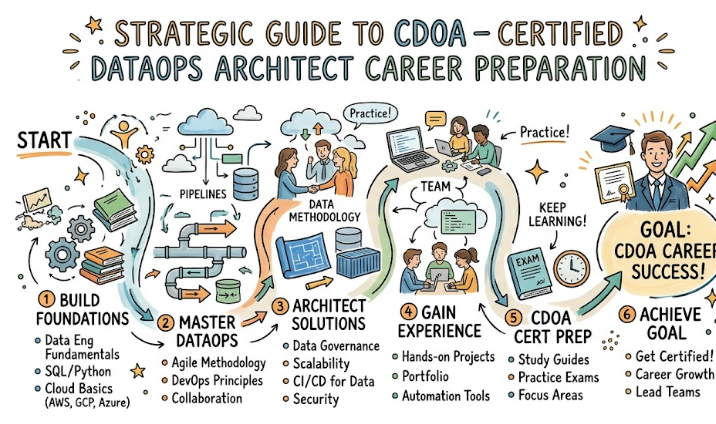
The traditional boundaries between data engineering and operations are being removed. In the modern tech environment, data is treated as a product that requires constant monitoring and automated delivery. This shift is where DataOps becomes essential. The CDOA – Certified DataOps Architect certification is recognized as a benchmark for professionals who wish to lead this change.
Complexity in data environments is being reduced through the application of DevOps principles to data workflows. This guide is written to help engineers and managers understand how this certification can be utilized to advance a career and improve organizational efficiency.
What is CDOA – Certified DataOps Architect
The CDOA is a professional credential that focuses on the architectural design of data operations. It is not just about tools; it is about the intersection of people, processes, and technology. The certification is designed to validate the ability of a professional to build resilient, automated, and scalable data pipelines.
Architecting these systems requires a deep understanding of continuous integration and continuous deployment (CI/CD) as they apply to data sets. By obtaining this certification, a professional is acknowledged as an expert in reducing the data lifecycle time while maintaining high quality.
Why it matters today?
Speed is now a competitive advantage. Decisions are being made based on real-time data analysis, which means the data must be fresh and accurate. Manual data processing is being replaced by automated workflows because human error is too costly in a high-stakes market.
DataOps provides the framework to handle the massive influx of information that companies deal with daily. Without a structured DataOps approach, data debt is accumulated, and systems become unmanageable. The CDOA provides the skills needed to prevent these bottlenecks and ensure that data flows smoothly from source to consumer.
Why CDOA – Certified DataOps Architect certifications are important?
Professional validation is necessary in a crowded job market. The CDOA certification is respected because it covers the full spectrum of data architecture. It ensures that an architect is not just focused on one tool but understands the entire ecosystem.
Consistency in data delivery is achieved when standardized practices are followed. These practices are taught and tested through the CDOA program. For organizations, hiring a certified architect means that a certain level of technical maturity is guaranteed. For the individual, it opens doors to leadership roles and higher salary brackets in both Indian and global markets.
Why Choose DataOpsSchool?
Expertise is best gained from those who specialize in the field. DataOpsSchool is chosen by many because its curriculum is developed by industry practitioners. The focus is kept on real-world application rather than just theoretical knowledge.
Support is provided throughout the learning journey. Resources are updated regularly to reflect the latest changes in cloud infrastructure and data tools. By choosing DataOpsSchool, a commitment is made to a learning path that is both rigorous and relevant to the current demands of the IT industry.
Certification Deep-Dive: CDOA – Certified DataOps Architect
What is this certification?
The CDOA – Certified DataOps Architect is a high-level credential for individuals who design and oversee automated data environments. It focuses on the integration of data engineering with operational excellence to ensure high-quality data delivery.
Who should take this certification?
This certification should be taken by Data Engineers, DevOps Professionals, and Software Architects. It is also highly recommended for Engineering Managers who need to oversee data-driven teams and infrastructure.
Certification Overview Table
| Track | Level | Who it’s for | Prerequisites | Skills Covered | Recommended Order |
| DataOps Foundation | Entry | Beginners / Managers | Basic IT Knowledge | Core DataOps Concepts | 1 |
| DataOps Associate | Mid | Data Engineers | SQL & Scripting | Pipeline Automation | 2 |
| DataOps Professional | Advanced | Senior Engineers | Associate Level | Orchestration & CI/CD | 3 |
| DataOps Expert | Expert | Lead Engineers | Professional Level | Data Quality & Security | 4 |
| DataOps Architect | Master | Systems Architects | Expert Level | Enterprise Architecture | 5 |
Skills you will gain
- Automated data pipeline construction is mastered.
- Data quality testing frameworks are implemented.
- Version control for data and schema is understood.
- Orchestration tools are utilized for complex workflows.
- Collaboration between data scientists and operations is facilitated.
- Cloud-native data architectures are designed.
- Monitoring and alerting for data health are established.
Real-world projects you should be able to do after this certification
- An end-to-end automated ETL pipeline is built using modern tools.
- A data masking and security protocol for sensitive info is deployed.
- A self-service data platform for internal stakeholders is designed.
- Real-time data streaming and processing architecture is implemented.
- A cross-cloud data migration strategy is executed successfully.
Preparation Plan
7–14 days plan
- The official curriculum and syllabus are reviewed.
- Core terminology and the DataOps manifesto are studied.
- Foundational practice exams are completed.
30 days plan
- Hands-on labs for pipeline automation are performed.
- Case studies on successful DataOps implementations are read.
- Weekly mock tests are taken to identify weak areas.
60 days plan
- Deep dives into orchestration and cloud integration are conducted.
- Full-length practice simulations are passed consistently.
- Final review of architectural design patterns is finished.
Common mistakes to avoid
- Hands-on practice is often neglected in favor of theory.
- The importance of data quality is sometimes underestimated.
- Legacy data management mindsets are not fully unlearned.
- Prerequisites are occasionally skipped, leading to confusion in advanced topics.
Best next certification after this
- Same track: CDOE – Certified DataOps Engineer.
- Cross-track: CAA – Certified AIOps Architect.
- Leadership / management: Certified Engineering Manager in Data.
Choose Your Learning Path
DevOps Path
This path is best for those coming from a systems administration background. Focus is placed on applying existing CI/CD knowledge to data storage and processing systems.
DevSecOps Path
This path is ideal for security-conscious professionals. Emphasis is given to integrating security checks and compliance protocols directly into the data pipeline.
Site Reliability Engineering (SRE) Path
For those focused on uptime and performance, this path highlights the monitoring of data systems and the reduction of manual “toil” in data operations.
AIOps / MLOps Path
This is designed for professionals working with machine learning models. The flow of data to train and validate models is the primary focus of this learning journey.
DataOps Path
The direct route for data engineers. It covers the complete lifecycle from data ingestion to consumption with a focus on automation and quality.
FinOps Path
Best for those concerned with cloud costs. This path teaches how to optimize the financial impact of large-scale data storage and processing.
Role → Recommended Certifications Mapping
| Role | Recommended Certification | Primary Benefit |
| DevOps Engineer | CDOA – Architect | Enhances data infrastructure skills. |
| Site Reliability Engineer | SRE Professional | Improves system reliability and monitoring. |
| Platform Engineer | Kubernetes Specialist | Master container orchestration. |
| Cloud Engineer | Cloud Architect (AWS/Azure) | Validates cloud infrastructure design. |
| Security Engineer | DevSecOps Professional | Integrates security into the pipeline. |
| Data Engineer | CDOA – Architect | Provides professional architectural status. |
| FinOps Practitioner | Certified FinOps | Optimizes cloud spending and visibility. |
| Engineering Manager | DataOps Leadership | Helps lead high-performing data teams. |
Next Certifications to Take
One same-track certification
The CDOE (Certified DataOps Engineer) is recommended. This allows for a deeper dive into the technical execution of the designs created by the architect.
One cross-track certification
The Certified AIOps Architect is a logical step. As data pipelines mature, the integration of AI to manage operations becomes the next level of evolution.
One leadership-focused certification
The Strategic IT Leadership certification should be considered. It bridges the gap between high-level technical skills and corporate decision-making.
Training & Certification Support Institutions
DevOpsSchool
Comprehensive training for all DevOps and DataOps tracks is provided. A blend of live sessions and recorded content is used to cater to different learning styles.
Cotocus
Enterprise-level training and consulting are the specialties here. Custom roadmaps for corporate teams looking to adopt DataOps are often developed by their experts.
ScmGalaxy
A vast library of community resources and technical blogs is maintained. It serves as a great hub for staying updated on the latest toolsets and industry trends.
BestDevOps
Focused on high-quality certification prep, this institution offers curated mock exams and study guides that are highly rated by professionals.
devsecopsschool.com
Specialized training in integrating security into modern workflows is found here. It is a key resource for those moving into DevSecOps roles.
sreschool.com
The principles of site reliability are taught with a focus on real-world scenarios. It is highly recommended for engineers focused on system stability.
aiopsschool.com
The intersection of Artificial Intelligence and operations is explored. Training for managing complex, AI-driven environments is the primary goal.
dataopsschool.com
The primary source for DataOps-specific certifications. The CDOA curriculum is managed and delivered with high professional standards.
finopsschool.com
Financial accountability in the cloud is taught here. It is an essential stop for anyone looking to manage cloud budgets effectively.
FAQs Section
What is the difficulty level of the CDOA certification?
The strategic complexity of this program is moderate to high, as it requires an understanding of both engineering and architectural principles.
How much time is required to prepare for the exam?
For a working professional, a period of 30 to 60 days is typically needed to fully grasp the architectural concepts and practice the labs.
What are the prerequisites for the CDOA?
A basic understanding of data engineering and cloud platforms is recommended, though the foundation level can be started by anyone with IT experience.
What is the recommended certification sequence?
The path should ideally begin with the Foundation level, followed by Associate, Professional, and finally the Architect level.
What is the career value of being a Certified DataOps Architect?
High visibility in the job market is gained, often leading to roles such as Lead Data Architect or Head of Data Operations.
How does this certification impact job roles and growth?
A significant increase in salary and the ability to work on global projects is often observed after obtaining this credential.
Is the exam conducted online?
The examination is facilitated through an online proctored environment, allowing for flexibility across different time zones.
How long is the certification valid?
The certification is typically valid for two to three years, after which a renewal or a higher-level exam is encouraged to maintain current status.
Are there lab-based questions in the exam?
Architectural scenarios are presented where the best design choices must be selected based on specific organizational needs.
Can a manager with no coding experience take this?
The Foundation track is suitable for managers, but the Architect level requires a grasp of technical design principles.
Is support provided for global students?
Training and certification support are provided to students in India and global markets through digital platforms.
What tools are covered in the curriculum?
A variety of industry-standard tools for orchestration, CI/CD, and data quality are integrated into the learning modules.
CDOA – Certified DataOps Architect Specific FAQs
1. How does CDOA differ from traditional data architecture?
The focus is shifted from static storage design to the dynamic, automated flow of data across the entire organization.
2. Is CDOA – Certified DataOps Architect globally recognized?
The standards followed in the curriculum are aligned with global industry requirements, making it valuable in any market.
3. What is the main goal of the CDOA program?
The primary objective is to empower professionals to build data systems that are as agile and reliable as modern software applications.
4. How does this certification help with data security?
The architecture taught includes the integration of security at every stage of the data pipeline, ensuring compliance by design.
5. Can I skip the associate level if I have experience?
While possible, it is recommended to follow the sequence to ensure that the specific DataOps methodology is fully understood.
6. What kind of salary hike can be expected?
Market trends suggest a substantial premium is paid to certified architects compared to those without professional validation.
7. Does the program cover cloud-specific architectures?
Concepts are taught in a way that can be applied to AWS, Azure, and Google Cloud environments.
8. Why is automation emphasized in the CDOA?
Automation is viewed as the only way to scale data operations effectively without increasing headcount or error rates.
Testimonials
Aarav
The clarity provided by this certification regarding data pipelines was immense. My ability to design complex workflows has been greatly improved.
Meera
Real-world application was the highlight for me. I was able to implement a new data quality framework at my workplace immediately after finishing the course.
John
Career clarity was gained through the structured learning path. I now have a much better understanding of my future as a data leader.
Sanjay
The confidence I feel during architectural discussions has grown significantly. Being able to justify design choices using DataOps principles is a game changer.
Elena
The transition from a standard DevOps role to a specialized DataOps position was made possible by this program. The architectural insights were invaluable.
Conclusion
The journey to becoming a CDOA – Certified DataOps Architect is a strategic investment in the future of data management. As organizations continue to struggle with the volume and velocity of information, the need for skilled architects will only increase.
Long-term career benefits include not just job security, but the opportunity to lead transformative projects that drive business value. Planning a learning path today ensures that a professional remains relevant and competitive in a rapidly changing technological world. Continuous learning and strategic certification are the pillars of a successful career in the modern IT landscape.