Introduction
Managing the financial side of cloud infrastructure is a critical responsibility for every modern engineer. As systems expand, the ability to align technical decisions with budget constraints determines the longevity of any cloud project. The Certified FinOps Engineer program is designed to provide this exact capability, turning standard cloud operations into a model of fiscal efficiency.
What is a Certified FinOps Engineer?
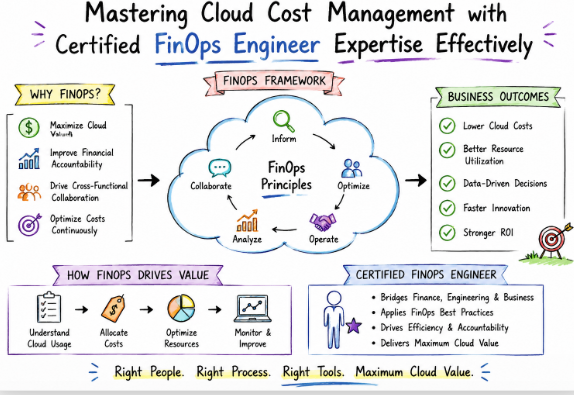
A Certified FinOps Engineer acts as a bridge between technical operations and financial health. This professional ensures that cloud resources are not just performant, but also cost-effective. By mastering the principles of cloud unit economics, a certified expert can transform how an organization tracks, manages, and forecasts its infrastructure spending. This role focuses on the belief that cloud cost management is a technical challenge, not just an accounting task.
Why it matters today?
In current high-growth environments, cloud consumption is often unmonitored until a surprise bill arrives. Organizations require engineers who can move beyond deployment and into active resource governance. This certification is crucial because it promotes a culture where every engineer understands the financial impact of their code, leading to reduced waste and improved operational margins. Without this oversight, businesses often find themselves paying for resources that provide zero value to their end users.
Why Certified FinOps Engineer certifications are important?
Holding this certification demonstrates that you possess the advanced skills to optimize complex environments. It is a benchmark that distinguishes engineers who can handle the pressures of large-scale cloud budgets. As more companies transition to cloud-native architectures, the demand for professionals who can maintain both uptime and budget compliance continues to grow rapidly. It proves that you are capable of aligning technical performance with long-term business strategy.
Why choose FinopsSchool?
FinopsSchool is chosen because it creates a learning environment where theory is replaced by real-world, actionable labs. The curriculum is crafted to ensure that students do not just pass an exam, but actually learn how to solve real cloud-financial problems. Furthermore, the support provided ensures that every candidate feels confident in applying these advanced concepts to their own production environments immediately. This institution focuses purely on the practical aspects of financial operations, making it the preferred choice for engineers who want results.
Certification Deep-Dive
What is this certification?
This program is a comprehensive look at the intersection of cloud engineering and financial management, covering cost-allocation logic, resource optimization, and budgetary forecasting. It provides the foundational knowledge required to manage large-scale cloud environments.
Who should take this certification?
It is perfect for site reliability engineers, cloud architects, developers, and project leads who want to gain mastery over their infrastructure costs. It is also highly recommended for anyone looking to transition into a more strategic role within an engineering organization.
Certification Overview Table
| Track | Level | Who it’s for | Prerequisites | Skills Covered | Recommended Order |
| Cloud Budgeting | Basic | Engineers | Cloud Basics | Cost Mapping | 1 |
| Infrastructure FinOps | Intermediate | DevOps/SRE | Cloud Operations | Right-sizing | 2 |
| Financial Automation | Advanced | SRE/Platform | Scripting/Coding | Auto-scaling | 3 |
| Strategic FinOps | Executive | Managers | Leadership Role | Budget Governance | 4 |
| Multi-Cloud Costing | Expert | Architects | Multi-cloud Env | Interoperability | 5 |
Skills you will gain
- Mastery of cost-monitoring tools and billing data analysis.
- Ability to link technical system metrics to specific business outcomes.
- Techniques for designing automated infrastructure that shuts down when not in use.
- Skills for predicting future cloud expenditure based on historical usage.
- Deep understanding of how to manage variable costs in a dynamic cloud environment.
Real-world projects you should be able to do
- Designing a system that tags every resource by department or project automatically.
- Creating a cost-anomaly detection script that triggers alerts during usage spikes.
- Performing a comprehensive audit of an existing cloud environment to find idle resources.
- Constructing a reporting dashboard that visualizes cloud spend against performance KPIs.
- Implementing a multi-region disaster recovery plan that minimizes cost while maintaining high availability.
Preparation plan
- 7–14 days plan: Focus on the terminology of cloud billing and the core concepts of public cloud financial models.
- 30 days plan: Spend time executing hands-on labs and practicing the configuration of budget alerts and cost-allocation tags.
- 60 days plan: Aim for deep technical mastery, including building custom automation to manage multi-cloud costs effectively and drafting financial policy documents.
Common mistakes to avoid
- Treating cost-optimization as a one-time project rather than an ongoing process.
- Over-optimizing at the cost of system reliability and performance.
- Misunderstanding the difference between unit cost and total expenditure.
- Forgetting to account for data egress fees when planning architecture changes.
Best next certification after this
- Same track: Certified Cloud FinOps Architect.
- Cross-track: Certified DataOps Engineer.
- Leadership / management: Certified Tech Financial Operations Manager.
Choose Your Learning Path
- DevOps: Focuses on shifting financial oversight “left” into the development and deployment cycle.
- DevSecOps: Centers on managing the costs associated with security tools and encrypted traffic.
- Site Reliability Engineering (SRE): Prioritizes cost-efficiency without compromising service level agreements.
- AIOps / MLOps: Dedicated to balancing the heavy compute costs required for AI model training.
- DataOps: Aimed at managing data lifecycle costs in large-scale storage and analytics platforms.
- FinOps: A complete roadmap designed to handle the entire lifecycle of cloud financial governance.
Role → Recommended Certifications Mapping
| Role | Recommended Certification |
| DevOps Engineer | Certified FinOps Engineer |
| Site Reliability Engineer | Certified FinOps Automation Specialist |
| Platform Engineer | Certified Cloud Cost Architect |
| Cloud Engineer | Certified FinOps Practitioner |
| Security Engineer | Certified FinOps Security Lead |
| Data Engineer | Certified Big Data FinOps Specialist |
| FinOps Practitioner | Certified FinOps Professional |
| Engineering Manager | Certified FinOps Strategy Leader |
Next Certifications to Take
- Same-track certification: The Certified Advanced FinOps Architect is recommended because it provides the deeper, architectural knowledge needed to solve complex, multi-layered cloud cost problems across various global regions.
- Cross-track certification: The Certified DataOps Engineer is suggested because understanding how to optimize the costs associated with data pipelines and storage tiers is becoming essential for every cloud professional today.
- Leadership-focused certification: The Certified Technology Financial Manager is advised as it offers the business-oriented strategy needed to lead institutional financial culture changes and communicate value to executive stakeholders.
Training & Certification Support Institutions
- DevOpsSchool: Offers industry-leading training programs that focus on the convergence of development and operational efficiency through hands-on practice.
- Cotocus: Provides deep-dive sessions for engineers looking to master advanced cloud systems and architectural patterns in real-world scenarios.
- ScmGalaxy: Known for expert-led training in the integration of complex supply chain and IT operational workflows, ensuring end-to-end efficiency.
- BestDevOps: Focuses on the core, fundamental principles that drive successful DevOps and site reliability practices in various enterprise settings.
- devsecopsschool.com: A platform dedicated to teaching how security is integrated into every phase of the software lifecycle without inflating operational costs.
- sreschool.com: Specializes in providing the knowledge required to maintain highly available and resilient production systems while managing infrastructure overhead.
- aiopsschool.com: Focuses on the practical application of artificial intelligence and machine learning within IT operational environments to predict and optimize resource needs.
- dataopsschool.com: Provides comprehensive training on managing efficient and scalable data engineering and operations pipelines, reducing storage and processing bloat.
- finopsschool.com: The authority for cloud financial management training, focusing on cost visibility, accountability, and total operational value.
FAQs Section
- What is the difficulty level?
The material is framed for intermediate learners, ensuring that complex financial concepts are made simple to understand. - How much time is required?
The program is flexible, designed for professionals who can dedicate a few weeks or months depending on their intensity. - Are there prerequisites?
A basic grasp of public cloud operations is recommended before starting. - What is the certification sequence?
It is encouraged to start with foundational principles before advancing to specialized operational tracks. - What is the career value?
It acts as a massive signal to employers that you value both technical quality and business viability. - How does it influence job roles?
It expands your potential by adding a financial layer of expertise to your technical skillset. - Is it suitable for managers?
It is perfect for those who lead teams and need to defend their infrastructure spend. - What if I have no finance background?
No prior finance experience is needed; the course is built for technical minds. - How is the exam structured?
You can expect a mix of theory and practical problem-solving to test real-world readiness. - Can I work while studying?
Yes, the self-paced nature of the training supports busy professional schedules. - Is it globally recognized?
The principles taught are universal and applicable to any organization using the cloud.
Certified FinOps Engineer FAQs
- How is cost efficiency measured? It is measured by analyzing unit economics and resource utilization rates against performance benchmarks.
- Does it cover public cloud APIs? Yes, you will learn how to interact with provider APIs to pull and analyze cost data effectively.
- Will I learn to use cost-allocation tags? Proper tagging architecture is taught as the foundation of all cost tracking and internal chargeback models.
- Does it help with multi-cloud setups? The methodology is designed to be platform-agnostic, working across all major cloud providers.
- Is it focused on strategy or tactics? You will learn both, starting with tactical tagging and moving into strategic long-term forecasting.
- How does it help with budgeting? It provides a clear way to link cloud usage metrics to expected monthly expenditures with high accuracy.
- Can it be applied to existing projects? It is highly recommended to apply these lessons to your current production environment immediately.
- What is the primary outcome? The primary outcome is achieving financial predictability in an otherwise unpredictable cloud environment.
Testimonials
- DevOps Engineer: This certification changed the way I look at infrastructure. I now manage costs with the same attention I give to uptime. — Sameer
- SRE: The projects were incredibly relevant. It gave me the skills to finally explain our cloud spend to leadership clearly. — Divya
- Cloud Engineer: I felt much more confident after completing the training. It provided a clear, logical path for managing our budget. — Amit
- Security Engineer: Efficiency is just as important as security. This path helped me understand how to keep both in check simultaneously. — Kavita
- Engineering Manager: I have seen a significant improvement in our team’s resource discipline since we adopted these practices.— Rajesh
Conclusion
Becoming a Certified FinOps Engineer is a smart career move for any professional handling cloud infrastructure. By developing a firm grasp of both technical architecture and financial management, you position yourself as an indispensable asset to your organization. Start your learning journey today to ensure your future in the evolving world of cloud engineering. Strategic planning and continuous learning are encouraged for long-term success.