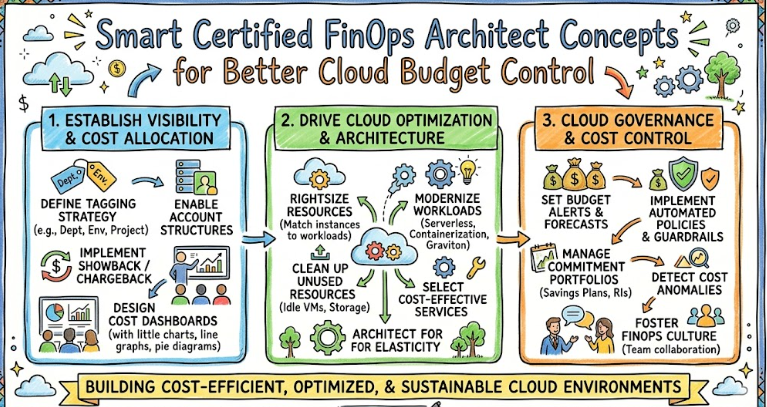
Introduction
Managing cloud infrastructure is no longer just about system uptime and speed. It is equally about cost efficiency. In many companies, engineering teams build systems without understanding the financial impact, while finance teams view the cloud bill without understanding the technical architecture. This disconnect leads to massive waste and reduced profitability.
A specialized framework is required to bridge this gap. Cloud financial operations ensure that operational decisions are aligned with business budgets. By learning how to design architectures that are naturally cost-effective, professionals can prevent budget overruns before they even happen. This guide explores the premier certification path designed to master these exact skills.
What is Certified FinOps Architect
The Certified FinOps Architect is an advanced professional credential designed for individuals who want to master the intersection of cloud architecture and financial accountability. This program goes beyond basic cost-tracking spreadsheets. It focuses heavily on building, designing, and maintaining cloud systems that are naturally optimized for cost from day one.
A person holding this credential knows how to evaluate cloud services not just for performance, but also for fiscal efficiency. They understand how serverless computing, containerization, auto-scaling, and varied purchasing models affect the company’s bottom line. They serve as the core technical link between engineering squads and corporate financial leaders.
Why it matters today?
Uncontrolled cloud infrastructure waste has become a primary concern for executive leadership teams across the globe. As businesses deploy complex multi-cloud environments, keeping track of variable billing metrics becomes nearly impossible without specialized knowledge.
Traditional IT budgeting models do not work in a modern cloud environment where costs change every single second. Companies now require architects who understand how to write code and design systems with financial guardrails built directly into the infrastructure. Without this expertise, digital transformation projects quickly become financial liabilities.
Why Certified FinOps Architect certifications are important
Earning a professional validation in cloud financial architecture establishes immediate credibility in a highly competitive job market. It proves to employers that an engineer can build high-performing systems without draining the corporate budget. It changes the conversation from “how do we fix this high bill?” to “how do we build this system correctly from the start?”.
Furthermore, this certification equips professionals with the exact frameworks needed to drive cultural change within an organization. It teaches engineers how to take accountability for their infrastructure costs and helps finance teams understand technical resource limitations. It is an essential step for anyone aiming to climb into senior technical leadership roles.
Why choose Finopsschool?
FinRules and traditional training methods often fail to cover the deep architectural changes needed for real cloud cost reduction. This is why learning through FinOpsSchool is highly beneficial. The programs offered by FinOpsSchool are crafted specifically around practical, real-world cloud scenarios rather than pure theoretical concepts.
FinOpsSchool provides students with hands-on labs, real billing data analysis, and modern frameworks that can be applied to live cloud environments immediately. By choosing this specialized platform, professionals gain access to updated learning materials that match current industry challenges. It ensures that your education directly translates into measurable cloud savings for your organization.
Certification Deep-Dive
What is this certification?
The Certified FinOps Architect credential is an elite training program focused on designing cost-optimized cloud systems. It validates an engineer’s ability to align technical cloud architecture decisions with corporate financial management goals.
Who should take this certification?
This program is ideally suited for Senior Software Engineers, DevOps Professionals, Cloud Architects, Platform Engineers, Site Reliability Engineers, and Technical Managers who are responsible for cloud infrastructure design and budgeting decisions.
Certification Overview Table
| Track | Level | Who it’s for | Prerequisites | Skills Covered | Recommended Order |
| Cloud FinOps Foundation | Associate | Beginners & Finance Teams | Basic Cloud Literacy | Cost visibility, basic tagging, terminology | First |
| FinOps Certified Practitioner | Professional | Operations & DevOps Engineers | Foundation Level Core | Cloud unit economics, forecasting, KPIs | Second |
| Certified FinOps Architect | Advanced | Senior Engineers & Architects | Practitioner Knowledge | Cost-optimized design, multi-cloud rules | Third |
| Enterprise FinOps Director | Leadership | Managers & Executives | Architect Level Core | Cultural transformation, global governance | Fourth |
Skills you will gain
- Advanced multi-cloud billing analysis and data parsing.
- Designing automated resource down-sizing and auto-scaling guardrails.
- Evaluating and selecting optimal cloud purchasing models like savings plans.
- Formulating clear cost-allocation tagging frameworks for complex organizations.
- Building real-time cost anomaly detection and alerting systems.
- Connecting infrastructure engineering choices directly to business unit economics.
Real-world projects you should be able to do after this certification
- Re-architecting a legacy multi-tier web application into a cost-efficient serverless model.
- Designing an automated system that identifies and purges unutilized cloud resources globally.
- Building a comprehensive, real-time cost monitoring dashboard across AWS, Azure, and Google Cloud.
- Formulating an enterprise-wide cloud commitment purchasing strategy that saves thousands of dollars annually.
Preparation plan
7–14 days plan
Spend the first week studying the official core modules and understanding key terminologies. Focus heavily on cloud billing concepts and basic allocation metrics. Dedicate the remaining days to reviewing practical case studies and taking basic practice quizzes to check your foundational knowledge.
30 days plan
Divide your month into clear phases. Spend the first two weeks deeply analyzing architectural patterns and learning how serverless or container choices impact spending. Use the third week to perform practical hands-on exercises with real billing files. Use the final week to review mock exams and refine weak subject areas.
60 days plan
A two-month plan allows for comprehensive mastery. Dedicate the first 20 days to foundational theories and core architectural frameworks. Spend the next 20 days working through advanced real-world optimization projects and automated scripting exercises. Use the remaining 20 days for deep-dive group discussions, mock testing, and extensive review of multi-cloud billing complexities.
Common mistakes to avoid
- Focusing purely on technical performance while completely ignoring financial metrics.
- Relying entirely on manual cloud adjustments instead of building automated guardrails.
- Failing to establish a clear resource-tagging policy before starting cost optimization.
- Treating cloud cost management as a one-time project instead of a continuous process.
Best next certification after this
Same track
The Enterprise FinOps Director certification is the logical next step to master large-scale organizational governance.
Cross-track
Advanced Cloud Security Professional or DevSecOps Master credentials are excellent for pairing cost efficiency with strict security compliance.
Leadership / management
An Executive IT Management or Technical Leadership certification helps transition these specialized architectural skills into broader corporate executive roles.
Choose Your Learning Path
DevOps Path
This path is tailored specifically for deployment specialists who want to embed financial guardrails directly into continuous integration and delivery pipelines. It focuses heavily on automating cost checks before infrastructure code is even pushed to production systems.
DevSecOps Path
Best for security-focused engineers who want to balance cost control with strict regulatory compliance. This path ensures that automated cost-saving measures never introduce safety vulnerabilities or break encryption standards across cloud systems.
Site Reliability Engineering (SRE) Path
Designed for stability experts who need to maintain maximum system uptime while simultaneously keeping infrastructure lean and cost-efficient. It teaches how to balance high availability with fiscal responsibility.
AIOps / MLOps Path
Perfect for data scientists and machine learning engineers who manage highly expensive graphics processing units and large-scale computing clusters. It focuses on optimizing the massive data pipelines required for artificial intelligence applications.
DataOps Path
Tailored for database administrators and data engineers who manage massive enterprise data warehouses and storage systems. This path highlights cost-effective data tiering, archiving, and cloud storage lifecycle strategies.
FinOps Path
The direct, dedicated pathway for professionals who want to specialize exclusively in cloud financial management, building communication bridges between corporate accounting departments and technical engineering squads.
Role → Recommended Certifications Mapping
| Professional Role | Recommended Primary Certification | Secondary Capability Certification | Recommended Order |
| DevOps Engineer | Certified FinOps Architect | DevSecOps Master | FinOps First, then Security |
| Site Reliability Engineer | Certified FinOps Architect | Advanced Reliability Expert | FinOps First, then Stability |
| Platform Engineer | Certified FinOps Architect | Cloud Infrastructure Expert | FinOps First, then Infrastructure |
| Cloud Engineer | Certified FinOps Architect | Multi-Cloud Specialist | FinOps First, then Multi-Cloud |
| Security Engineer | DevSecOps Specialist | Certified FinOps Architect | Security First, then FinOps |
| Data Engineer | DataOps Specialist | Certified FinOps Architect | Data First, then FinOps |
| FinOps Practitioner | Certified FinOps Architect | Enterprise FinOps Director | Architect First, then Director |
| Engineering Manager | Enterprise FinOps Director | Certified FinOps Architect | Director First, then Architect |
Next Certifications to Take
One same-track certification
The Enterprise FinOps Director credential should be pursued to expand your capabilities into global corporate policy creation. This certification prepares professionals to lead large cross-functional teams and establish company-wide financial standards. It shifts your focus from single-system design to high-level organizational transformation.
One cross-track certification
The Certified DevSecOps Professional credential from recognized global bodies is highly recommended to merge security protocols with financial optimization. This ensures that infrastructure changes pass all safety audits automatically. It builds a well-rounded technical profile that handles both protection and efficiency.
One leadership-focused certification
The Certified Technology Officer or Strategic IT Leadership credential should be considered to move into executive decision-making positions. This training teaches professionals how to align general technology investments with long-term business profitability. It prepares technical specialists for board-room discussions and corporate strategy planning.
Training & Certification Support Institutions
DevOpsSchool
Comprehensive training programs and structured learning resources are provided by DevOpsSchool to help professionals master modern deployment methodologies. Their courses emphasize hands-on lab environments and practical corporate cloud scenarios. Expert guidance is delivered to ensure students pass their professional exams with high confidence.
Cotocus
Specialized corporate training and cloud architectural consulting are delivered globally by the team at Cotocus. They focus on modernizing infrastructure strategies and helping engineering squads adopt automated workflows. Their educational modules are structured to fit the busy schedules of working software engineering professionals.
ScmGalaxy
A massive community knowledge hub and educational resource center is maintained by ScmGalaxy for configuration and platform engineers. Deep technical tutorials, study guides, and industry best-practice articles are published regularly to support continuous professional development. It serves as an excellent platform for peer-to-peer technical learning.
BestDevOps
Focused learning pathways and targeted certification preparation materials are offered by BestDevOps to students worldwide. Their training curriculum is designed to simplify complex cloud frameworks into clear, bite-sized lessons. Practical implementation of automation tools remains the core highlight of their educational programs.
devsecopsschool.com
Dedicated entirely to the intersection of cloud infrastructure security and automated development cycles, this portal offers deep-dive technical courses. Students are taught how to insert automated security scanning tools directly into deployment pipelines. It provides an essential resource for modern security compliance training.
sreschool.com
Educational resources focused purely on site reliability engineering, system scalability, and high-availability design are provided by this specialized institution. The lessons highlight how to maintain zero-downtime systems under heavy consumer traffic conditions. It remains an ideal learning space for engineers focused on platform stability.
aiopsschool.com
This learning center provides specialized training on using artificial intelligence and machine learning algorithms to optimize automated IT operations. Students discover how to use smart data analytics to predict system failures and automate routine maintenance tasks. It bridges the gap between data science and traditional operations.
dataopsschool.com
Focused entirely on automated data management pipelines, this platform trains data professionals on building efficient, secure enterprise data streams. The coursework covers data quality monitoring, automated data warehouse management, and storage optimization. It is an excellent fit for modern data engineering teams.
finopsschool.com
The premier learning institution focused exclusively on cloud financial operations, budgeting strategy, and cost-optimized system architecture design. It provides the official frameworks and practical training paths required to master corporate cloud economics. It remains the core educational hub for aspiring FinOps Architects globally.
FAQs Section
1. What is the overall difficulty level of these advanced cloud financial certifications?
The advanced programs are considered moderately difficult and require a solid understanding of cloud services and billing structures. They are designed for experienced professionals rather than absolute tech beginners.
2. How much time is typically required to prepare for the final examination?
Most working professionals dedicate between four to six weeks of consistent study, spending roughly one to two hours per day reviewing materials and completing practical labs.
3. Are there any strict technical prerequisites required before enrolling in the course?
While no formal certificates are mandated beforehand, having basic cloud literacy and familiarity with standard AWS, Azure, or Google Cloud services is highly beneficial.
4. What is the recommended certification sequence for a complete beginner?
It is best to start with the foundational Cloud FinOps course, progress through the Certified Practitioner level, and then tackle the advanced Architect program.
5. What long-term career value does this financial architectural knowledge offer?
It elevates a technical engineer into a strategic business asset, making them eligible for high-paying roles that oversee both technology deployment and corporate budgets.
6. Which specific job roles benefit the most from learning these optimization frameworks?
Cloud Architects, DevOps Engineers, Platform Managers, and SRE specialists see the most immediate benefit in their day-to-day infrastructure management tasks.
7. How does this certification help an engineer move into executive management?
It teaches engineers how to discuss infrastructure in terms of business value and profitability, which is the exact language used by corporate executive leaders.
8. Is multi-cloud architecture covered extensively in the advanced curriculum?
Yes, modern business infrastructure utilizes varied providers, so analyzing costs across multiple platforms simultaneously is a core component of the training.
9. Can non-technical financial analysts find value in taking these courses?
The foundational and practitioner tracks are excellent for financial analysts who want to understand the technical drivers behind the corporate cloud bill.
10. How frequently are the learning materials and exam formats updated?
The educational contents are revised regularly to stay perfectly aligned with the latest billing modifications and feature releases from major cloud vendors.
11. Are practical hands-on labs included as part of the preparation program?
Yes, real-world case studies and practical billing file analysis exercises are woven directly into the training to ensure real operational capability.
12. Does this certification hold global recognition across international job markets?
Yes, these frameworks are utilized by major enterprise organizations worldwide, making the credential highly valuable across both domestic and international markets.
Certified FinOps Architect Focused FAQs
1. What is the core focus of the Certified FinOps Architect program?
The primary focus is teaching professionals how to design and build cloud infrastructure that is naturally cost-optimized and financially accountable from its inception.
2. How does this specific program differ from the standard Practitioner course?
The Practitioner course focuses on high-level frameworks and general cost tracking, while the Architect program dives deep into technical system design and automated guardrails.
3. What exact skills are tested during the final evaluation process?
Candidates are evaluated on their ability to analyze complex multi-cloud bills, formulate tagging policies, design auto-scaling guardrails, and implement cost anomaly alerts.
4. Are automated infrastructure tools covered during the training sessions?
Yes, various automated cloud native tools and third-party optimization platforms are explored to show students how to handle cost reductions programmatically.
5. Can this credential help reduce an enterprise cloud bill immediately?
Yes, the practical strategies taught during the course can be applied to live cloud environments right away to identify and eliminate ongoing infrastructure waste.
6. What type of real-world scenarios are explored in the case studies?
Students analyze complex scenarios like re-architecting legacy applications, managing container costs, and optimizing large-scale data storage across different cloud tiers.
7. Is knowledge of coding or scripting required for this architectural track?
Basic familiarity with deployment scripting or infrastructure-as-code concepts is helpful, as automation is a key element of modern cost guardrails.
8. How does this training help align engineering teams with finance departments?
It establishes a common language and shared key performance indicators, allowing engineers to understand budgets and finance teams to understand technical limits.
Testimonials
The architectural frameworks provided by this training completely transformed how our team deploys cloud infrastructure. Our cloud bills were reduced significantly within the first month of implementation.
— Rajesh
A deep understanding of cloud unit economics was gained through this course. Real-world application of these cost guardrails gave me the confidence to lead our company’s multi-cloud migration strategy safely.
— Ananya
Complete career clarity was achieved after completing this advanced architectural certification path. I am now able to communicate technical cloud design choices directly in terms of business profitability to our executives.
— Marcus
The automated resource optimization strategies taught in the program were put into action immediately. Our infrastructure stability was maintained perfectly while eliminating thousands of dollars in hidden waste.
— Priya
This course bridges the gap between system performance and financial responsibility beautifully. My confidence in managing large enterprise budgets grew immensely after mastering these architectural patterns.
— David
Conclusion
Cloud cost optimization has become an essential capability for modern technology leaders. The Certified FinOps Architect program provides the exact technical depth and financial strategy required to build high-performing, cost-efficient systems. By gaining these advanced skills, professionals can protect their organizations from unexpected budget overruns and drive sustainable business growth.
In the long term, integrating financial accountability with cloud architecture opens up significant career opportunities. It positions engineers as vital strategic assets capable of managing both technical innovation and corporate profitability. Investing in structured learning through specialized paths ensures that your cloud infrastructure remains a driver of value rather than an uncontrolled expense.